
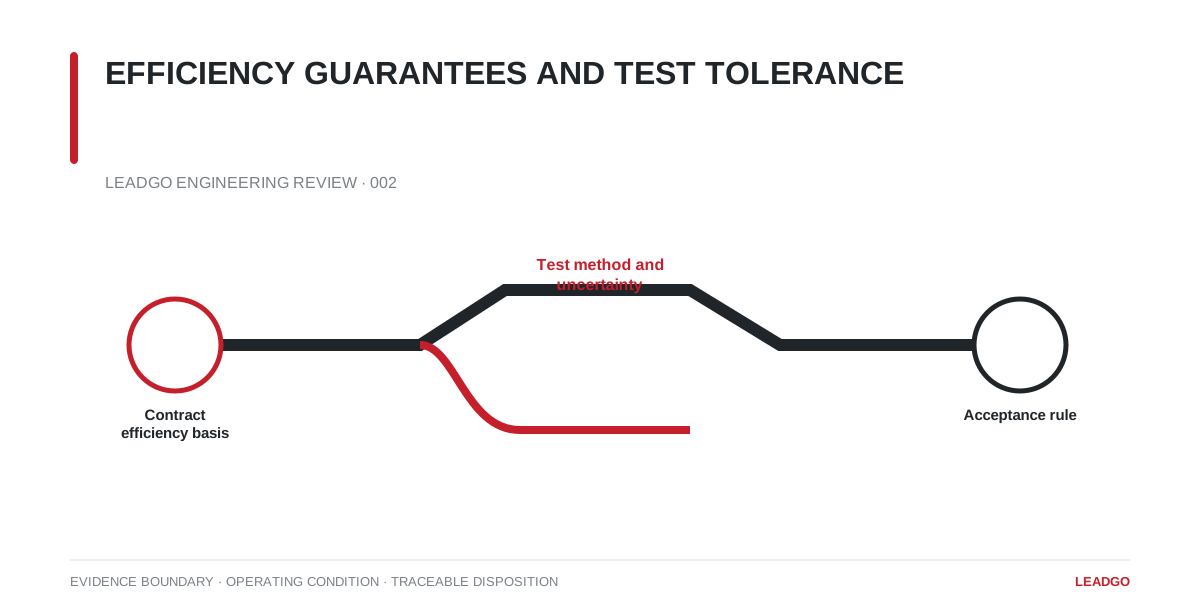
Efficiency disputes often begin after testing because the parties agreed on a percentage but not on what that percentage meant. A useful acceptance statement connects the commercial guarantee to a reproducible test.
Define the guarantee
State whether the value applies at rated output or at several load points. Identify voltage, frequency, duty, cooling arrangement and any auxiliaries included in the power boundary. If the project requires both a minimum efficiency class and a specific guaranteed value, list them separately.
Name the test method and edition. Methods can treat residual loss, stray-load loss and temperature correction differently. A value developed under one method should not be judged with an unrelated acceptance rule.
Acceptance decision before testing
Test tolerance is an allowance applied under a defined contractual or standard rule. Measurement uncertainty describes confidence in the instruments and test process. They affect acceptance differently and should not be blended into an improvised margin.
The test plan should identify:
- instrument accuracy, calibration and range;
- how input power and shaft output are determined;
- winding-temperature correction;
- stabilization and repeat-reading criteria;
- calculations included in the final report;
- the exact pass, review or retest rule.
A result close to the boundary should not trigger negotiation at the test stand. The purchase order should already say whether it is accepted, retested, reviewed with uncertainty or handled through an agreed remedy.
For bid comparison, keep guaranteed and typical values in different columns. Ask whether each figure is measured, calculated or declared. The final report should retain raw readings as well as the reported efficiency so another engineer can reconstruct the result.