
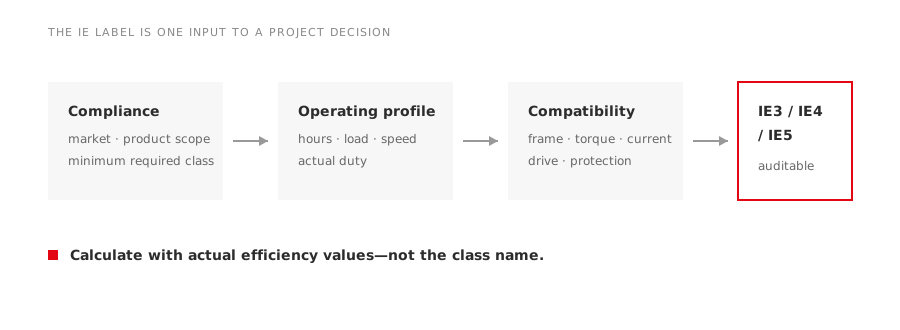
IE3, IE4 and IE5 are efficiency classes, not automatic project recommendations. The label gives a disciplined way to compare motor losses at defined conditions. The project still decides how much those losses matter.
Direct answer
Use five gates in order:
- destination-market compliance;
- actual duty and operating hours;
- measured load and speed profile;
- mechanical and electrical compatibility;
- lifecycle cost under the project’s own assumptions.
If a regulation or customer specification requires a class, the commercial comparison begins above that minimum. For example, EU requirements depend on motor type, power, poles and other scope conditions; the IE label alone is not a declaration that every motor is legal for every market.
What changes as the project horizon changes
| Project condition | Main decision pressure | Evidence to request |
|---|---|---|
| Low annual hours or standby duty | Compliance, availability and correct starting performance | Scope statement, duty and starting data |
| Long continuous operation | Verified losses at the real load point | Efficiency test basis and part-load data |
| Variable-speed process | Motor-plus-drive performance across operating points | Converter compatibility and system-loss data |
| Direct replacement | Shaft, frame, current, torque and protection compatibility | Drawing, nameplate and starting characteristics |
| Greenfield project | Optimise motor, drive and driven equipment together | Load curve and system design alternatives |
A continuously operated pump motor may justify close attention to a small loss difference. An emergency motor may accumulate few running hours but carry stringent starting, certification and availability requirements. Both can be rational purchases with different IE choices.
Do not calculate savings from the class name
Use the stated or tested efficiency of the actual candidates. IE classes define minimum nominal efficiency values by rating; they are not a fixed percentage improvement between every IE3 and IE4 motor.
For one operating point, the electrical input can be estimated from:
input power = required shaft output / motor efficiency
Annual energy then depends on operating hours at that point. Real plants need more than one point when load or speed varies. Include converter losses where a drive is used and check whether throttling, bypass or mechanical transmission losses dominate the opportunity.
Avoid generic claims that energy always represents a particular percentage of lifetime cost. The share changes sharply between a continuously loaded process motor and a lightly used auxiliary.
Check the replacement consequences
A higher-efficiency design may change:
- frame length or mass;
- starting current and torque envelope;
- rated speed and process output;
- power factor and protection settings;
- VFD switching and thermal requirements;
- bearing, fan or service-part configuration.
The existing base and coupling can make installation cost more important than the motor purchase difference. Conversely, a planned shutdown may offer a low-cost opportunity to upgrade because alignment and commissioning work are already scheduled.
Use a transparent decision sheet
Record the following for each candidate:
- mandatory market and project requirement;
- rated and part-load efficiency on a common test basis;
- operating hours by load or speed band;
- electricity tariff assumptions;
- motor, drive and installation cost differences;
- starting and acceleration compatibility;
- expected service period and maintenance plan;
- sensitivity if hours, load or tariff change.
The result should remain understandable when one assumption changes. A payback figure without the underlying hours, load and efficiency inputs is not auditable.
LEADGO publishes separate YE3, YE4 and YE5 product pages. Compare the exact rating and project requirements rather than treating the three series names as the decision.
A worked method without invented savings
For three candidates at the same required shaft output, enter each verified efficiency at the applicable load point. Convert shaft demand into electrical input, add drive and auxiliary losses, then multiply each operating band by annual hours. Apply the site’s tariff and repeat across the expected project life.
Run expected, lower-utilisation and higher-utilisation cases. If the preferred class changes easily, the decision is sensitive and should not be presented as a fixed payback promise. Do not assume the motor operates at nameplate load: oversizing can move the real point away from the headline efficiency.
When a lower class can remain rational
After mandatory minimums are met, a lower class may remain defensible for low hours, emergency duty, temporary equipment or a replacement where mechanical changes dominate. A higher class becomes more attractive as hours, load and energy value rise, especially when installation work is already planned.
Write the required class, standard, rated efficiency and tolerance into the purchase specification. Confirm whether efficiency will be demonstrated by certified data, a type-test report, witness testing or another agreed route. At commissioning, record load, current, voltage, speed and hours so the tender calculation can later be checked against the plant.