
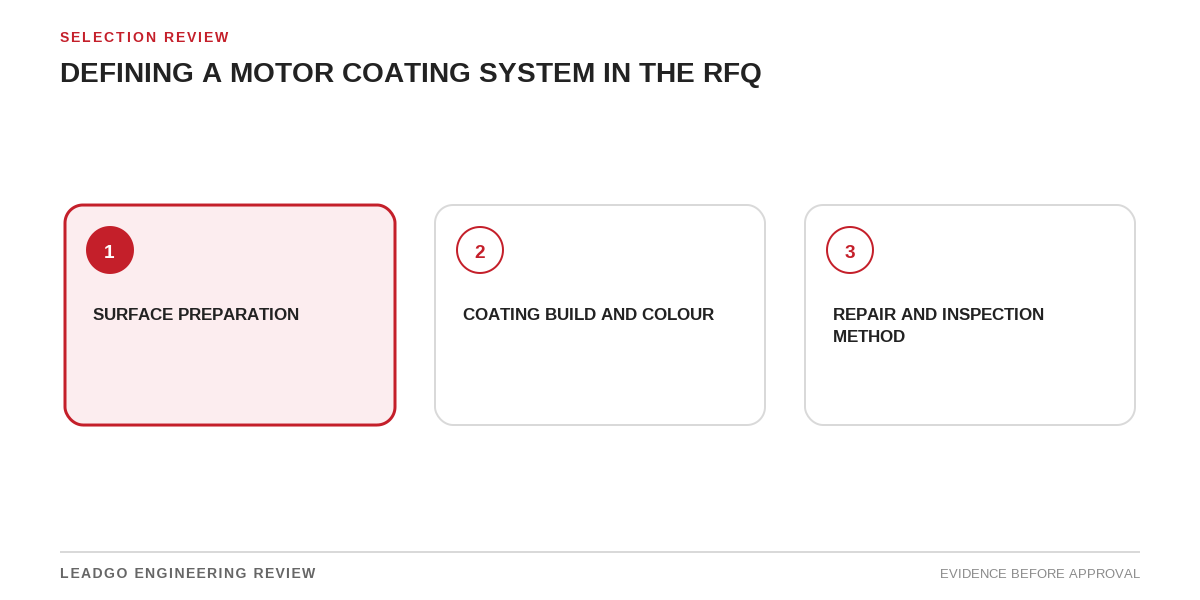
Corrosion protection is often reduced to a sentence such as “paint suitable for outdoor service.” That wording leaves the supplier to choose the environment, surface preparation, coating build and repair method. A motor can leave the factory with a good-looking finish and still corrode at edges, lifting points, drain paths, fasteners or damaged transport areas. A coating RFQ should describe the exposure and the evidence needed to accept the complete system.
Establish the corrosion exposure boundary
Describe where the motor will be installed and how it will be stored before energization. Record salt spray, humidity, condensation, ultraviolet exposure, chemical vapour, abrasive dust, washdown, temperature cycling, immersion risk and the expected maintenance environment. Outdoor coastal service, a chemical plant, a cement mill and a dry indoor warehouse do not represent the same coating duty.
Define which surfaces are included: frame, end shields, fan cover, terminal box, fasteners, lifting lugs, base, shaft-adjacent areas, cooler, brake and accessories. State whether the coating requirement applies to internal cavities or only external surfaces. The boundary should also identify areas where coating is prohibited because of electrical contact, grounding, bearing fit or heat transfer.
Coating RFQ and acceptance matrix
Use the matrix below as a minimum buyer-side tool. It separates the coating product from the process that makes the product effective.
| Control point | RFQ question | Factory evidence | Acceptance decision |
|---|---|---|---|
| Exposure | What corrosion, chemical and storage classes apply? | Approved environment statement | System matches the documented exposure |
| Preparation | How are rust, oil, salts and abrasive residue removed? | Preparation record and profile result | Surface condition is within the system limit |
| Primer | Which primer, batch and compatibility basis are used? | Product data, batch and shelf-life record | Correct product and application window |
| Build coats | What layers, colours and dry-film thickness are specified? | Coat log and thickness map | Film build meets the agreed range |
| Edges and details | How are corners, welds, drains and lifting points treated? | Detail photographs and inspection record | No thin or inaccessible edges are left open |
| Cure | What temperature, humidity and recoat intervals apply? | Environmental log and cure record | Coating was not overcoated or shipped too early |
| Inspection | Which visual, thickness, adhesion or holiday checks apply? | Calibrated instrument records | Results are traceable to the motor tag |
| Repair | How are transport and installation damages repaired? | Approved repair method and closeout record | Repair blends into the system and is rechecked |
Do not accept a coating system because its final colour resembles the specification. The process evidence is part of the protection system.
Common coating procurement errors
The first error is naming a coating brand without naming the environment. A product designed for a dry indoor enclosure may not tolerate salt, ultraviolet exposure or chemical washdown. Ask the supplier to state the exposure basis and system build.
The second error is specifying a total thickness with no layer structure. A thick film can still fail if the primer is incompatible, the substrate is contaminated or the recoat window is missed. Request the system sequence and layer records.
The third error is ignoring edges and crevices. Corners, welds, drains, lifting points and bolt heads often receive less film and become the first corrosion sites. Include detail treatment and photographs in the inspection plan.
The fourth error is allowing field repair by an unapproved paint. A touch-up can soften the original film, trap salts or create a visible boundary. The repair pack should identify preparation, compatible product, cure and reinspection.
Decision steps for RFQ approval
- Classify the environment and storage exposure before choosing the coating family.
- Define the protected surfaces and surfaces that must remain uncoated.
- Select the surface preparation, primer, build coats, edge treatment and repair system.
- Set environmental limits, recoat windows and shipment cure requirements.
- Define thickness, adhesion, holiday or other inspection methods and hold points.
- Review supplier deviations with an exposure-based technical disposition.
- Accept the system only when coating records, inspection results and damage repairs are complete.
This sequence keeps the RFQ focused on performance and evidence instead of a colour or product name.
Supplier and RFQ data requirements
Request the coating system schedule, product technical data sheets, safety data sheets, batch numbers, shelf-life, surface-preparation standard, surface profile, environmental limits, mixing ratio, induction time, pot life, recoat interval, cure time and allowable shipment condition. Ask for the expected dry-film thickness range by layer and the method used to measure it.
Require a coating map showing difficult details and a repair procedure for transport, lifting and installation damage. The supplier should identify which tests are witnessed, which are recorded by the applicator and which are subject to rework. Any deviation should state the affected surface, exposure assumption, technical basis and approval authority.
For coastal, chemical or offshore service, request the system’s compatibility statement for the specified chemicals, washdown media and storage condition. Do not infer compatibility from a generic outdoor label.
Include a coating hold-point plan in the purchase order. The first hold point should occur after preparation but before primer so salts, profile and edge condition can be checked. The second should occur after the build coats and before packing, when the thickness map, cure and detail photographs are still accessible. If the motor is packed while the film is soft or contaminated, later inspection cannot restore the evidence.
Ask the supplier to show how the coating system will be protected during lifting, transport and installation. Pads, slings, temporary braces and cable work can damage edges that were accepted at the factory. A short damage register with location, cause, preparation, repair product, cure and reinspection is more useful than a statement that the motor was “touched up.”
For long storage, add a preservation check to the coating plan. The record should state whether the motor is under cover, how condensation is controlled, whether desiccant or heaters are used and how often exposed surfaces are inspected. Storage damage is not always a coating failure; water trapped under a wrapping, a blocked drain or a salt-contaminated packing material can start corrosion after an otherwise acceptable factory test. Request photographs and a release inspection before installation so the coating guarantee is not extended blindly across an uncontrolled storage period.
Also record the date on which the storage inspection was accepted. A coating report without a storage interval can be misread as a perpetual guarantee even when the environment changed.
Link that date to the next planned inspection.
Factory and site acceptance workflow
At the factory, verify the motor identity before reviewing coating records. Check preparation, environmental conditions, coat sequence, thickness locations, edge coverage, cure and any repairs. Take photographs that show the detail and the measurement location, not only the finished colour.
At site, inspect transport damage before lifting and again after installation. Mark damage on a controlled sketch, remove loose material without spreading contamination, apply the approved repair system and repeat the relevant visual and thickness checks. If corrosion is visible beneath a damaged area, stop and obtain a disposition; coating over active corrosion hides the mechanism rather than closing it.
Applicability boundary and release rule
This method applies to industrial motors exposed to outdoor, coastal, humid, chemical, dusty or extended-storage conditions. It does not replace a specialist corrosion study for immersion, high-temperature service or unusual chemical exposure. Stainless, galvanized or special alloy components may require a separate compatibility review.
Release the motor only when the system matches the actual exposure and the records prove preparation, build, cure and inspection. If the service environment is not yet fixed, issue a conditional coating requirement and close it before manufacture rather than accepting a generic “outdoor” finish.
Coating acceptance checklist
- Environment and storage exposure are classified.
- Protected and uncoated surfaces are identified.
- Preparation, primer, coats, edges and cure are documented.
- Thickness map and inspection method are agreed.
- Batch, shelf-life and environmental records are retained.
- Transport and installation repair method is approved.
- Damage and corrosion findings have a controlled disposition.