
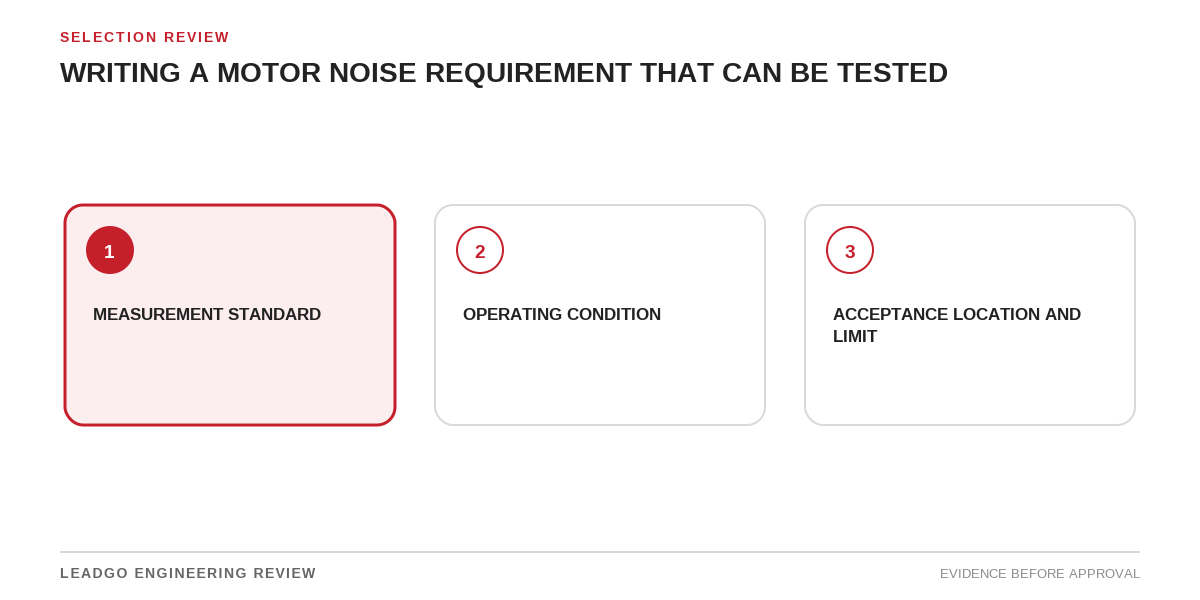
Noise is often written into a motor purchase order as a number with no measurement boundary. That makes the number difficult to defend when a factory test is quiet but the installed machine is loud. The buyer needs to distinguish the motor’s own airborne sound from structure-borne transmission, fan noise, coupling noise, process turbulence and room reflections. A useful specification makes the test repeatable before anyone debates the result.
Define what the noise requirement covers
State whether the requirement applies to airborne sound pressure, sound power, structure-borne vibration-related noise or an overall acoustic environment. Define the weighting, frequency range, measurement distance, microphone positions, operating load, speed, cooling configuration and auxiliary equipment state. If the motor is VFD-fed, specify the frequency or speed at which the guarantee applies and whether carrier-frequency effects are included.
The specification should identify the acoustic boundary. Is the supplier responsible for the bare motor, motor plus fan cover, motor with brake, motor and cooler, or the complete motor-driven package? A room or enclosure requirement cannot be assigned to the motor supplier without a layout and a defined contribution model.
Procurement-to-acceptance noise matrix
Use the matrix below to convert a noise clause into a measurable test. Each row should have a value, method and owner before the purchase order is released.
| Item | Specification decision | Measurement condition | Evidence or owner |
|---|---|---|---|
| Quantity | Sound pressure, sound power or vibration-related metric | Defined weighting and units | Approved acoustic procedure |
| Operating point | Speed, voltage, frequency, load and cooling state | Stable thermal condition | Factory test schedule |
| Positions | Radial, axial, drive end, non-drive end and height | Fixed distance and grid | Position sketch and photos |
| Background | Ambient level and interfering sources | Quiet or corrected condition | Background readings |
| Instrument | Class, calibration and serial number | Pre/post calibration check | Instrument certificate |
| Factory setup | Foundation, coupling, enclosure and auxiliary status | Configuration identified | Test configuration record |
| Site setup | Installed package, room, guards and driven equipment | Same or explained difference | Site measurement report |
| Acceptance | Limit, tolerance and retest rule | Decision for exceedance | Signed disposition |
The matrix prevents an argument based on two numbers obtained under different physical conditions.
Common specification errors
The first error is quoting a sound-pressure limit without measurement geometry. Doubling the distance changes the observed result, and a reflective room can raise the reading even when the source is unchanged. Put the microphone positions in a sketch.
The second error is ignoring background noise. A nearby fan, pump or process line can dominate the measurement. Record background readings and state whether a correction is allowed and how it is calculated.
The third error is mixing factory and site quantities. A factory sound-power value cannot be compared directly with a site sound-pressure value. Use the same quantity or explain the conversion and boundary.
The fourth error is accepting one operating point for a variable-speed motor. Magnetic noise, fan noise and bearing noise can change with speed and load. Identify the points that matter to the operator, not only the easiest point for the test bench.
Decision steps for a noise review
- Define the acoustic boundary and identify all equipment inside it.
- Select the quantity, weighting, positions and operating conditions.
- Write the background and instrumentation method before requesting a guarantee.
- Agree the factory configuration and the permitted site deviations.
- Witness or review factory readings with calibration and configuration evidence.
- Repeat site readings with the motor, driven equipment and room in the agreed state.
- If the limit is exceeded, separate sources and issue a disposition rather than assigning blame from one reading.
This order keeps the commercial guarantee tied to a test that the project can actually reproduce.
Supplier and RFQ data to request
Ask for the guaranteed noise quantity, limit, tolerance, speed and load point, cooling state, test standard or controlled method, microphone locations, room or foundation description, background correction and instrumentation class. Request the test report template before the factory test so missing fields are discovered early.
For a VFD-fed motor, request carrier-frequency assumptions, switching frequency range, output filter status and any speed points where the guarantee changes. For a brake, fan or cooler, request separate contribution data or a declared package boundary. Ask the supplier to identify whether the value is guaranteed, typical or estimated.
At site, request the layout, foundation and coupling records, room acoustic treatment, process operating point, guard status and nearby equipment schedule. The RFQ should require a repeat measurement or engineering review when the site configuration differs from the factory configuration.
Site acceptance workflow
Before measuring, verify the motor tag, operating point, speed, voltage, load, cooling and auxiliary state. Record the room, weather or ventilation condition where it can affect the result. Measure background first, then the agreed grid, and photograph the microphone positions. Keep the original readings as well as any corrected values.
If one position is high, repeat it and check whether the source is airborne or structure-borne. Compare with vibration and current data, inspect guards and coupling alignment, and isolate nearby equipment where safe. Do not quiet the installation temporarily by changing the operating point; that changes the acceptance condition.
When a reading exceeds the limit, freeze the operating condition and preserve the original data. Confirm the instrument calibration, microphone position, speed, load and background correction before changing anything. Then classify the excess as airborne, structure-borne or external. A narrow tonal peak may point to magnetic or switching behaviour; a broadband rise may come from airflow, turbulence or a fan; a frequency tied to running speed may require a mechanical or bearing review.
Use a short isolation plan where safe: compare with the driven equipment uncoupled, change the cooling arrangement only if the test procedure permits it, or measure at an equivalent point on the foundation. Do not use an isolation result to rewrite the original acceptance reading. The disposition should state the measured value, the verified source, the corrective action, the responsible party and the retest condition. If the package is compliant but the room is not, record two separate decisions so a motor warranty is not used to cover a building acoustic problem.
The report should show the arithmetic behind any background correction and identify whether the stated result is a direct reading or an average across positions. Keep both the individual readings and the final reported value. A single averaged number can hide one local peak near a bearing housing, fan inlet or terminal box. If the specification includes an operator position or a room boundary, add that point to the drawing instead of assuming that a motor test position represents the occupied area.
Retain the raw spectrum when the instrument supports it. A spectrum helps distinguish a tonal issue from broadband airflow noise and gives the supplier a useful basis for corrective action.
It also preserves a baseline for later maintenance comparison.
Keep the spectrum with the signed report so a future measurement can compare the same frequency bands and operating point.
Applicability boundary and final decision
This method applies to industrial motor procurement and factory or site acceptance. It does not replace a building acoustic assessment, occupational exposure assessment or a specialist acoustic investigation for unusual environments. Hazardous-area, high-speed and large air-cooled machines may require additional measurement controls.
Accept the motor only when the result belongs to the agreed quantity, operating point, configuration and correction method. If the site package adds a pump, fan, gearbox or room effect that was outside the motor guarantee, record the motor result and the package result separately.
Noise acceptance checklist
- Acoustic boundary and quantity are defined.
- Speed, load, cooling and VFD conditions are recorded.
- Microphone positions and distances are documented.
- Background, calibration and instrument identity are retained.
- Factory and site configurations are comparable or deviations are explained.
- Airborne and structure-borne sources are separated when needed.
- Retest and disposition rules are agreed before measurement.