
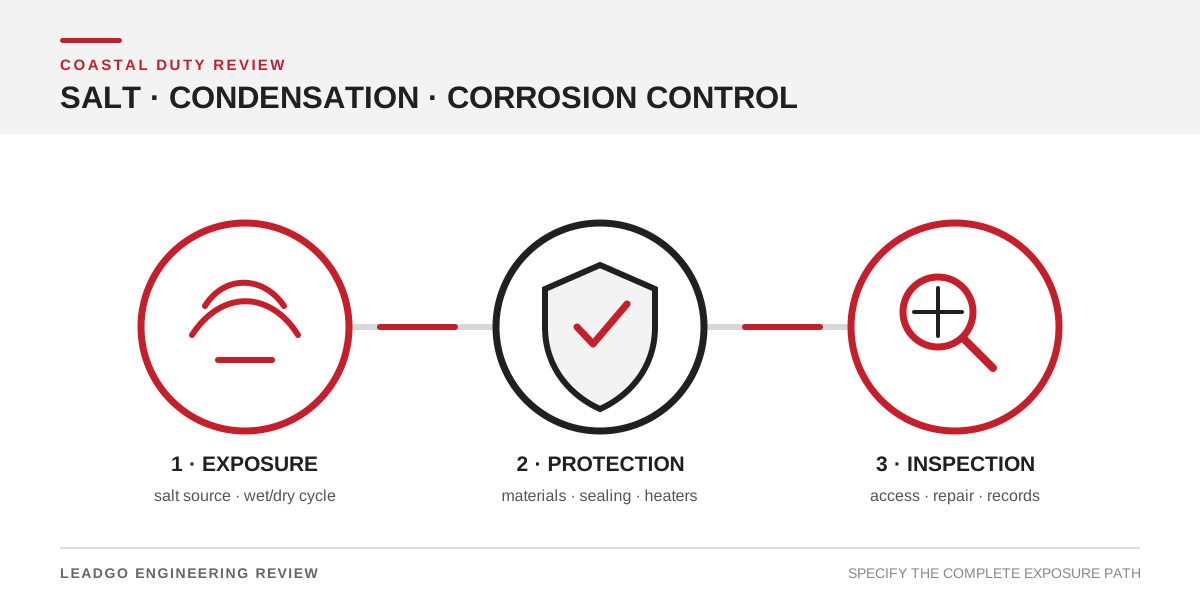
“Marine duty” is not a complete technical requirement. A sheltered coastal plant, an open jetty and a shipboard deck produce different salt deposition, wetting and maintenance conditions.
Convert the environment into requirements
| Exposure | Specification response | Acceptance evidence |
|---|---|---|
| Salt-laden outdoor air | Defined coating and compatible hardware | Coating data and inspection record |
| Daily condensation | Heater/drain logic and sealed terminals | Schematic and functional test |
| Wash or spray | Entry orientation, glands and seals | Installation drawing |
| Long storage | Packaging and periodic inspection | Preservation log |
State ambient range, humidity cycle, distance from shore, direct spray, UV, wash chemicals and expected outage length. Select coating only after defining preparation and repair practice. Review stainless fasteners against adjacent metals; a noble fastener does not automatically remove galvanic risk.
Protect openings and idle machines
Check terminal boxes, cable glands, drain orientation, fan cover and shaft seals in the actual mounting position. Space heaters must be off while the motor is energized unless the approved design says otherwise, and on during defined stopped conditions. Provide indication or alarm where heater failure matters.
Retain the environmental basis, coating schedule, material list, heater schematic, storage procedure and field touch-up instruction. These records are more actionable than a standalone “marine” label.
Related reading: motor IP ratings explained and motor space heaters and condensation.