
A motor fails, the repair shop quotes a rewind, and someone in the room says that rewinding costs you efficiency. That sentence has decided a lot of purchase orders. It traces back to studies of mostly small motors from the 1980s and early 1990s, and it does not match what controlled testing of larger machines has since found.
The short answer
Within the tested range, a rewind done to a controlled process did not produce a significant efficiency penalty. The joint EASA/AEMT study tested 23 motors from 50 to 300 hp (37.5 to 225 kW) before and after rewind, to IEEE 112 Method B at the University of Nottingham, and reported results within 0.2 percentage points. A 2019 repeat on ten IE3 machines of 30 to 75 kW measured an average change of 0.1 points. These are study results, not a guarantee for motors or processes outside the samples.
Some rewinds do lose efficiency. The same study measured real losses on every machine it rewound with no process control, which puts the variable in the shop. So the decision splits into two questions: can you specify and verify the repair, and what would you buy instead.
Where the older number came from
Earlier work sampled mostly smaller machines, in several cases under 30 hp (22.5 kW), and produced the claim that efficiency falls between 1% and 5% on every rewind. EASA and AEMT commissioned the 2003 study because no comprehensive data existed above 40 hp, and those are the machines a plant rewinds instead of scrapping.
What the testing measured
The study ran in three stages, and the difference between them is the whole point.
| Stage | What was controlled | Efficiency change |
|---|---|---|
| 1 | Nothing specified for stripping or rewinding; burnout at 350 °C | −0.3% to −0.5% |
| 2 | Burnout raised to 360 °C, winding resistance controlled | −0.7% to +0.2% |
| 3 | Same controls, motors rewound multiple times | −0.6% to +0.8% |
The worst result in Stage 2 came from a machine with a defective core from its original manufacturer, so the repair did not cause it. Stage 3 answers the cumulative-damage question: motors rewound two and three times showed no progressive decline, and that stage averaged a 0.2 point improvement over the starting condition.
The four places efficiency actually goes
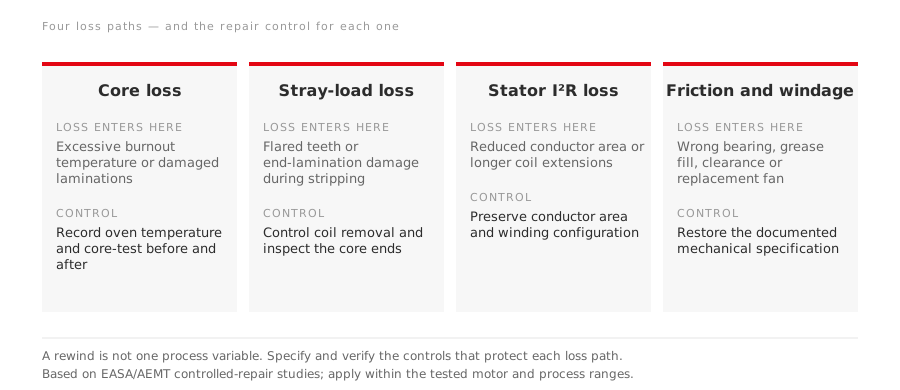
Every measured loss in the study traced to one of four mechanisms, and each has a specification that prevents it.
| Loss | What causes it during repair | What to require in writing |
|---|---|---|
| Core loss | Burnout temperature above what the coreplate tolerates, damaging interlaminar insulation | Controlled burnout oven with recorded temperature |
| Stray load loss | Stripping damage; end laminations flared by chiselling or by pulling coils out of the slots | No cutting against the core end laminations; inspect for flared teeth |
| Stator I²R | Smaller conductor cross-section substituted for stock reasons, or a longer mean length of turn | Cross-sectional area never reduced; coil extensions kept short |
| Friction and windage | Over-greased bearings, wrong internal clearance, incompatible greases, a fan of different design | Original bearing type and clearance, manufacturer’s grease fill, interchangeable fan |
The bearing line is easy to underrate. In Stage 1 the study logged machines reading a full point down while over-greased, then recovering most of that once the bearings were cleaned. A rewind can be judged a failure on a dynamometer because of grease.
The burnout window is the number to put in the purchase order
Stripping the old winding is where the irreversible damage happens, and it is bounded on both sides.
In the study’s process, insufficient burnout made coil removal more mechanical and increased the risk of damage, while excessive temperature threatened interlaminar insulation. Its recommendations discuss 360 °C for organic coreplate and up to 400 °C (750 °F) for inorganic coreplate. Those figures are not a universal oven recipe: coating type, exposure time, oven control, the repair standard and a before-and-after core-loss test must govern the actual procedure.
Specify it, because you can check it afterwards. Oven temperature records either exist or they do not.
When replacement is the better answer
Five situations where the repair economics stop mattering.
- Catastrophic winding damage. The study is explicit that repairing severely damaged machines may be unwise, and that where operational need forces the repair anyway, a new motor should follow as soon as practical.
- Confirmed core damage. Core iron that fails a loss test is not fixed by a rewind.
- Certified explosion-protected motors without a compliant repair route. Ex equipment can be repaired, but IEC 60079-19 sets type-specific requirements and competence expectations. If the repairer cannot demonstrate that capability and preserve the required records, replacement is the safer path. The certificate covers a specific construction, which is also why checking it against the actual model matters more here than in general-purpose duty.
- The replacement sits a class higher. If the failed machine is IE3 and the current equivalent is IE4, the step you gain by replacing can exceed anything the rewind might cost you. Check the electrical consequences before treating it as a drop-in: the product standards behind YBX3 and YBX4 guarantee a locked-rotor current roughly 15 to 25 per cent higher for the IE4 machine, and a locked-rotor torque about 10 per cent lower. Those are guaranteed envelopes rather than measured values, and they are still enough to trip a starter sized for the old motor.
- High running hours with a favourable payback. At high utilisation, a small efficiency improvement can outweigh the difference between repair and replacement cost. Calculate it from measured or quoted efficiency at the operating point, load, annual hours, electricity price, installation cost and expected service period rather than applying a universal lifecycle-cost percentage.
Compare the right two numbers
The comparison is the installed cost of each path. Replacement pulls in alignment, coupling work, base modifications, control changes, commissioning and whatever production is lost while it happens. Repair pulls in transport and the outage. The energy side of it is arithmetic, and the US Department of Energy publishes MEASUR, an open-source tool that runs the rewind-versus-replace case from repair cost, purchase price, operating hours, energy use and the two efficiency figures.
If you compare efficiency figures across the two options, confirm the same method produced both. Test standards differ in how they treat stray losses, and the study noted that one method can overstate reported efficiency relative to another by 0.5 to 1.5 points depending on the machine. The test method behind an efficiency number decides whether two numbers can be compared at all.
Common mistakes
- Accepting a rewind quote with no process specification, then treating the result as evidence that rewinds lose efficiency.
- Allowing a two-layer winding to be rebuilt as single-layer. It halves the coils to wind and raises both I²R and stray losses. Any change to the winding configuration and lead arrangement should be agreed in writing, not discovered on the test floor.
- Substituting sealed bearings for shielded ones, or accepting a different internal clearance.
- Fitting a replacement fan of a different design, which changes windage, temperature rise and I²R together.
- Assuming a motor that has been rewound twice is close to worn out. The testing says otherwise.
Where this leaves a buyer
Ask the repair shop which standard it works to. ANSI/EASA AR100 and IEC 60034-23 both incorporate the good-practice procedures that came out of this research, so naming one of them in the purchase order is a short way to specify most of what this article covers. Then ask for the burnout temperature record.
As a motor manufacturer rather than a repair shop, our interest here is narrow: the replacement side of the decision deserves the same scrutiny as the repair quote, and it needs the starting characteristics in front of you and not the efficiency class alone. The YBX4 flameproof series page works that comparison through against YBX3; the IE4 induction series is the general-purpose equivalent.
Related: Retrofitting an old VFD project: induction or PM · Type test versus routine test reports · F-class insulation, B-class rise: what the margin buys