
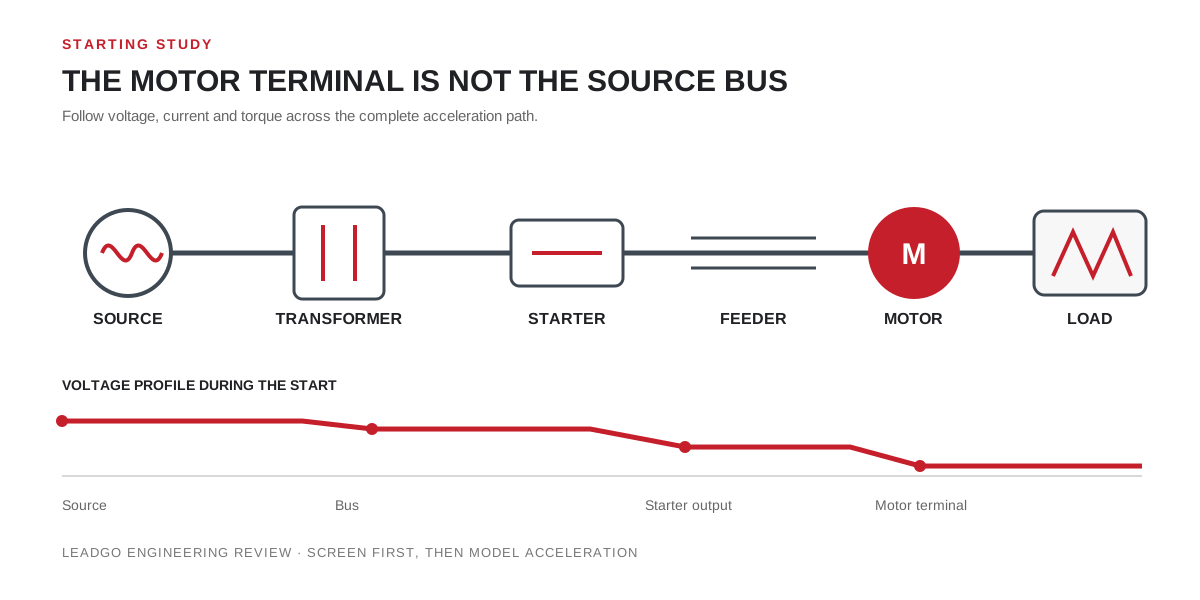
When a large motor fails to accelerate, people often start with the cable. The cable matters, but the more useful boundary begins at the live source and ends at the driven machine. Between those points sit the transformer, switchgear, starter, feeder, motor torque curve and load torque curve.
A review that stops at steady-state voltage drop can approve a system that is weak during the exact seconds when torque is needed most.
Start with a transparent screening calculation
Schneider Electric publishes this transformer screening relationship:
Transformer voltage drop (%) = motor locked-rotor current ÷ transformer secondary full-load current × transformer impedance (%)
Consider a hypothetical motor with locked-rotor current equal to 6.0 times rated current. If its rated current equals 25% of transformer secondary full-load current and the transformer impedance is 6%, the screen gives:
6.0 × 0.25 × 6% = 9% transformer voltage drop
This is not the motor-terminal result. It excludes upstream source impedance, feeder drop, other bus loads and the changing current while the motor accelerates. It is useful because it exposes the scale of the issue early, not because it replaces a power-system study.
Add the boundaries the simple screen cannot see
| Study boundary | Input that must be project-specific | Decision affected |
|---|---|---|
| Utility or generator source | Minimum short-circuit strength and operating configuration | Voltage retained on the main bus |
| Transformer | Rating, impedance, tap and actual concurrent load | Transformer contribution to the dip |
| Starter and feeder | Starting method, conductor impedance and route | Voltage arriving at the motor terminals |
| Motor | Current-speed and torque-speed data for the offered design | Available accelerating torque |
| Driven machine | Load torque, inertia and starting condition | Acceleration time and stall risk |
| Shared bus | Contactors, controls and other sensitive equipment | Nuisance drop-out or process interruption |
The table also clarifies ownership. The motor supplier provides the offered motor data; the equipment supplier provides load torque and inertia; the electrical designer owns the network model and bus criteria.
Check torque at the depressed voltage, not only current
An induction motor’s starting and accelerating torque is voltage-sensitive. Therefore, the study must iterate: the network determines terminal voltage, terminal voltage changes motor torque, and motor torque changes acceleration time and the duration of the voltage dip.
Reduced-voltage starters need special care. A current reduction is not automatically a successful start. If the selected voltage or current limit leaves too little margin above load torque, the motor can remain in acceleration long enough to trigger thermal or stall protection.
For high-inertia loads, request current-speed and torque-speed data rather than a single locked-rotor point. The critical condition may occur after breakaway, where the load curve and motor curve approach each other.
Design the site test around the study assumptions
The commissioning test should verify the model without turning the first start into an experiment. Before energising, confirm protection settings, permissives, uncoupled checks where applicable and the driven machine’s intended starting condition.
During the controlled start, record simultaneously:
- voltage at the motor terminals or the closest approved measurement point;
- current in all phases;
- time from energisation to stable operating speed;
- shared-bus voltage and any sensitive-equipment response;
- process condition, valve or damper position and starting method state.
If measured acceleration differs materially from the study, do not “correct” the record by changing only the assumed load. Reconcile source strength, tap position, feeder data, motor curve and mechanical condition one by one.
Approval rule before energisation
Release the start when the model uses the actual network configuration, the offered motor data and the driven-load curve, and when the resulting terminal voltage and acceleration meet named project criteria. Keep the screening calculation in the file, but label its boundary so no one mistakes it for the final system answer.
Evidence used for this review
- Schneider Electric: Transformer selection for a motor load
- Schneider Electric: Motorpact application guide