
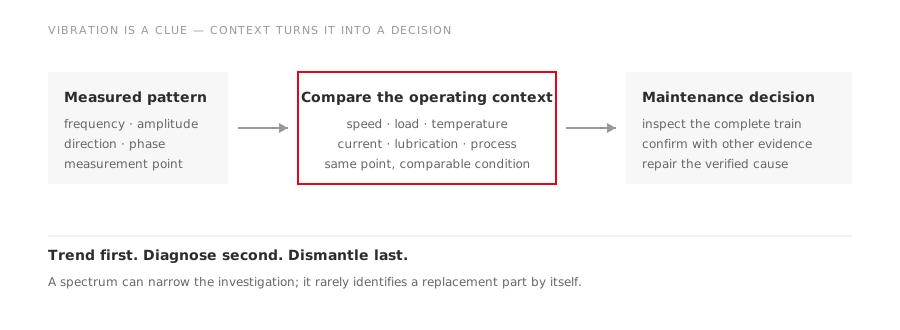
A vibration meter can tell you that a machine has changed. It cannot, by itself, tell you which component to buy.
That distinction matters in motor maintenance. A rising peak at running speed, a new bearing-frequency component or an increase in axial vibration can narrow the investigation. The same pattern can still have more than one cause, and the source may sit in the coupling, base or driven machine rather than inside the motor.
Direct answer
Motor vibration analysis can reveal patterns consistent with:
- rotor or coupling imbalance;
- shaft or coupling misalignment;
- mechanical looseness and soft foot;
- rolling-element bearing damage;
- rubs, bent shafts and some resonance conditions;
- air-gap eccentricity and selected electromagnetic force problems;
- gear, belt, fan and process disturbances transmitted into the motor.
It is much less reliable as a stand-alone method for insulation ageing, a loose terminal that has not yet created a force change, loss of lubrication before surface damage begins, or a control problem that appears only during a short transient. Those need other measurements.
Read patterns as clues
| Observation | Possible causes | What should be checked next |
|---|---|---|
| Strong radial component at 1× running speed | Imbalance, eccentricity, resonance or a distorted rotating part | Phase, direction, balance condition, runout and speed response |
| High axial vibration with 1× or 2× components | Angular misalignment, coupling forces or thrust problem | Alignment, coupling condition, axial float and driven equipment |
| Harmonics of running speed | Looseness, rub, distortion or nonlinear contact | Feet, bolts, base, fits and time waveform |
| Bearing-related high-frequency energy | Surface damage, poor lubrication or contamination | Bearing geometry, envelope spectrum, temperature and lubricant condition |
| Components related to supply or pole-pass frequencies | Air-gap eccentricity, unbalance in magnetic pull, rotor or supply problem | Current spectrum, voltage balance, air gap and load condition |
| Broadband rise | Friction, poor lubrication, cavitation or process turbulence transmitted through the train | Acoustic check, lubrication, pump or fan operating point |
The table is a starting point, not a verdict. For example, imbalance often produces a dominant 1× radial response, but a flexible foundation can amplify the same frequency. Correcting the rotor without checking the base may leave the measured vibration almost unchanged.
Why the baseline matters
An overall velocity value compresses a complex signal into one number. It is useful for screening, but it can hide the frequency that changed.
A stronger programme records the following at commissioning and repeats them from the same marked locations:
- horizontal, vertical and axial readings at both bearing positions;
- motor speed and load at the time of measurement;
- overall vibration in clearly stated units;
- frequency spectrum and, where needed, time waveform or envelope data;
- bearing temperature, current and relevant process conditions.
Comparable conditions are essential. A pump near shutoff, a fan operating in stall or a reciprocating load can change the vibration entering the motor even when the motor itself has not deteriorated.
What vibration cannot settle alone
Vibration does not replace electrical tests. A developing turn-to-turn fault may first show as current or temperature asymmetry. Insulation contamination may reduce resistance without creating a useful mechanical signature. A wrong protection setting can trip a healthy motor. Conversely, a mechanically damaged driven machine can produce a severe signal at the motor bearings.
For that reason, combine vibration with:
- phase current and voltage balance;
- winding resistance and insulation-test history;
- bearing and winding temperatures;
- lubrication records;
- alignment and soft-foot checks;
- drive fault history and process trends.
A practical escalation rule
Trend first, diagnose second, and dismantle last. If the signal changes, confirm the reading, compare operating conditions and inspect the complete train before ordering parts. Stop the equipment under the site’s safety procedure if vibration rises suddenly, contact or rubbing is suspected, or continued operation could damage the shaft, bearing, coupling or driven machine.
For a supplier review, send raw spectra where possible rather than screenshots with no scale. Include the motor nameplate, bearing design, mounting, coupling, driven equipment, speed range and the exact point at which the change appeared.