
Permanent-magnet synchronous motors are often compared with induction motors using a single efficiency number. Buyers usually discover later that the harder questions concern starting, the drive, field weakening and service.
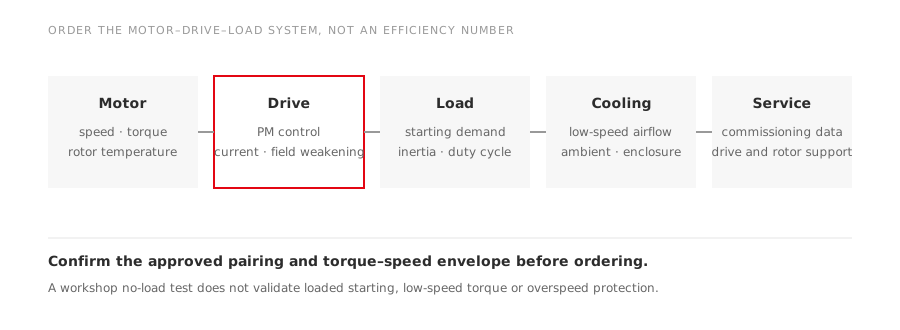
The useful purchasing unit is the motor, drive, load and cooling system together.
Is a PMSM an AC or DC motor?
A PMSM is an AC synchronous motor. Permanent magnets establish the rotor field. Alternating stator current creates a rotating field, and the rotor follows it at synchronous speed in normal operation.
The DC link inside a variable-frequency drive does not turn the machine into a DC motor. The inverter converts that DC-link energy into controlled multiphase AC for the stator.
Does every PMSM need a drive?
Most variable-speed PMSMs require a compatible drive to start, control current and establish rotor position. They should not be connected directly to a fixed-frequency supply.
A line-start PMSM is different. It includes an asynchronous starting provision, commonly a cage, so it can accelerate from the line and then pull into synchronism. LEADGO’s TYC series follows this line-start concept; the TYP series is designed for a matched drive.
Can an induction-motor VFD run it?
Only when the drive explicitly supports the proposed PMSM and the control is commissioned for that motor. The drive needs the right motor model, current control, position-estimation or feedback method, speed range and protection.
A workshop test at no load does not validate:
- loaded starting;
- low-speed torque;
- current limiting;
- field weakening;
- overspeed protection;
- rotor-temperature margin;
- recovery after a trip.
Ask for the approved motor-drive pairing and torque-speed envelope.
Is a PMSM always more efficient?
Permanent magnets eliminate the rotor current and slip loss found in a cage induction motor. That gives the designer a strong efficiency and power-factor advantage, particularly at variable speed or part load.
It is still unsafe to declare that every PMSM beats every induction motor. Compare:
- measured motor and drive efficiency at the relevant points;
- time spent at each speed and load;
- cooling and auxiliary power;
- transmission losses that a direct-drive arrangement may remove;
- purchase, drive and commissioning cost;
- maintenance and outage consequence.
For a constant-speed load running near rated output, a premium induction motor may remain the simpler commercial answer. For a variable-speed system that spends much of its life away from rated load, the PMSM case often becomes stronger.
What limits operation above base speed?
Above base speed, the drive reaches a voltage limit and commonly commands negative d-axis current to weaken effective air-gap flux. This extends speed, but reduces torque capability and applies an opposing field to the magnets.
The approved field-weakening range depends on rotor design, magnet grade, current limit, temperature and mechanical speed. A maximum-speed figure without the continuous and short-time torque envelope is incomplete.
Do the magnets wear out?
Magnets do not have a mechanical wear surface, but they can lose flux. Some temperature-related flux reduction is reversible after cooling. Irreversible loss occurs when thermal and opposing-field stress push the magnet operating point beyond the knee of its temperature-specific demagnetization curve.
That is why one universal “maximum magnet temperature” is not enough. See when permanent-magnet demagnetization becomes irreversible for the diagnostic and selection details.
Is maintenance easier?
Removing rotor bars, slip and—where direct drive is used—parts of the transmission can remove maintenance items. Bearings, cooling, seals, cables, the drive and the driven machine still require attention. High-speed and direct-drive systems may also demand more specialised balancing, rotor handling and controls expertise.
Before ordering, ask who can diagnose the complete system and what data must be saved at commissioning. A service plan should cover the drive and rotor, not only winding repair.
Can it replace an induction motor directly?
Sometimes mechanically, rarely by assumption. Confirm frame and shaft, voltage, supply method, speed range, torque, inertia, cooling, hazardous-area approval, drive compatibility and protection. A line-start PMSM, a general drive-fed PMSM and a high-speed PMSM solve different duties.