
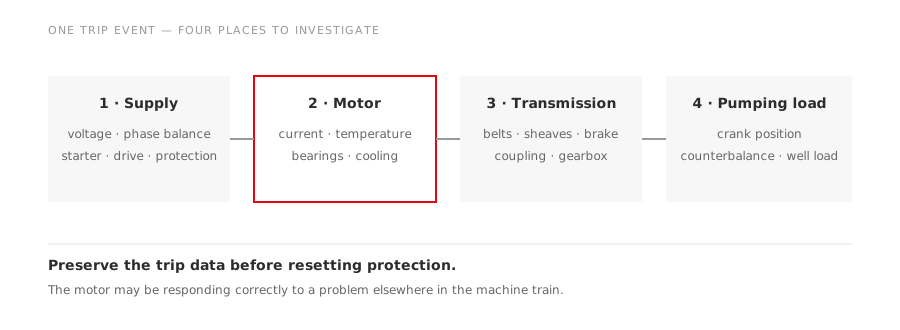
A beam pumping unit changes torque throughout every stroke. That makes its motor a poor place for guesswork: the highest current, loudest sound or worst vibration may follow crank position rather than a defect inside the motor.
This guide is a triage framework. Site lockout procedures, hazardous-area requirements and the equipment manufacturer’s instructions take priority.
Direct answer
Divide the problem into four parts before replacing anything:
- incoming supply, starter or drive, and protection;
- the motor itself;
- belts, sheaves, coupling, brake and gearbox;
- counterbalance, pumping unit and downhole load.
Preserve the trip history and relate current, sound or vibration to crank position. A fault that repeats at the same point in the stroke often needs a different investigation from one that follows elapsed running time or motor temperature.
Symptom-to-check matrix
| Symptom | First checks | Do not assume |
|---|---|---|
| Trip during starting | Supply voltage, phase balance, starter or drive log, brake release, seized train, cold load | The motor is undersized |
| Trip at one crank position | Current versus position, counterbalance, gearbox and mechanical binding | The overload relay is defective |
| Trip after several minutes | Current trend, cooling path, ambient, starts per hour, winding and bearing temperature | Restarting will clear it |
| New hum or growl | Voltage balance, mounting, bearing points, belts and gearbox | Sound travels poorly; the loudest panel may not contain the source |
| Periodic knock or click | Belt splice, sheave, key, looseness, brake, gearbox and structure | Every periodic sound is a bearing defect |
| Rising vibration | Alignment, belt tension, soft foot, foundation, sheave runout and driven train | A high motor reading proves an internal motor fault |
If the unit trips during starting
Record which protective device operated and its indicated cause. Check all three phase voltages before and during the start where the site’s procedure permits. A low or unbalanced supply, a brake that has not released, excessive belt tension or a mechanically locked train can all produce high current.
Do not increase the overload setting simply to make the machine start. Confirm the motor’s locked-rotor characteristics, starter or drive capability, acceleration time and the actual breakaway requirement.
If the trip follows crank position
Plot current against one complete pumping cycle. Add crank angle or a repeatable position reference. If the peak appears at the same point, review:
- counterbalance condition;
- polished-rod load and pumping-unit geometry;
- belt slip or tight spots;
- brake drag;
- gearbox condition;
- a changing downhole load.
The motor may be responding correctly to an abnormal load. Replacing it without correcting that load can reproduce the failure.
If the motor becomes noisy or hot
Compare the motor’s drive-end and non-drive-end bearing points with the base, gearbox and nearby structure. Check whether the change follows speed, load, temperature or crank position. Inspect cooling passages and the external fan without removing guards while the equipment is running.
For a drive-fed motor, save the drive’s current, frequency, DC-bus and fault data before clearing the history. For a line-fed motor, measure phase current and voltage using the site’s approved method. Temperature alone is not enough: record where it was measured, the instrument used and the ambient condition.
Information that prevents a wrong motor order
Before requesting a replacement, document:
- motor nameplate and connection;
- starter or drive model and settings;
- current and voltage by phase;
- speed and pumping rate;
- trip code and time into the cycle;
- crank position at the event;
- belt, sheave, gearbox and brake condition;
- counterbalance and recent well or mechanical changes;
- ambient, enclosure and hazardous-location requirements.
LEADGO supplies both conventional high-slip NEMA Design D pump motors and the CYJTYP semi-direct permanent-magnet system. They use different starting and transmission arrangements, so their fault paths and replacement checks are not interchangeable.