
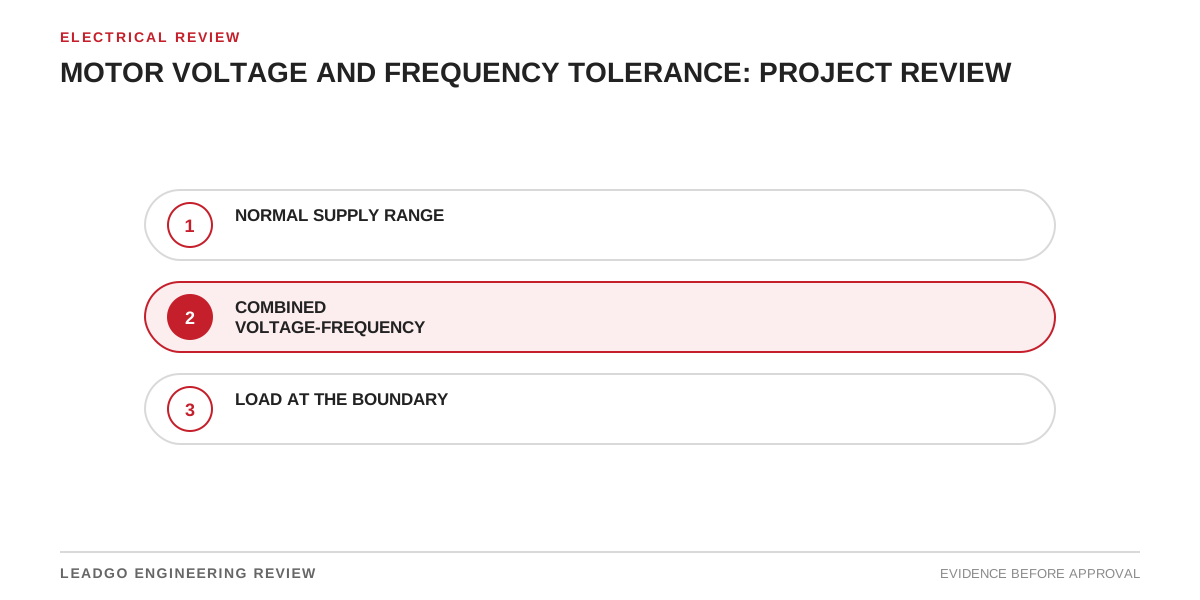
“Voltage within tolerance” and “frequency within tolerance” can both be true while their combination creates an unfavourable operating point. Motor flux broadly follows the voltage-to-frequency relationship, while load and cooling decide whether the resulting current and heat are acceptable. The enquiry should therefore describe an operating envelope, not two disconnected percentages.
Review the corners of the supply envelope
| Supply corner | Primary concern | Project evidence |
|---|---|---|
| High voltage / low frequency | Higher V/Hz and magnetic stress | Recorded supply limit and motor confirmation |
| Low voltage / high frequency | Reduced V/Hz and available torque | Load torque and acceleration requirement |
| Low voltage during start | Longer acceleration or failure to accelerate | Network study and motor/load torque curves |
| High or low frequency at full process load | Speed, driven-equipment demand and cooling | Process envelope and equipment speed limits |
| Unbalanced phase voltage | Unequal phase current and heating | Phase-by-phase measurements and protection basis |
| Generator or weak-bus operation | Frequency/voltage recovery during start or load steps | Dynamic study or site test evidence |
Use the combinations the source can actually produce. If a generator governor and AVR cause voltage and frequency to move together during a motor start, a rectangular “maximum/minimum” box may describe impossible corners while missing the real transient path.
Define normal, excursion and trip regions
Mark which supply conditions are expected continuously, which are temporary events and which must initiate an alarm, process reduction or trip. Attach a duration to excursions. A broad theoretical limit should not silently become the normal design point.
Then pair each condition with load. A lightly loaded standby motor and a fully loaded crusher motor do not present the same thermal or torque question at low voltage.
Measure at the correct point
For an operating plant, collect voltage at the motor control centre or motor terminals when feasible, with time-aligned frequency, phase current and process load. Record instrument accuracy and sampling period. An upstream bus average may hide feeder drop during starting, and a handheld snapshot may miss recurring events.
Do not average the three phase voltages before checking unbalance. Keep the individual readings and the method required by the governing project standard.
Turn the review into purchase and protection requirements
The approved data sheet should state rated voltage/frequency, normal supply envelope, abnormal cases, load at each relevant boundary and required performance or derating. Coordinate undervoltage, overvoltage, frequency and thermal protection with process ride-through needs.
For supply asymmetry, see why voltage unbalance overheats a motor. For starting response, compare DOL, star-delta, soft starter and VFD methods.