
Three-phase motors are designed around a balanced supply. When the three line-to-line voltages differ, the motor does not simply divide the error evenly. Negative-sequence voltage produces a counter-rotating magnetic field, increasing loss and heating while useful shaft output remains unchanged.
NEMA MG 1 states that polyphase motors should operate successfully at rated load when voltage unbalance at the motor terminals does not exceed 1%, while warning that performance will not necessarily match balanced-voltage operation. That 1% is a meaningful engineering limit, not permission to ignore the condition.
Calculate the percentage correctly
Measure all three line-to-line voltages at the motor terminals:
- Vab
- Vbc
- Vca
Calculate their average. Then find the largest absolute deviation of any reading from that average.
Voltage unbalance (%) = maximum deviation from average ÷ average voltage × 100
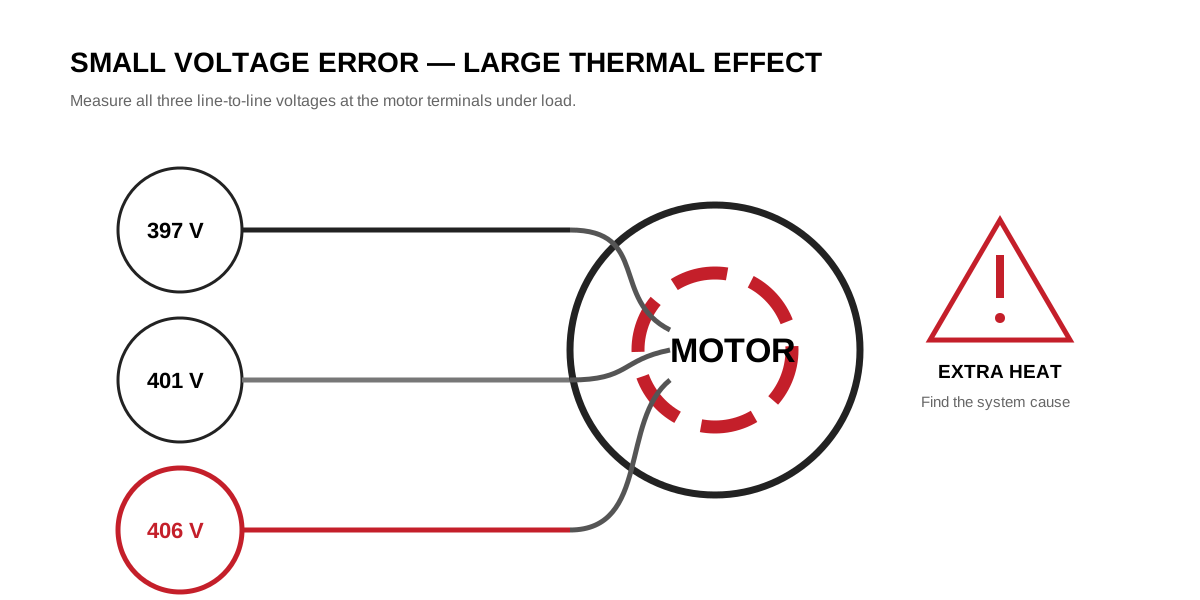
Suppose the readings are 397 V, 401 V and 406 V. The average is about 401.3 V. The maximum deviation is about 4.7 V, so the unbalance is approximately 1.16%. Looking only at the average would incorrectly suggest that the supply is almost perfect.
Why current reacts more strongly
The unbalanced voltage creates positive- and negative-sequence components. The negative-sequence field rotates opposite to the rotor, producing high effective rotor frequency and additional rotor and stator losses. Current imbalance can therefore be several times the percentage voltage unbalance, although the exact ratio depends on motor impedance and load.
Do not publish or apply a single multiplier as if it were universal. Measure all three currents and winding temperatures where possible. A motor already close to its thermal limit has less tolerance than a lightly loaded machine with clean cooling passages.
Common sources in the installation
| Source | Typical check |
|---|---|
| Uneven single-phase loads upstream | Compare phase loading at the distribution board |
| Loose or oxidised connection | Inspect and measure voltage drop across joints |
| Damaged contactor pole | Measure voltage on both sides under load |
| Fuse or cable problem | Compare phase impedance and temperature |
| Transformer tap or winding issue | Check secondary voltages and upstream records |
| Motor winding fault | Determine whether abnormal current stays with the motor phase |
The safest diagnosis moves from supply to motor. Record voltages at the source, starter output and motor terminals under the same operating condition. A no-load measurement may look balanced because the defective connection has little voltage drop until current rises.
Separate voltage unbalance from voltage deviation
Balanced voltage can still be too high or too low. Unbalance and deviation from rated voltage are different calculations and create different symptoms. Check both.
Frequency matters as well because voltage-to-frequency ratio influences flux. This becomes especially important when operating a motor on a different grid; see running the same motor at 50 Hz and 60 Hz.
A practical troubleshooting sequence
- Confirm the process load and whether the motor is overloaded.
- Measure all three line-to-line voltages at the motor under load.
- Calculate percentage unbalance rather than judging by eye.
- Measure all three phase currents at the same time.
- Inspect terminals, contactors, fuses and cable joints with the equipment safely isolated.
- Compare readings upstream to locate where the imbalance appears.
- If the supply is balanced but current remains unbalanced, test the motor and outgoing cable.
Do not repeatedly reset thermal protection while investigating. The trip may be the only device preventing insulation damage. The first-inspection sequence in why oilfield motors run hot applies equally to general industrial installations.
What to record for the supplier
Send the motor manufacturer the six simultaneous values—three voltages and three currents—plus load, frequency, connection, ambient temperature and the point where each value was measured. A statement such as “the voltage is 400 V” hides the information needed to diagnose unbalance.
Voltage unbalance is a system condition. Replacing the motor without locating the source can damage the replacement in the same way. Measure at the terminals, correct the supply or connection fault, and then verify that current and temperature return to a stable pattern.