
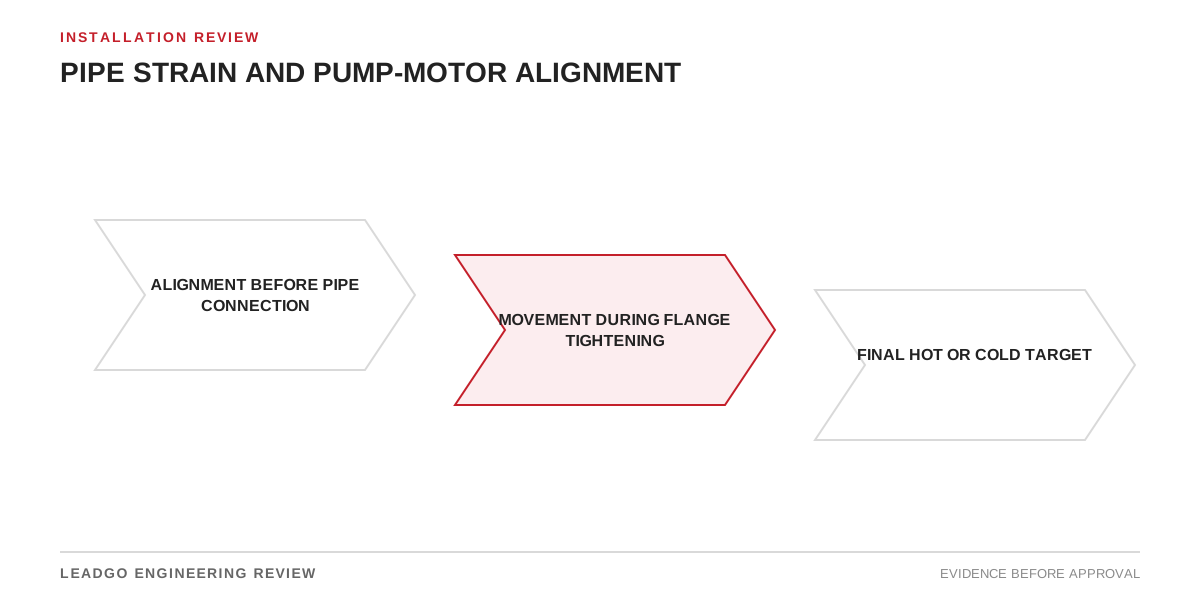
Do not accept alignment until piping is connected and its influence is measured. Treat missing inputs as open actions rather than filling them with values from a similar project; the pump alignment record must identify this boundary explicitly.
Use the project condition, not a shortcut — pump alignment
Mechanical installation determines how housing distortion, shaft load, thermal movement and connected equipment reach the motor; the pump alignment record must identify this boundary explicitly. Measurements should represent the final assembled condition, after grouting, piping, belt or coupling work and bolt tightening are complete; the pump alignment record must identify this boundary explicitly.
Name the source for every governing input. Manufacturer documents, plant calculations and field measurements serve different purposes and should not be blended without a traceable basis; the pump alignment record must identify this boundary explicitly.
Three items to close — pump alignment
| Step | Review point | What to confirm |
|---|---|---|
| 1 | Alignment before pipe connection | Define alignment before pipe connection and identify the controlled document or measurement that supports it. |
| 2 | Movement during flange tightening | Confirm movement during flange tightening under the stated operating condition rather than a nominal assumption. |
| 3 | Final hot or cold target | Record final hot or cold target with its source, revision and responsible reviewer. |
The review should expose interfaces, not hide them. If one input changes, revisit the other two and note the effect on protection, temperature, mechanical load or process operation; the pump alignment record must identify this boundary explicitly.
Two weak review habits — pump alignment
- Borrowing an unverified input. Using alignment before pipe connection from a similar motor or site. Keep the borrowed value visibly provisional until the project source is available; the pump alignment record must identify this boundary explicitly.
- Treating an interface as a late detail. Closing the review before final hot or cold target is documented. A clear hold point is preferable to an acceptance that cannot be reproduced; the pump alignment record must identify this boundary explicitly.
A comparison with a similar machine may help frame a question, but it does not close the item; the pump alignment record must identify this boundary explicitly. Acceptance should point back to evidence for the actual equipment and duty; the pump alignment record must identify this boundary explicitly.
Leave a traceable decision — pump alignment
Keep these items with the approval or maintenance record:
- source and operating condition for alignment before pipe connection
- dated evidence for movement during flange tightening
- approved limit or disposition for final hot or cold target
Close the record with accepted values, unresolved actions and the person responsible for each action; the pump alignment record must identify this boundary explicitly. Supporting photos are useful when their location and date are clear.
Decision rule — pump alignment
Do not accept alignment until piping is connected and its influence is measured. Carry the rule into the approval record and future maintenance baseline. Any exception should state its technical basis, scope and authorising party.
Going deeper — pump alignment
Pipe-connection movement test — pump alignment
Use a staged test to separate machine alignment from pipe-induced movement. Record readings at the same coupling reference and with the same instrument setup.
| Hold point | Condition | Record | Decision |
|---|---|---|---|
| A | Pump and motor fixed, piping disconnected or demonstrably free | Soft foot, shaft runout basis, coupling gap and offset/angle readings | Establish mechanical baseline |
| B | Pipe flanges brought near without force | Natural flange gap, parallelism and lateral offset | Stop if pipe does not meet nozzle naturally |
| C | Flange bolts tightened in approved sequence | Movement at pump feet or coupling after each stage | Reject forced fit or unexplained movement |
| D | Supports, springs and restraints in final cold position | Final cold alignment, support settings and nozzle condition | Confirm installed cold target |
| E | Stable operating temperature where practical | Hot movement evidence, vibration and bearing temperatures | Validate target or define correction |
The exact allowable movement must come from the pump, coupling and project requirements. The value is less important than a repeatable test showing that connection did not pull the pump away from its accepted position.
Prepare a valid baseline — pump alignment
Alignment cannot be trusted until base condition is controlled. Confirm grout cure and baseplate condition, clean and tighten mounting interfaces, correct soft foot, and record shaft/coupling runout that could bias readings. Use the specified bolt tightening method. If shims are changed, recheck soft foot before interpreting alignment.
The pipe system should be in its final supported configuration: permanent supports installed, spring supports set for the correct condition, temporary erection devices removed or identified, and major valves/equipment in the design state. A pipe that aligns only while held by a chain block has not reached a valid acceptance condition.
Before bolting, measure flange separation, angular mismatch and lateral offset. Do not use flange bolts to draw the pipe into position. If the spool must be forced, send the issue back to piping for correction and reassess support loads.
Cold target versus operating target — pump alignment
Machines move as foundations, casings and pipes heat. A cold alignment target may intentionally include offset so shafts approach the desired relationship during operation. Obtain this target from an approved thermal-growth basis, not from a rule of thumb.
Where hot alignment measurement is unsafe or impractical, use verified growth calculations, machine movement probes or an approved indirect method. Record process temperature, load, time at condition and measurement delay. A “hot” reading after the train has cooled is not comparable with a stable operating condition.
Applicability and exclusions — pump alignment
The method applies to motor-driven centrifugal and similar pumps with coupled shafts and connected piping. Vertical pumps, close-coupled arrangements and flexible-hose systems need adapted interfaces. It does not establish allowable nozzle loads; the pump supplier and piping stress analysis must provide those limits.
Alignment is also not a substitute for checking pipe support design. A machine may align cold yet receive excessive loads during thermal movement, water hammer or operating transients. Conversely, one small change in coupling readings does not by itself prove an unacceptable nozzle load; it is an investigation trigger.
Common errors — pump alignment
- Aligning before grouting, final tightening or pipe support completion and never repeating the measurement.
- Accepting “flanges bolted successfully” as evidence that the pipe was strain-free.
- Moving only the motor to correct a pump displaced by piping, which hides the force source.
- Mixing measurement methods without a common sign convention and reference plane.
- Ignoring coupling spacer installation, coupling growth or shaft end float.
- Recording only final values and losing the before/after connection evidence.
Data to request — pump alignment
From the pump supplier, request nozzle-load limits, foot and flange requirements, shaft/coupling runout limits, cold alignment target and thermal-growth basis. From the motor supplier, request shaft-position considerations, bearing end float where relevant and permissible external shaft loads. From the piping designer, request stress-analysis cases, support settings and any required sequence for connection and spring release. From the coupling supplier, request installation gap, allowable misalignment and measurement reference.
Release decision — pump alignment
Close the work only when base condition, soft foot, pipe connection sequence, final support state and alignment readings form one traceable record. Attach instrument identity, calibration status, measurement geometry, sign convention, bolt state and personnel. If operation shows unexpected vibration or bearing temperature, preserve the cold record and compare it with hot movement before shifting the motor. The objective is not merely a green alignment screen; it is a train that remains mechanically coherent when piping becomes part of the system.