
Flameproof protection accepts that ignition may occur inside an enclosure and prevents the flame from propagating outside. Pressurization takes another route: keep the hazardous atmosphere away from ignition-capable parts.
That difference can make a purged or pressurized package attractive for control panels, analyzers and equipment assemblies. It also introduces a dependency on protective gas, monitoring and interlocks.
Direct answer
Purging and pressurization may reduce the need to build every internal component as a separate explosion-protected item. The design must still match the classified location and receive the required acceptance.
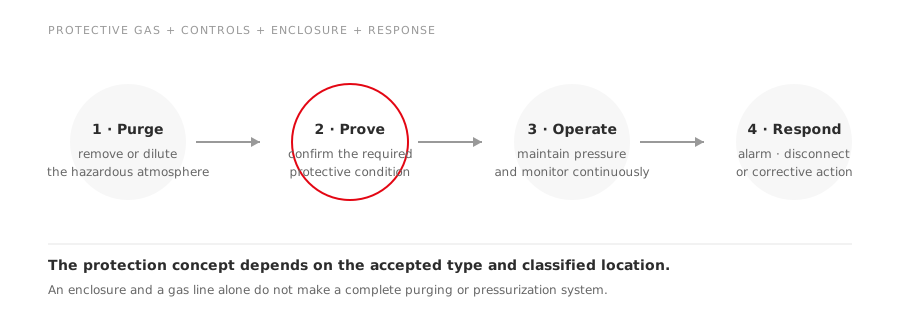
The system normally has to:
- remove or dilute the hazardous atmosphere before energisation where required;
- establish the specified protective-gas condition;
- prevent or limit re-entry during operation;
- detect loss of pressure or flow;
- produce the required alarm, disconnect or corrective response.
The enclosure, gas supply, controls and internal equipment form one protection system.
Type X, Y and Z in North American practice
The following is a simplified selection view of NFPA 496 terminology. The applicable edition and authority having jurisdiction control the final design.
| Purge or pressurization type | Typical use | Internal equipment basis |
|---|---|---|
| Type X | Reduces a Division 1 enclosure to an unclassified condition | Equipment that is not otherwise suitable for the classified location may be used when all required safeguards are met |
| Type Y | Reduces a Division 1 enclosure to Division 2 | Internal equipment remains suitable for Division 2 |
| Type Z | Reduces a Division 2 enclosure to an unclassified condition | Ordinary-location internal equipment may be used when the complete system is accepted |
This table does not select a system. Gas or dust classification, enclosure volume, leakage, ignition sources, protective-gas quality, alarms, shutdown behaviour and local adoption all matter.
Where the economic advantage comes from
A large panel populated entirely with separately approved hazardous-location components can be expensive and difficult to modify. A reviewed purge or pressurization system may allow more conventional internal components and make heat management or access easier.
The saving is not simply the difference between two enclosure prices. Add:
- protective-gas supply and conditioning;
- purge controller, valves and pressure or flow sensing;
- alarms and interlocks;
- commissioning tests and documentation;
- gas consumption and filter maintenance;
- the production consequence of pressure loss.
A plant with clean instrument air and established purge maintenance may reach a favourable answer. A remote installation with unreliable gas supply may not.
The cost of losing pressure
Loss of protective pressure is a protection-system event. The response depends on the system type and the hazards inside and outside the enclosure. It may require an alarm, restoration within a defined response, automatic disconnection, or other action accepted for that installation.
Design questions include:
- Which circuits remain energized after loss of pressure?
- Can hot surfaces or stored energy remain ignition-capable?
- Is the alarm monitored at all operating times?
- Does restart require a complete purge cycle?
- What happens during plant-air failure or maintenance bypass?
- How is enclosure leakage verified after doors, glands or seals are changed?
If those answers are missing, the design has only an enclosure and a gas line—not a complete protection concept.
Do not transfer approval between packages
A purged control cabinet does not automatically make an adjacent ordinary motor acceptable. The motor may require its own protection concept, or it may need to be included within a specifically assessed package. Likewise, a certificate for one enclosure size and purge controller should not be assumed to cover a redesigned cabinet.
For IEC/GB projects, use the applicable pressurization protection requirements and equipment marking. For North American projects, define the Class/Division or Zone basis, NFPA 496 type and the authority that will accept the installation.
Information to send an integrator
Provide the classification drawing, gas or dust group, temperature requirement, ambient range, enclosure volume, internal heat dissipation, ignition-capable components, available protective gas, required uptime and the site’s loss-of-pressure philosophy.
Then request a cause-and-effect document showing permissives, purge sequence, alarms, trips and restart conditions. That document is as important as the enclosure drawing.