
The question arrives in the wrong order almost every time. Someone sends a motor model and asks whether it is suitable for their area. But the area was classified first, and that document is what decides — the nameplate only answers whether a particular machine satisfies it.
Direct answer
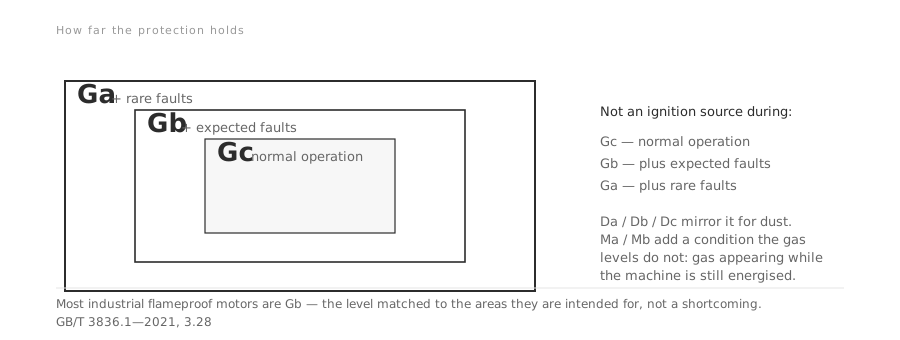
A zone admits equipment of its own protection level and of every higher level:
| Zone | Admits |
|---|---|
| Zone 0 | Ga |
| Zone 1 | Ga or Gb |
| Zone 2 | Ga, Gb or Gc |
| Zone 20 | Da |
| Zone 21 | Da or Db |
| Zone 22 | Da, Db or Dc |
Read the table in the direction that matters: you may always go up, never down. A Ga machine is acceptable in Zone 1 and Zone 2; a Gc machine is acceptable only in Zone 2. Specifying above what the zone requires is legal and usually just expensive. Specifying below it is not a margin call.
Why this rule is not in the equipment standard
We said in equipment protection levels explained that we would not publish this table from memory or from secondary sources, because the rule lives on the installation side of the standard series rather than the equipment side. The installation standard is now in the library, so here it is with its source.
The division is worth understanding, because it explains a recurring misunderstanding:
- The equipment standard defines what each protection level means — under which fault conditions the protection still holds.
- The installation standard defines which level a given zone requires, and what else has to be considered when putting equipment into that area.
So a certificate can be entirely valid and still not answer your question. The certificate describes the machine. The area classification document describes the area. Matching them is a third act, and it is governed by a third document.
The Chinese installation standard changed status, and that matters
The current edition is GB 3836.15—2024, replacing GB/T 3836.15—2017. Two changes are worth putting in front of a buyer:
It is no longer a recommended standard. The designation moved from GB/T to GB. In the Chinese system that is the difference between a recommended national standard and a mandatory one. It was issued on 2024-07-24 and took effect on 2025-08-01.
The motor provisions were consolidated. The foreword’s list of technical changes records that the requirements for rotating machines were changed and gathered into clause 5.6.2 — where the 2017 edition had spread them across six separate clauses. If an engineering practice is still working from the 2017 edition, the motor requirements are not where the new edition puts them, and a clause-by-clause comparison will not line up.
Choosing the level is the start, not the end
Having the right EPL does not finish a motor specification. The installation standard lists what else has to go into selecting a rotating machine, and the list is not the one people expect:
- Duty type
- Supply voltage and frequency range
- Heat conducted in from the driven equipment — a pump is the example the standard gives
- Bearing and lubricant life
- Insulation class
Note the third item. It is the one most often missing from an enquiry: the machine is not only heating itself, it is being heated through the shaft and the mounting by whatever it drives.
There is also a specific instruction for machines exposed to vibration, and it is mundane in a way that should be reassuring rather than surprising — check that terminal screws and nuts are tight, so that a poor connection does not overheat, and that the cable entry and its strain-relief components are secure. Vibration attacks the terminal box, and on a flameproof machine the terminal box is part of the protection, not just a wiring space. That is the same failure path set out in why oilfield motors run hot.
Three cases the standard singles out
Converter-fed machines. Where a motor is fed from a variable-frequency converter, the converter — a matched unit, a similar unit, or the protective device — has to be selected according to the instructions for use and the requirements of the certification. The standard attaches a note explaining the mechanism people get caught by: a filter at the converter output can drop the voltage at the motor terminals; the lower voltage raises current and slip, and stator and rotor temperatures rise with it. Under a constant rated load that rise is pronounced.
That is the physical reason a flameproof machine and its drive are one specification rather than two purchases — see flameproof motors on a VFD.
Reduced-voltage and soft starting. The soft starter and any protective device are likewise to be selected according to the instructions for use.
Machines above 1 kV. Several provisions apply, including surge suppression between the switchgear breaker and the motor cable termination where vacuum breakers or contactors are used above a defined starting current, and a caution about keeping stops during starting to an absolute minimum when commissioning medium-voltage machines — including stops made just to check the direction of rotation.
That last one is a nice illustration of how these documents work. Checking rotation is ordinary practice; on a medium-voltage machine during commissioning, the standard asks you to minimise it. Terminal markings are how you establish rotation without repeatedly starting the machine.
The X that changes the answer
The standard restates, in the motor clause, something worth carrying into every enquiry:
Where the Ex certificate number carries the symbol X, the specific conditions of use for that machine have to be taken into account.
An X is not a defect and not a downgrade. It means the certificate is conditional, and the conditions are part of the approval. A machine whose certificate has an X, installed without reading the conditions, is not a certified installation — see checking an Ex certificate.
What to have in hand before asking for a quotation
- The area classification document — zone, and therefore the required EPL.
- Gas or dust, and the subgroup — these are properties of your site, not of the motor.
- The temperature class required, set by what is present.
- Duty, supply and frequency range, including whether a converter or soft starter is involved.
- What the motor drives, because heat comes back through the coupling.
- Whether the supply is above 1 kV, which brings its own clause.
With one through three you can state the marking you need. With four through six a manufacturer can tell you whether a particular series meets it.
LEADGO’s hazardous-area range covers flameproof “d” machines for gas and enclosure “t” machines for dust, in fixed-speed and converter-fed versions — the hazardous-area products page lists the series and what each is certified for. Send the six items above rather than a model number: the model number is the answer, and those six are the question.
Going deeper
- Equipment protection levels explained — what Ga, Gb and Gc mean as fault envelopes, and why the levels nest
- Reading an Ex marking — the five independent segments, of which EPL is only one
- Who classifies the area — whose document the zone comes from in the first place
- Checking an Ex certificate — certification is per model and per rating, and the X suffix is conditional