
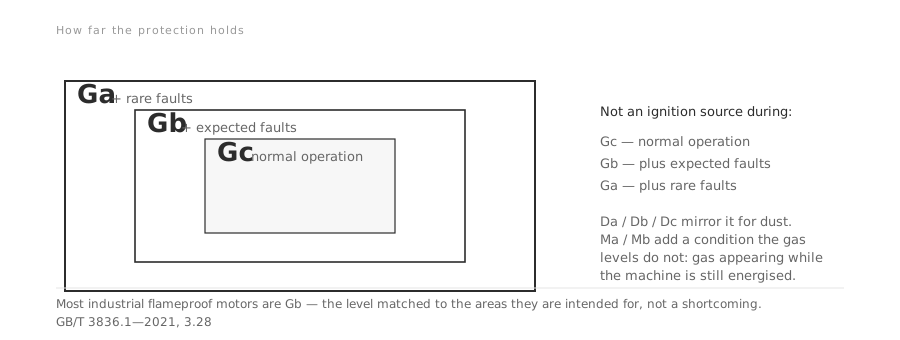
Ex db IIB T4 Gb ends with two characters that most specifications copy without reading. They are the only part of the marking that answers the question an auditor will actually ask: under what fault conditions does this protection still hold?
Direct answer
The equipment protection level classifies how likely the equipment is to become an ignition source, given the differing characteristics of explosive gas atmospheres, explosive dust atmospheres and mine firedamp atmospheres.
There are eight levels across three atmosphere families:
| EPL | Atmosphere | Not an ignition source during |
|---|---|---|
| Ga | Gas | Normal operation, expected faults, and rare faults |
| Gb | Gas | Normal operation and expected faults |
| Gc | Gas | Normal operation, with additional measures possible so that frequent expected ignition sources — a lamp failure, for instance — do not produce effective ignition |
| Da | Dust | Normal operation, expected faults, and rare faults |
| Db | Dust | Normal operation and expected faults |
| Dc | Dust | Normal operation, with the same provision for additional measures as Gc |
| Ma | Mine firedamp | Normal operation, expected faults, rare faults — and even where gas suddenly appears while the equipment remains energised |
| Mb | Mine firedamp | Normal operation, and expected faults arising in the interval between gas suddenly appearing and the equipment being de-energised |
Most industrial flameproof motors are Gb. That is not a compromise; it is the level matched to the areas they are intended for.
Mining is not just “one level up”
Ma and Mb are worth reading closely, because they contain a condition the gas levels do not: what happens when firedamp appears while the machine is still live.
Ma equipment must not become an ignition source even in that situation. Mb equipment must hold through expected faults occurring in the window between the gas appearing and the supply being cut. That window — not a fault probability — is the defining idea, and it is why mining protection is a separate family rather than a stricter grade of the gas one.
The lowercase letter is not the EPL
This is the most common misreading of a marking, and the standard separates the two concepts explicitly.
A level of protection is defined as a subdivision of a type of protection, used to distinguish the likelihood of the equipment becoming an ignition source, and associated with an EPL. Intrinsic safety “i”, for example, subdivides into ia, ib and ic, associated with Ga, Gb and Gc respectively.
So in Ex db IIB T4 Gb, the db is the flameproof enclosure at the level associated with Gb, and the trailing Gb states the EPL. They correspond — but they are different fields, and both are required in the marking.
The full mapping, as the standard sets it out
For explosive gas atmospheres, these are the protection-level symbols and the EPLs they are associated with:
| Symbol | Type of protection | Associated EPL |
|---|---|---|
| da / db / dc | Flameproof enclosure | Ga or Ma / Gb or Mb / Gc |
| eb / ec | Increased safety | Gb or Mb / Gc |
| ia / ib / ic | Intrinsic safety | Ga or Ma / Gb or Mb / Gc |
| ma / mb / mc | Encapsulation | Ga or Ma / Gb or Mb / Gc |
| nA / nC / nR | Non-sparking / spark-protected / restricted breathing | Gc |
| ob / oc | Oil immersion | Gb or Mb / Gc |
| pxb / pyb / pzb, pv | Pressurisation | Gb or Mb / Gb / Gc; pv for Gb or Gc |
| q | Powder filling | Gb or Mb |
| sa / sb / sc | Special protection | Ga or Ma / Gb or Mb / Gc |
| op is / op pr / op sh | Optical radiation, three variants | Various, per the standard |
Two things fall out of this table that matter in procurement.
Not every protection type reaches every level. Increased safety “e” has no Ga variant. Non-sparking “nA” exists only at Gc. So a requirement for Ga in a gas atmosphere already rules out several technologies before anyone looks at a catalogue.
Dust has its own list. For explosive dust atmospheres the symbols are ta / tb / tc for enclosure protection, ia / ib / ic, ma / mb / mc, pxb / pyb / pzc, sa / sb / sc and the optical variants — associated with Da, Db and Dc. Gas and dust markings must be kept separate and must not be combined into one string.
An EPL can be marked stricter than the protection type implies
The standard carries a note that explains markings which otherwise look like mistakes: the EPL marked on equipment may be more restrictive than the EPL normally used for a given type of protection, in order to reflect some other aspect of the equipment — such as a material limitation.
Its own example is a machine whose aluminium content exceeds the permitted value: marked Ex ia IIC T4 Gb, where the intrinsic-safety level ia would normally sit with Ga.
On a motor this is not hypothetical. Aluminium appears in frames, end shields and cooling fans. If a marking looks internally inconsistent, a material limitation is one of the first things to ask about — and it will be recorded in the certificate.
What this article deliberately does not give you
The rule that maps an area classification to a required EPL is not in the equipment standard. GB/T 3836.1 defines what each EPL means; the selection rule — which EPL is required in which zone — belongs to the installation side of the standard series.
We said here that we would not publish a zone-to-EPL table from memory or from secondary sources. We have since obtained the installation standard, so the correspondence is now set out with its source in what a Zone 1, 2, 21 or 22 area actually requires — the short version being that a zone admits its own protection level and every higher one.
The order of operations below is unchanged, and it is still the part that matters:
- The area is classified by the owner or design engineer. See who classifies a hazardous area.
- The classification determines the required EPL, via the installation standard.
- The required EPL, together with group and temperature class, determines the marking you specify.
- The certificate is then checked against that marking, per model and rating.
A supplier can help with steps three and four. Steps one and two are yours, and no motor datasheet substitutes for them.
Going deeper
- Explosion-proof motor selection: how to read the marking — the five independent decisions, of which EPL is the last
- Gas and dust subgroups explained — the segment before it, and why coverage runs one way only
- Motor temperature classes T1 to T6 — the segment before that, and what actually sets the limit
- How to verify an explosion-proof motor certificate — checking all of the above against the document