
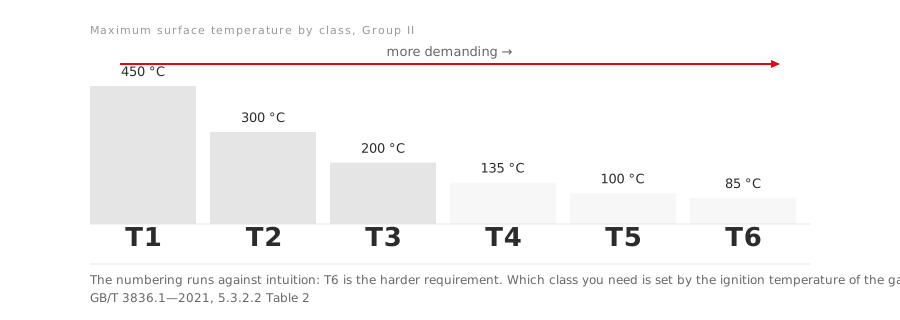
Of the five segments in an Ex marking, the temperature class is the one buyers most often try to improve by asking for a bigger number. It is also the one where the bigger number means the opposite of what it looks like.
Direct answer
A temperature class is a classification based on the maximum surface temperature of the equipment, related to the specific explosive gas atmosphere it is intended for. The scale runs downward:
| Class | Maximum surface temperature |
|---|---|
| T1 | ≤ 450 °C |
| T2 | ≤ 300 °C |
| T3 | ≤ 200 °C |
| T4 | ≤ 135 °C |
| T5 | ≤ 100 °C |
| T6 | ≤ 85 °C |
T6 is the harder requirement, not the better product. And the figure that decides which class you need is not a property of the motor at all.
What the measured temperature is actually checked against
This is the clause worth quoting into a specification. For Group II equipment, the measured maximum surface temperature shall not exceed whichever of these applies:
- the specified temperature class;
- a specified maximum surface temperature; or
- the ignition temperature of the specific gas in the intended atmosphere.
Read the third item carefully. The temperature class is a convenient shorthand for a requirement that is really about your site’s gas. Where the ignition temperature of what is present is known, that number governs — and a class marking is a band drawn around it, not a substitute for it.
That is why “which T class do I need?” is not a question a motor supplier can answer. It is answered by the material safety data of what is in your process.
The class belongs to a machine in an ambient, not to a model number
Two clauses in the same chapter make this explicit.
The maximum surface temperature is determined taking into account the maximum ambient temperature and the corresponding maximum rated external heat source. And the note under the temperature-class table states plainly that different ambient temperatures and different external heat or cold sources may give more than one temperature class.
So a single machine can legitimately be T4 in one ambient and T3 in another. When a certificate lists several combinations, that is not vagueness — it is the specification being honest about a dependency that exists in physics.
The practical consequence for procurement: a temperature class quoted without the ambient it applies at is an incomplete statement. Ask which ambient, and check it against where the machine is actually going. The default envelope, before any additional marking is required, is −20 °C to +40 °C.
Process temperature is part of the specification
Where equipment is physically connected to, or affected by, a separate external heating or cooling source — the standard’s own examples are a heated or cooled process vessel or pipe, and the usual industry term is process temperature — the ratings of that source shall be specified in the Ex certificate and in the manufacturer’s instructions.
On a motor this is not exotic. A pump motor close-coupled to a hot process line, a motor on a kiln or dryer, a machine mounted where radiant heat reaches it — all of these bring an external source into the thermal picture, and the standard treats that source as data that has to be written down, not as an installation detail.
If a certificate for such an installation says nothing about an external source, it has not been written for that installation.
Mining is a different rule entirely
Group I equipment — for mine firedamp atmospheres — is not classified with T numbers at all. Its maximum surface temperature must be specified in the documentation and must not exceed:
- 150 °C where coal dust may accumulate on the surface of the equipment; or
- 450 °C where coal dust will not accumulate — for example, inside a dust-protected enclosure.
The distinction is a layer of settled dust, which is exactly the mechanism a T class does not describe.
Dust equipment does not use T classes either
Group III equipment carries an actual maximum surface temperature in degrees Celsius rather than a class. For EPL Da it is measured with a dust layer of at least 200 mm surrounding all faces of the equipment, and layers thicker than that do not produce a higher rise that needs considering. We set that out alongside the subgroups in gas and dust subgroups explained.
What attacks this specification in service
The temperature class is a statement about surface temperature under the rated conditions used in the assessment. Anything that pushes surface temperature above those conditions attacks the specification directly rather than merely shortening life:
- A blocked or fouled cooling path. A fan cover packed with dust or a frame caked in process material is a thermal change, not a housekeeping issue.
- A settled dust layer. It insulates the frame, which is precisely why dust equipment is tested with one.
- An unmatched inverter supply. Additional harmonic losses raise temperature, which is why running a flameproof motor on a drive is a specification question rather than a wiring one — and why, for increased-safety machines type-tested with an inverter, the instructions must state the inverter parameters used in that test.
- Operating outside the stated ambient. The class was assessed at a stated maximum; exceeding it moves the machine outside what was assessed.
What to have before specifying
- The ignition temperature of what is present on site. This is the governing figure.
- The ambient range at the installed location, and whether it exits −20 °C to +40 °C.
- Any external heat or cold source the machine is connected to or affected by.
- The certificate, checked for which class applies at which ambient — not a family-level statement.
LEADGO’s flameproof range carries its temperature class per model on the certificate. Send the ignition temperature, the ambient and the process temperature, and ask for the certificate covering that combination.
Going deeper
- Explosion-proof motor selection: how to read the marking — where the temperature class sits among the five independent decisions
- Gas and dust subgroups explained — the segment before it, and why dust is marked in °C instead
- How to verify an explosion-proof motor certificate — including the ambient and special-conditions checks above