
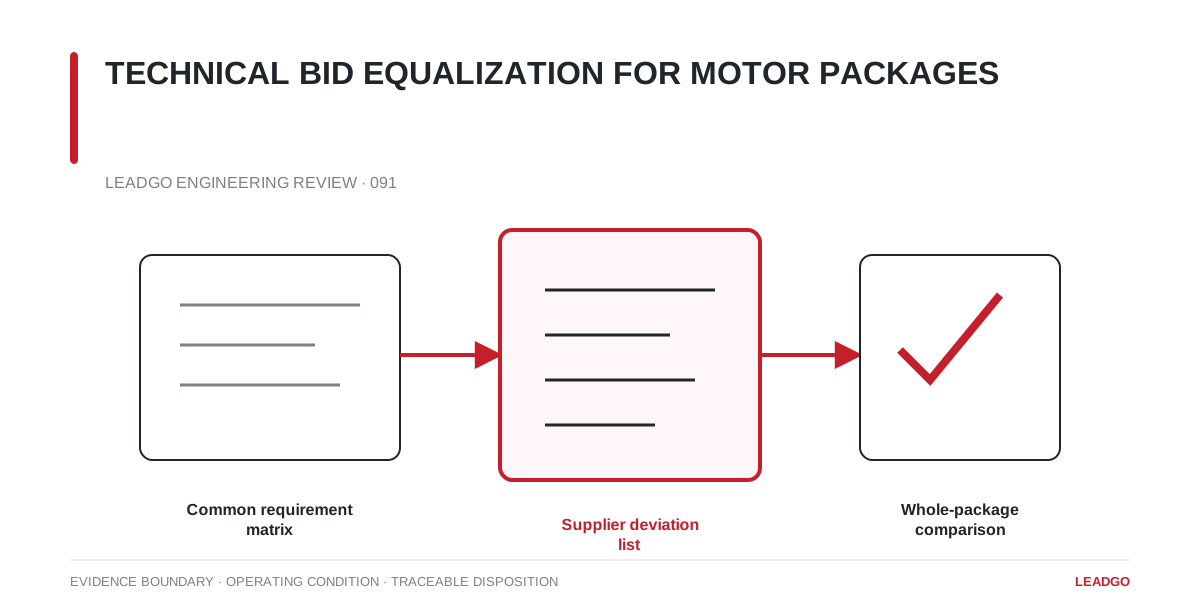
Motor bids rarely arrive in a comparable shape. One supplier quotes a bare motor, another includes sensors and terminal accessories, and a third assumes that the buyer will accept a different starting current or test method. A spreadsheet that compares only output, efficiency, price and delivery can make the least complete offer look strongest.
Technical equalization converts each proposal into the same engineering structure. Its purpose is not to make every motor identical. It exposes where the offers differ, what evidence supports each claim, and which differences move risk or work into the buyer’s scope.
Applicability boundary and package definition
Use this process for motors whose duty, interfaces or documentation matter to the project outcome: high-voltage machines, hazardous-area motors, VFD systems, pump and compressor packages, vertical motors, special mountings and orders with witnessed testing. A simplified comparison may be enough for a standard replacement only when every critical interface has already been confirmed.
Define the package boundary before issuing the RFQ. State whether the supplier includes the motor alone or also provides the drive, baseplate, coupling, cooling unit, encoder, space heater, sensors, local terminal boxes, condition-monitoring hardware, spare parts, special tools and commissioning support.
Separate three requirement types:
- mandatory: failure makes the offer technically unacceptable unless the purchaser formally changes the requirement;
- preference: alternatives may be compared if their consequences are visible;
- information: required to complete studies, interfaces or lifecycle planning even when it does not decide compliance by itself.
Without that distinction, teams can spend time negotiating a preference while overlooking an unanswered mandatory requirement.
Motor-package equalization matrix
Create one row per decision, not one row per supplier document. Each cell should contain the offered value, source reference, compliance status and any action needed.
| Requirement block | Minimum comparison | Evidence required | Consequence to expose |
|---|---|---|---|
| Rated duty | Output, voltage, frequency, poles, speed and duty type | Completed data sheet | Wrong process point or supply mismatch |
| Load interface | Torque-speed curve, inertia, starts and acceleration | Driven-load data and motor curves | Failure to accelerate or thermal overuse |
| Starting system | Starting current, torque and selected method | Guaranteed data and study inputs | Bus voltage, protection and process effects |
| VFD operation | Speed range, torque envelope, cooling and insulation | Motor-drive compatibility statement | Low-speed heating or waveform stress |
| Efficiency | Class, rated value, method and tolerance basis | Applicable test report or controlled family basis | Invalid bid comparison or energy model |
| Environment | Ambient, altitude, humidity, dust and corrosion exposure | Site data and supplier derating | Unstated derating or unsuitable materials |
| Hazardous area | Marking, certificate scope and conditions | Full certificate and schedule | Equipment not suitable for classified location |
| Mechanical fit | Mounting, shaft, flange, loads and terminal position | Certified outline drawing | Rework, alignment or cable-routing conflict |
| Bearings and lubrication | Arrangement, life basis, grease or oil system | Bearing schedule and calculations where required | Maintenance or thrust-capacity mismatch |
| Cooling | IC method, airflow or water conditions and auxiliaries | Cooling data and interface drawing | Site utility or access requirement |
| Protection and sensors | RTDs, PTCs, heaters, vibration and CT interfaces | I/O list and terminal plan | Missing channels or incompatible plant systems |
| Testing | Routine, type, special and witnessed tests | ITP, procedures and acceptance criteria | Unpriced tests or disputed acceptance |
| Documentation | Approval, manufacturing and as-built records | Vendor document register | Late engineering release or incomplete handover |
| Commercial interface | Exclusions, spares, supervision and warranty boundary | Priced schedule and deviation list | Cost transferred outside quoted package |
Use clear statuses: compliant, deviates, clarification required, not offered and not applicable. A blank cell is “clarification required,” not compliant.
Common errors in motor bid comparison
Comparing catalogue maxima with guaranteed project values. A series brochure can show the capability of a product family. The offered frame, winding, cooling method and duty still need confirmation.
Allowing suppliers to choose different operating cases. One bidder may state starting current at rated voltage while another applies a reduced-voltage starter. Normalize the condition before ranking the numbers.
Hiding deviations in supplier notes. A general note can override several checked boxes. Extract every exception into the controlled deviation register and link it to the affected rows.
Mixing base offers and alternatives. If a lower-cost alternative is entered directly into the main matrix, the comparison no longer shows whether each supplier met the original requirement. Keep compliant base offers and proposed alternatives separate.
Treating “equivalent” as evidence. Different standards, bearings, sensors or tests may be technically acceptable, but the supplier must explain the equivalence and the purchaser must accept its consequences.
Comparing purchase price before closing scope. The apparent saving can disappear when the buyer adds omitted sensors, special tests, cable boxes, filters, site modifications or commissioning support.
Using a compliance percentage. Ten minor compliant rows do not offset one unresolved hazardous-area certificate or starting problem. Weight decisions by consequence, not row count.
Decision steps for a defensible award
- Freeze the RFQ revision and identify the documents that form the technical baseline.
- Define the package battery limits and assign every interface to buyer, supplier or third party.
- Build the matrix before opening supplier offers so the criteria do not shift toward a preferred bid.
- Enter offered values with page, document and revision references; do not paste conclusions without sources.
- Classify each row and transfer every deviation or unanswered item into an action register.
- Issue a common clarification list so all bidders answer the same unresolved requirements.
- Re-evaluate revised offers without deleting the original response or negotiation history.
- Check cross-discipline interfaces with power-system, mechanical, process, civil, instrumentation and maintenance owners.
- Translate accepted deviations into cost, schedule, performance, maintenance and compliance consequences.
- Establish which bids are technically acceptable before commercial ranking begins.
- Freeze the selected technical offer, accepted deviations and post-award actions.
- Reference that frozen package in the purchase order and vendor document register.
The final recommendation should show facts and choices. It should not conceal uncertainty by forcing every row into a yes/no answer.
Supplier data to request in the RFQ
A high-value equalization depends on structured bidder inputs. Request:
- completed motor data sheet with no blank mandatory fields;
- guaranteed technical particulars for the exact offered rating;
- torque-speed and current-speed data under the specified supply or starting method;
- combined motor and load inertia responsibility statement;
- efficiency class, rated efficiency, test method and tolerance basis;
- outline, mounting, shaft, terminal-box and accessory drawings;
- bearing arrangement, lubrication method and external-load limits;
- cooling requirements and purchaser utility interfaces;
- VFD compatibility limits, required filters and allowable speed range;
- hazardous-area certificate and schedule where applicable;
- protection, monitoring and auxiliary-device schedule;
- proposed ITP, test procedures and list of type-test evidence;
- vendor document register with planned submission dates;
- explicit exclusions, deviations and alternatives;
- recommended spares, special tools and preservation requirements;
- commissioning, supervision and after-sales scope;
- manufacturing location and responsibility for subcontracted package elements.
Require bidders to state “not applicable” with a reason instead of leaving fields empty. This single discipline reduces false compliance and shortens the clarification cycle.
Whole-package cost and risk normalization
After technical acceptability is established, compare the cost of reaching the same project outcome. Add buyer-side adaptations, omitted tests, required filters, spare parts, extra engineering, site supervision and schedule effects. Keep estimates separate from firm supplier prices and name the owner of each assumption.
Lifecycle differences deserve attention when evidence supports them. Efficiency at the expected operating point, lubrication needs, sensor maintainability, local service capability and spare interchangeability may influence ownership cost. Avoid converting uncertain future savings into a precise present value without a controlled duty profile and cost basis.
For schedule, distinguish quoted manufacturing lead time from the dates needed for approval drawings, long-lead components, testing, shipment and final documents. A motor that ships on time can still delay the project if interface drawings arrive after civil or electrical design release.
Acceptance process after award
Equalization does not end at purchase order. Convert open clarifications into a post-award action list with owners and due dates. Verify that approved deviations appear consistently in drawings, calculations, test procedures and final data sheets.
At design review, compare vendor submissions with the frozen offer rather than reopening the RFQ from memory. At factory testing, use the accepted test method and limits. At handover, reconcile the final data book, nameplate and supplied accessories against the awarded package.
Preserve the matrix, clarification responses, accepted deviations and approval record. They explain why the chosen motor was acceptable and prevent later teams from treating an unaccepted alternative as part of the contract.