
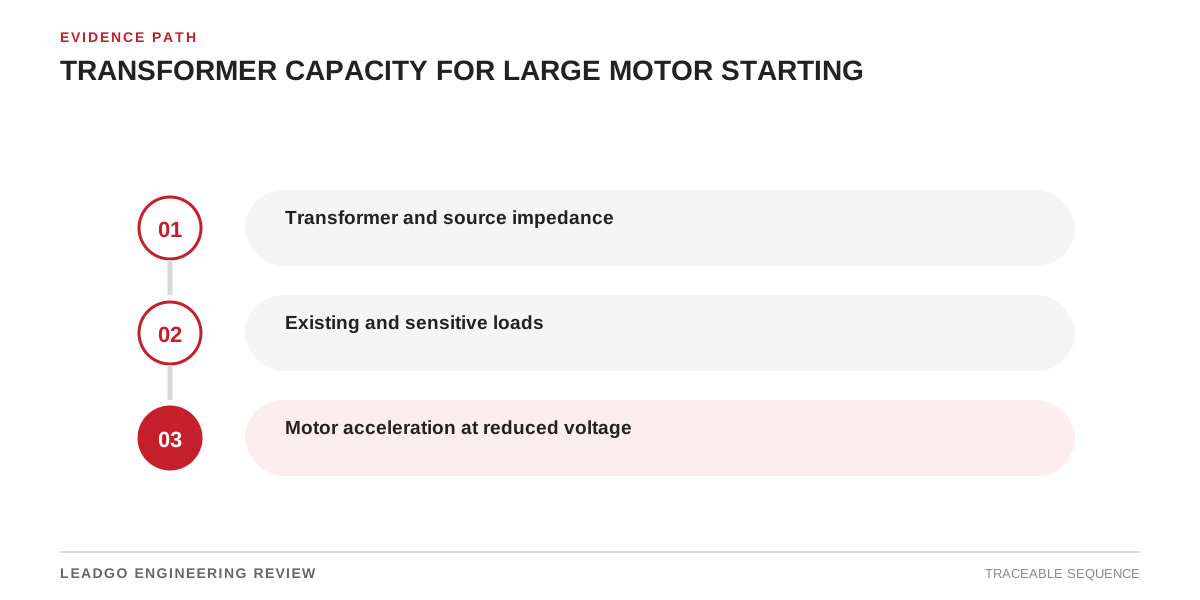
Asking whether a transformer is “large enough” hides the real question. Starting must keep the supply acceptable for other loads and preserve enough voltage at the motor for the driven equipment to accelerate.
Define the electrical boundary
Use the actual operating single-line, not a motor-to-transformer ratio. The source, transformer, feeder and motor form one circuit during start. Existing loads influence pre-start voltage, while sensitive loads may impose the project voltage-dip limit.
| Study block | Minimum data | Why it changes the answer |
|---|---|---|
| Upstream source | Fault level or equivalent impedance, operating configuration | A weak source adds drop before the transformer |
| Transformer | kVA, percent impedance, X/R ratio, tap and loading | Equal-kVA units can behave differently |
| Distribution | Cable or bus impedance, length and parallel paths | Motor voltage can be below secondary-bus voltage |
| Existing load | kW, kvar, motor status and equipment limits | Concurrent demand changes voltage and tolerance |
| Starting motor | Current-speed and torque-speed curves | Locked-rotor current does not describe the run-up |
| Driven equipment | Torque-speed, inertia and unloading sequence | Reduced voltage works only if acceleration completes |
Couple voltage drop to acceleration
Calculate network voltage during successive parts of the start, then use that terminal voltage in the motor torque model. If reduced torque extends acceleration, high current persists longer and the electrical study must reflect that duration.
A reduced-voltage starter can lower source current but also changes motor torque. A soft starter controls current through applied voltage; a variable-frequency drive changes voltage and frequency. Compare options at the driven load, not by current reduction alone.
Check three outcomes
First, confirm positive accelerating torque across the speed range. Second, confirm acceptable voltage for contactors, controls, protection and other loads. Third, confirm transformer and feeder short-duration duties remain within project and supplier limits.
The continuous loading check remains necessary. Successful starting does not excuse excessive steady demand, and spare kVA does not prove acceptable transient voltage.
Verify assumptions on the first start
Record the approved model revision, transformer tap, switching configuration, concurrent loads and starter settings. Capture motor-terminal voltage and current on a common timebase with acceleration time or speed.
Compare the trace with the study. A deeper dip or slower run-up may indicate a weaker source, incorrect tap, unexpected feeder impedance, excess load torque or a starter that does not deliver the assumed voltage.
Approval rule
Approve only when the full-network model shows acceptable voltage for affected equipment and the motor accelerates inside its thermal limit at predicted terminal voltage. Keep the result conditional while source strength, transformer impedance or load torque remains unverified.