
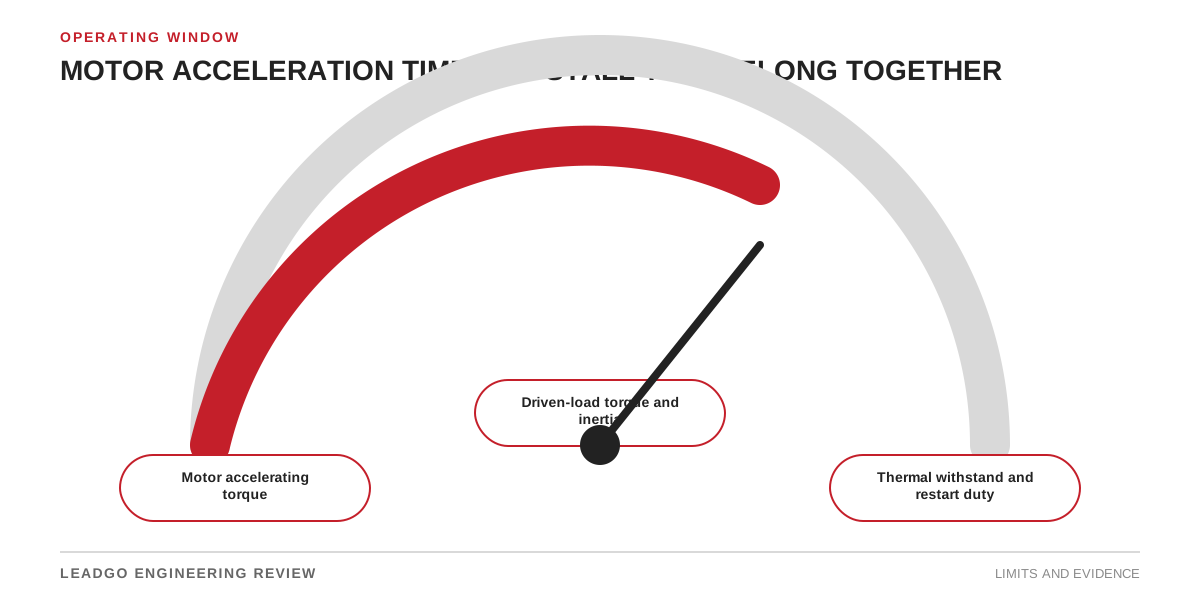
A motor can have adequate rated power and still fail to accelerate. Starting succeeds only while motor torque stays above load torque long enough to reach operating speed, without exceeding thermal withstand or the protection setting.
Replace one time with a torque-speed case
Collect the motor curve at proposed terminal voltage and the driven-load curve for the real starting condition. Add motor inertia and load inertia referred to the motor shaft.
Acceleration time = integral of combined inertia divided by accelerating torque over the speed range.
Accelerating torque at each speed is motor torque minus load torque. A practical study divides the speed range into intervals. It must not substitute rated torque for the changing curve.
Test what lengthens acceleration
| Case | Model change | Decision |
|---|---|---|
| Minimum starting voltage | Recalculate motor torque at predicted terminal voltage | Confirm positive torque margin |
| Maximum process resistance | Use the credible maximum load curve | Confirm acceleration before the thermal limit |
| Maximum combined inertia | Include tolerances and coupled masses | Confirm time and shaft-train data |
| Hot restart | Apply confirmed hot withstand and start sequence | Define restart interlock and cooling delay |
| Unloading failure | Model failure of a valve, damper or bypass | Decide whether starting must be inhibited |
Induction-motor torque is voltage-sensitive. A nominal-bus calculation can be optimistic when starting current depresses the supply. The electrical and mechanical models must use the same terminal-voltage assumption.
Separate stall detection from acceleration
A start-time element supervises duration. A locked-rotor element may use current, a speed-switch input or another criterion. ABB’s 615 documentation presents start-up supervision and locked-rotor protection as distinct functions. One timer cannot identify every failure mode.
Choose pickup and time after approving the acceleration study. Confirm how the relay detects start, resets at running speed and responds to a failed speed switch.
Record the margin
State calculated acceleration time, permitted cold and hot stall time, relay operating time and the margin between them. Name every assumption: voltage, tap, load, inertia, starting method and ambient condition.
During commissioning, capture current, terminal voltage and speed or a reliable running indication on one timeline. If measured acceleration is longer, investigate before widening the trip time.
Approval rule
Approve only when the worst credible case retains positive torque margin, finishes inside thermal withstand and leaves separation for protection tolerance and operating variation.