
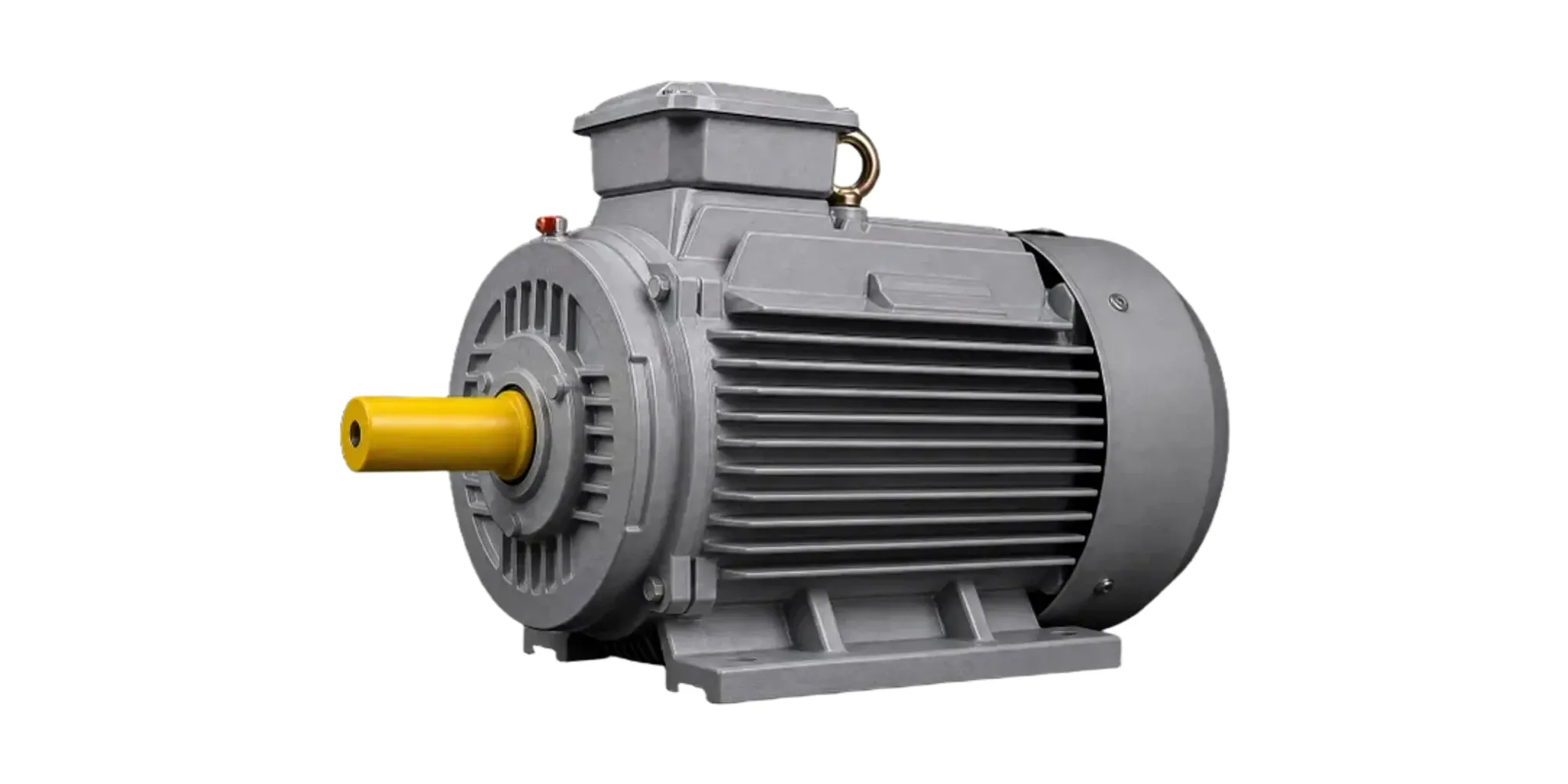
Two specifications land on the same desk: one motor at IP66, one at IP67. The second number is bigger, so the second motor must be the safer choice. That inference is wrong, and the standard says so in a single sentence most people never read.
Direct answer
An IP designation has two characteristic numerals, and they answer two unrelated questions:
- The first numeral — protection against solid objects, and protection of people against contact with live or moving parts inside the enclosure.
- The second numeral — protection against the harmful effects of water.
For most of the range, a stated degree implies every lower degree beneath it. Above the second numeral 6, that implication is explicitly withdrawn.
The first digit protects two different things
This is the half that gets forgotten. IEC 60034-5:2020 clause 5.1 says the first characteristic numeral indicates the degree of protection provided to persons and to the parts of the machine inside the enclosure.
“Excluded” in the standard’s sense means a part of the body, a tool or a wire held by a person either will not enter the machine, or, if it enters, that adequate clearance is maintained from live parts or dangerous moving parts. Smooth rotating shafts and similar parts are not considered dangerous.
| First numeral | Excludes | Contact protection |
|---|---|---|
| 0 | No special protection | None |
| 1 | Solid objects greater than 50 mm | A large surface of the body, such as a hand — but not deliberate access |
| 2 | Solid objects greater than 12 mm | Fingers or similar objects not exceeding 80 mm long |
| 3 | Solid objects greater than 2.5 mm | Tools or wires exceeding 2.5 mm diameter |
| 4 | Solid objects greater than 1 mm | Wires or strips |
| 5 | Dust — protected, not excluded | Full protection |
| 6 | Dust — ingress totally prevented | Full protection |
So IP55 is not dust-tight. Five is dust-protected; six is the degree at which ingress of dust is totally prevented. The standard adds a caution worth quoting into any specification argument: the brief descriptions in the second column of the table cannot be used to specify the type of protection. The definition column is the specification; the label is shorthand.
The second digit is a sequence of specific water tests
| Second numeral | Protected against |
|---|---|
| 1 | Vertically dripping water |
| 2 | Dripping water with the machine tilted up to 15° |
| 3 | Water sprayed at up to 60° from vertical |
| 4 | Water splashing from any direction |
| 5 | Water projected by a nozzle from any direction |
| 6 | Water from heavy seas, or powerful jets |
| 7 | Immersion under stated conditions of pressure and time |
Each is a different test rig, not a stronger version of the previous one.
Where the ladder stops working
Clauses 5.2 and 6.2 set out an implication rule, and then 6.2 carves a hole in it:
- First numeral, and second numerals up to and including 6 — a stated degree implies every lower degree, so the tests for those lower degrees are not required, except in case of doubt.
- IPX7, IPX8 and IPX9 — compliance must not be assumed to carry the lower degrees with it.
That is the whole reason IP67 does not answer a question about hose-down washing. Immersion and high-pressure jets stress an enclosure in different ways — a seal that holds against static head can fail against a directed jet. A wash-down site that also floods needs both degrees stated, which in practice appears as a dual designation rather than a single higher number.
It is also why “our motor is IP68, so it covers everything below” is not a claim the standard supports.
Two clauses that surprise people
External fan guards. Clause 5.3 requires the blades and spokes of fans external to the enclosure to be protected by guards. The guard test is tied to the machine’s own rating: a 50 mm sphere test at IP1X, and a finger test from IP2X through IP6X, with the rotor slowly rotated during the test.
Drain holes. Clause 5.4 deals with a real field practice — running a motor with its drains open. Drains intended to be open on site are kept open during testing, and a drain counts as open as long as no breather or plug is fitted. Then two specific allowances: a machine rated IP3X or IP4X that is intended to run with open drain holes may have drains complying with IP2X; a machine rated IP5X intended to run with open drains shall have drains complying with IP4X.
That last pair matters on real installations, because opening a drain to let condensate out is a maintenance decision that quietly changes what the enclosure is.
Dust: the rating is deliberately generic
Table 2 carries a note that is easy to skim past and important on real sites: the degree of protection against dust defined by the standard is a general one. Where the nature of the dust is specified — particle dimensions, or fibrous particles, for instance — test conditions can be determined by agreement between manufacturer and user.
In other words, if your dust is unusual, the IP number on its own is not the end of the conversation. This is also the seam where IP and explosion protection meet: combustible dust is handled by a separate protection system, not by a higher first numeral.
What an IP rating does not tell you
- Not explosion protection. Ex protection is a different system with its own standards, marking and certification. A motor for a classified area needs both, and neither implies the other.
- Not corrosion resistance. Salt fog, chemical attack and paint specification are separate questions.
- Not cooling. How heat leaves the machine is the IC code, a different designation entirely — carried, as it happens, in the same standards that carry IP.
LEADGO’s standard industrial series are built to IP55 with IP65 and higher available on request; the explosion-proof range carries an Ex marking in addition to its IP rating, because those are two separate specifications on one nameplate. Ask for both against the clause, and where the site both floods and gets hosed down, ask for both water degrees explicitly.
Going deeper
- What TEFC actually means — enclosure type, IP rating and cooling code are three statements, not one
- NEMA MG 1 explained — MG 1 carries the same IP system in its Part 5, and the IC cooling code in Part 6
- Explosion-proof motor selection: how to read the marking — the separate specification that sits alongside IP on a hazardous-area nameplate