
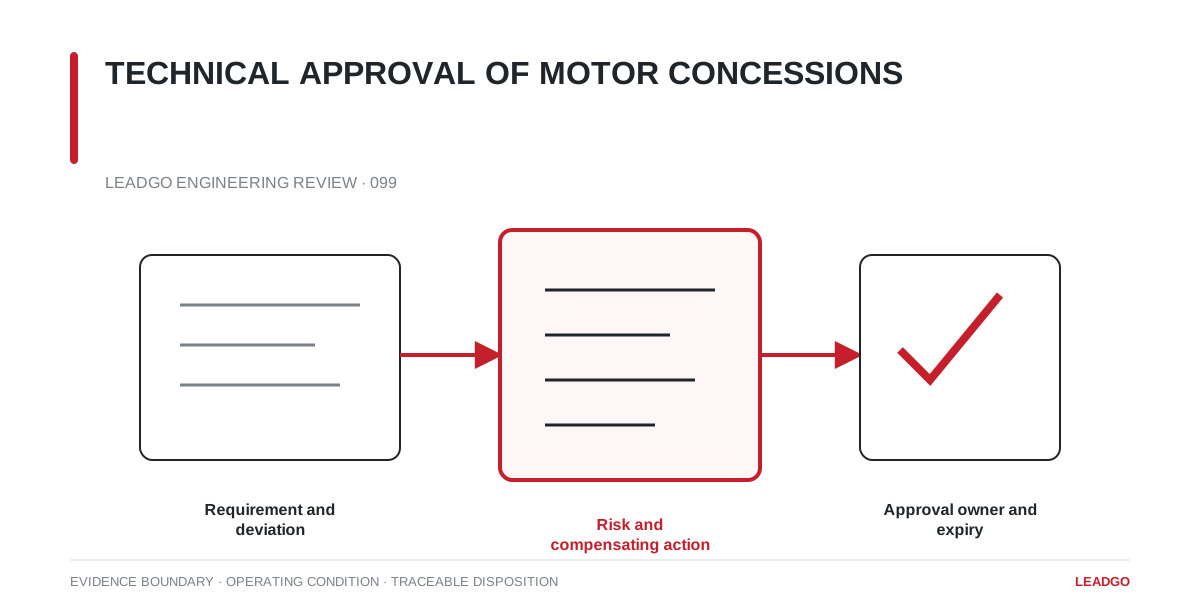
A concession is a decision to accept a defined departure from a requirement. It is not a general statement that the motor is “technically acceptable.” That phrase hides the information needed by the buyer, inspector, commissioning team and maintenance owner: what changed, why it matters, what evidence supports acceptance and where the accepted condition will be recorded.
The strongest time to control concessions is before purchase-order placement. Require bidders to submit a clause-by-clause deviation schedule and state that silence means compliance only if the contract says so. After award, any new departure should enter a controlled process before manufacture, testing or shipment passes the point where correction becomes difficult.
Applicability and statutory limits for motor concessions
This method applies to design deviations, material substitutions, dimensional differences, missed inspection points, test-result departures and documentation gaps. It is useful for project motors, replacement motors and package equipment where several parties share interfaces.
It does not authorise departure from law, certification or a mandatory safety requirement. A project approver cannot waive a statutory obligation or extend a certificate beyond its scope. Hazardous-area protection and other regulated items may require the certificate holder or authority having jurisdiction to participate. When that boundary is uncertain, keep the item open.
Engineering tool: concession decision matrix
Use one row per condition. Combining unrelated departures in one record makes approval ambiguous and closure difficult.
| Review field | Question to answer | Evidence expected | Release consequence |
|---|---|---|---|
| Exact requirement | Which clause, drawing note, data-sheet value or ITP step applies? | Controlled document and revision | No review without a traceable baseline |
| Actual condition | What was offered, manufactured or measured? | Drawing, material record, test result or inspection report | Define facts before discussing acceptance |
| Scope | Which tag, serial number, component and quantity are affected? | Equipment list and traceability record | Prevent accidental fleet-wide approval |
| Function affected | Does it alter starting, running, cooling, protection, fit or maintenance? | Calculation, curve, interface review or engineering note | Identify disciplines that must review |
| Compliance boundary | Is a code, certificate or legal obligation involved? | Applicable certificate and requirement | Escalate; do not waive locally |
| Consequence | What can happen during installation, operation or maintenance? | Risk assessment tied to duty | Establish severity and detectability |
| Compensating action | What restores an acceptable boundary? | Rework plan, inspection, test or operating restriction | Make conditional acceptance measurable |
| Approval authority | Who owns the affected requirement and risk? | Project authority matrix | Avoid approval by an uninvolved reviewer |
| Closure evidence | What proves the condition was completed? | Signed verification and updated final record | Keep release on hold until closed |
The matrix is not a scorecard. A low-cost deviation with a certification consequence may require rejection, while a visible dimensional difference may be accepted after interface confirmation. The decision follows consequence and evidence, not convenience.
Classify the departure before deciding
Start by separating four conditions. A clarification explains an ambiguous requirement without changing it. A deviation is proposed before the item is made. A nonconformity records that the delivered or manufactured condition does not meet the requirement. A concession is the authorised disposition accepting that condition, usually with limits or actions.
This distinction matters because the available choices change with timing. Before manufacture, the buyer may compare an alternative on equal terms. After manufacture, schedule pressure can bias the decision. The record should preserve the same technical threshold even when recovery cost has increased.
Nine-step disposition workflow
- Freeze the baseline document and revision. Copy the relevant clause into the record rather than paraphrasing it.
- Identify every affected motor, component and interface. Include tags and serial numbers when available.
- Describe the actual condition in measurable language. Replace “minor difference” with dimensions, material designation, measured result or missing activity.
- Screen the compliance boundary. Stop if acceptance would conflict with certification, law or a mandatory project rule.
- Ask each affected discipline to state the consequence. Electrical, mechanical, controls, civil, process and maintenance reviewers may see different risks.
- Compare correction, replacement and conditional acceptance. Include the verification needed for each route.
- Assign an approver who owns the requirement and has authority for the consequence.
- Record conditions, owner and due milestone. Conditional acceptance without a closure point is an unresolved action.
- Update the final data sheet, drawings, test records, spare-parts data and data book where the accepted condition affects them.
Approval failures that create hidden liability
The first error is approving a supplier’s explanation rather than the condition. “No effect on performance” is a claim; it needs a calculation, test or interface analysis tied to the purchased duty.
The second is allowing one approval to drift across similar motors. Different ambient conditions, starting methods, driven loads or certificates can make the same departure acceptable on one tag and unacceptable on another.
The third is treating schedule impact as technical evidence. Delivery urgency is a project consideration, but it does not demonstrate temperature margin, starting capability, mechanical fit or certification compliance.
The fourth is closing the concession when the form is signed. Closure occurs when required actions are verified and downstream documents reflect the accepted condition.
Supplier evidence pack for a concession
Ask for the exact requirement reference, proposed or actual condition, reason for departure, affected serial numbers, comparison with the compliant design, calculations and test evidence, certificate impact statement, drawings marked with the change, proposed corrective or compensating action, schedule for completion and responsible signatory.
For a material substitution, request material designation, properties relevant to the duty, traceability and effect on temperature, corrosion, strength and repair. For a missed test or inspection, request the reason, available records, whether equivalent evidence exists and a recovery plan. For a performance departure, require curves and tolerances at the agreed supply and duty conditions rather than a catalogue statement.
Acceptance wording that survives handover
A useful disposition states one of four outcomes: rejected; more information required; accepted for the listed equipment without further action; or accepted subject to named conditions. It also states what the decision does not cover. For example, acceptance of a terminal-box orientation does not imply approval of cable routing unless that interface was reviewed.
Write conditions so that another person can verify them without interpreting intent. “Improve protection” is not closable; “install the approved guard shown on drawing revision C and submit the signed dimensional inspection record before shipment release” identifies the action, evidence and milestone. Where an operating restriction is accepted, carry it into the manual, nameplate or site procedure appropriate to the risk instead of leaving it only in project correspondence.
The final record should allow a maintenance engineer years later to answer three questions: what requirement changed, why the condition was accepted and where the installed configuration is documented. If the concession cannot answer those questions, the project has transferred uncertainty into operation.
RFQ and purchase-order checklist
- Require a complete deviation schedule with the bid.
- Define the post-award concession workflow and approval authority.
- State that manufacture at risk does not create automatic acceptance.
- Preserve supplier responsibility despite buyer review.
- Link conditional concessions to inspection or shipment release points.
- Require accepted departures to appear in as-built records.
Before commercial closure, reconcile the concession register with the final document register and shipment-release record. Any entry still marked “accepted with conditions” should show either completed evidence or a formally transferred site action with an owner. This last reconciliation prevents a technically sound decision from becoming an invisible handover gap.
A disciplined concession process does not eliminate change. It makes change visible, reviewable and traceable to the motor that will actually be installed.