
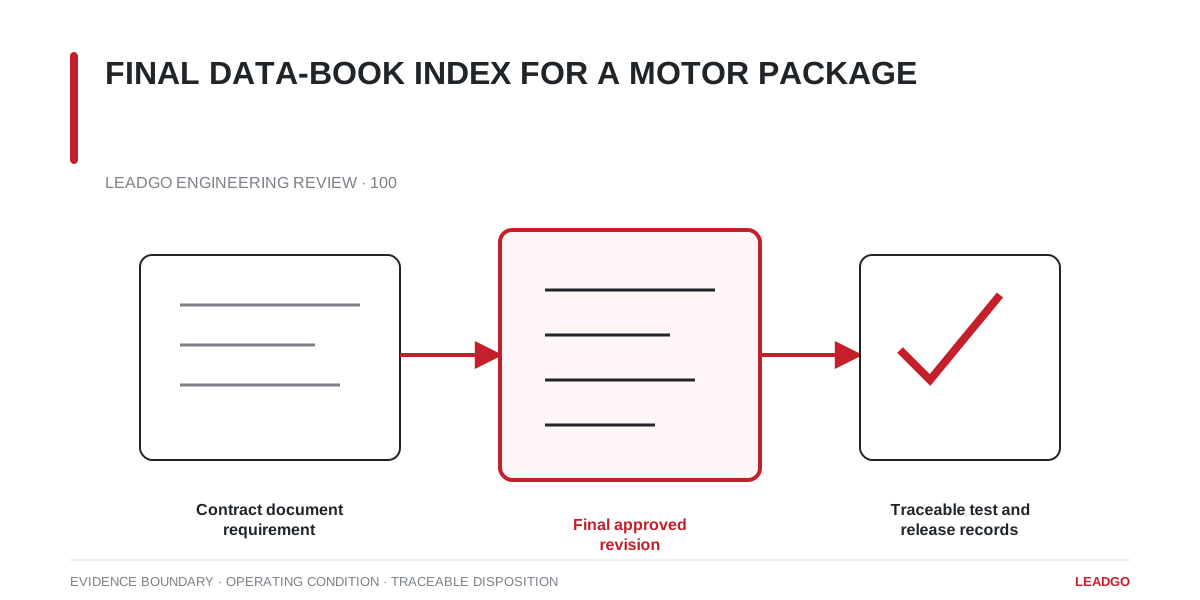
The final data book is the buyer’s evidence package for the motor that was actually manufactured. It should support installation, protection settings, commissioning, maintenance, repair and future replacement. A folder containing many PDFs can still fail that purpose if records are preliminary, belong to another motor or cannot be connected to serial numbers and accepted deviations.
Data-book quality is largely decided before production. If the purchase order asks only for a “standard dossier,” the supplier and buyer may hold different expectations about native files, test detail, certificates, language and as-built status. Define the index early, then use it as a live closure register.
Applicability and project-risk limits for the dossier
This method suits project motors, high-voltage machines, hazardous-area motors, custom designs and package equipment with formal handover requirements. A catalogue replacement motor may justify a shorter dossier, but it still needs enough information to prove identity, rating, connection, installation and warranty basis.
The index does not create evidence that never existed. A late request cannot reconstruct an unwitnessed test or restore missing material traceability. Those gaps require a controlled disposition, not a blank placeholder labelled “not applicable.”
Engineering tool: final data-book acceptance matrix
| Document family | Minimum acceptance check | Identity link | Operational use | Typical rejection condition |
|---|---|---|---|---|
| Final motor data sheet | Guaranteed values and approved deviations incorporated | Tag, model and serial number | Ratings and replacement basis | Offered values remain provisional |
| General arrangement | Final dimensions, mass, lifting and access details | Tag and drawing number | Installation and removal | Superseded revision included as current |
| Foundation and loads | Bolt pattern, static and dynamic loads, directions | Motor and driven package | Civil verification | Loads differ from construction issue |
| Shaft and coupling drawing | Datums, tolerances, key and permissible loads | Shaft or motor identity | Alignment and coupling replacement | Interface not matched to supplied motor |
| Terminal diagram | Main and auxiliary terminal markings and links | Terminal-box arrangement | Cabling and fault finding | Generic diagram conflicts with build |
| Performance curves | Agreed supply and duty basis identified | Motor design or serial number | Starting and system studies | Catalogue curve without tolerance basis |
| Routine and specified tests | Method, conditions, results and acceptance stated | Serial number | Release and future comparison | Results cannot be assigned to the motor |
| Certificates | Scope, edition and equipment marking align | Certified type and marking | Compliance verification | Certificate family does not cover product |
| Material and component records | Required traceability and approved substitutions shown | Component and motor serial | Repair and compliance | Batch or component link is missing |
| Concessions and NCRs | Final disposition and actions closed | Affected tags and serials | Understand as-built departures | Approval exists but drawing was not updated |
| Spare-parts list | Manufacturer references and interchangeability boundary | Motor configuration | Maintenance planning | Generic list omits variant-specific parts |
| Preservation instructions | Storage period, inspections and renewal actions | Shipment and motor | Warehouse control | Instructions end before expected storage |
Add columns for required format, responsible reviewer, contractual due date, current status and closure evidence. The final index should show no unexplained gaps.
Build the index from the contract
Start with the purchase specification, data sheet, approved document register, inspection plan and correspondence that formally changed the scope. Do not use the supplier’s final table of contents as the sole baseline. Reconcile each contract deliverable to one controlled entry and record approved “not applicable” decisions with their basis.
Group documents by their use rather than by the supplier department that produced them. An installer should be able to find dimensions and terminal details; a commissioning engineer should find settings inputs and test baselines; a maintainer should find bearings, seals, lubrication, sensors and spare references.
Ten-step dossier acceptance sequence
- Freeze the required-document baseline and approved changes.
- Compare the submitted index line by line with the vendor document register.
- Check every file opens, is legible and matches the index title and revision.
- Verify tag, model and serial-number traceability where machine-specific evidence is required.
- Confirm final or as-built status. Resolve “approved with comments” records before handover.
- Cross-check key values across the data sheet, nameplate, curves, drawings and test reports.
- Link every accepted concession to updated documents and affected equipment.
- Confirm certificates and reports cover the supplied configuration rather than a related product family.
- Record missing, duplicate, superseded and corrupt files as actions with owners and due dates.
- Issue a signed index or transmittal identifying the accepted final set.
Cross-document checks that expose hidden gaps
A document can look correct alone and still conflict with the package. Compare rated voltage, frequency, output, speed, duty, enclosure, cooling method, insulation system and mounting across the final data sheet and nameplate record. Compare shaft dimensions with the coupling drawing. Compare terminal markings with the connection diagram. Confirm sensor quantities and types align between the general arrangement, terminal plan and instrument schedule.
Test reports deserve the same treatment. The serial number, test date, procedure revision, supply conditions, connection and acceptance criteria should be visible. If a type-test report from another design is contractually permitted, its applicability statement should explain why it represents the supplied motor.
Common data-book errors that survive page-count reviews
One frequent failure is accepting volume instead of completeness. Hundreds of pages do not compensate for a missing protection input or final foundation drawing. Another is retaining multiple revisions without a clear current-status marker. Maintenance staff may later select the wrong drawing.
Scanned pages can also destroy usability. Searchability, bookmarks and consistent filenames matter in large dossiers, but polished navigation cannot replace technical content. Native schedules or curves may be needed where the contract requires future analysis.
The most serious error is closing the register at shipment while conditional concessions, open test actions or red-line drawings remain unresolved. If shipment must proceed, identify the open package separately and preserve the agreed release authority.
Supplier submission fields that make records usable
Require the final index in an editable register plus the agreed document formats. Ask for document number, title, revision, status, equipment tag, model or serial reference, submission date and superseded-document relationship. For tests, require procedure, calibrated instrument references where specified, conditions, results, acceptance and sign-off. For certificates, require the complete referenced schedule or annexes.
Also request a list of vendor manuals and component data that apply to the supplied configuration, not a library of every option. Spare-part references should identify variant boundaries. Preservation records should show what was done before shipment and what remains for storage.
Define the electronic delivery structure as well as the content. Stable filenames, bookmarks, a searchable index and a clear revision convention reduce retrieval errors. If native schedules, curves or settings files are required for future engineering work, list them separately from signed PDFs. Confirm that links are relative or self-contained so the dossier still works after it leaves the supplier’s document platform.
Handover test: can the next team use it?
Before acceptance, give the dossier five practical questions: Which drawing controls the foundation? Which curve supports the starting study? How are space heaters and winding sensors connected? What was the factory test baseline? Which accepted departures affect replacement or maintenance?
If reviewers cannot answer from the index and linked records, the book is not ready for handover. A final dossier succeeds when it reduces future uncertainty, not when it merely satisfies a document count.
Archive the accepted index with its transmittal and checksum or other project-approved integrity control. Keep superseded records only in a clearly separated history area. The operating copy should lead users directly to the final configuration while preserving enough audit history to explain approved changes.