
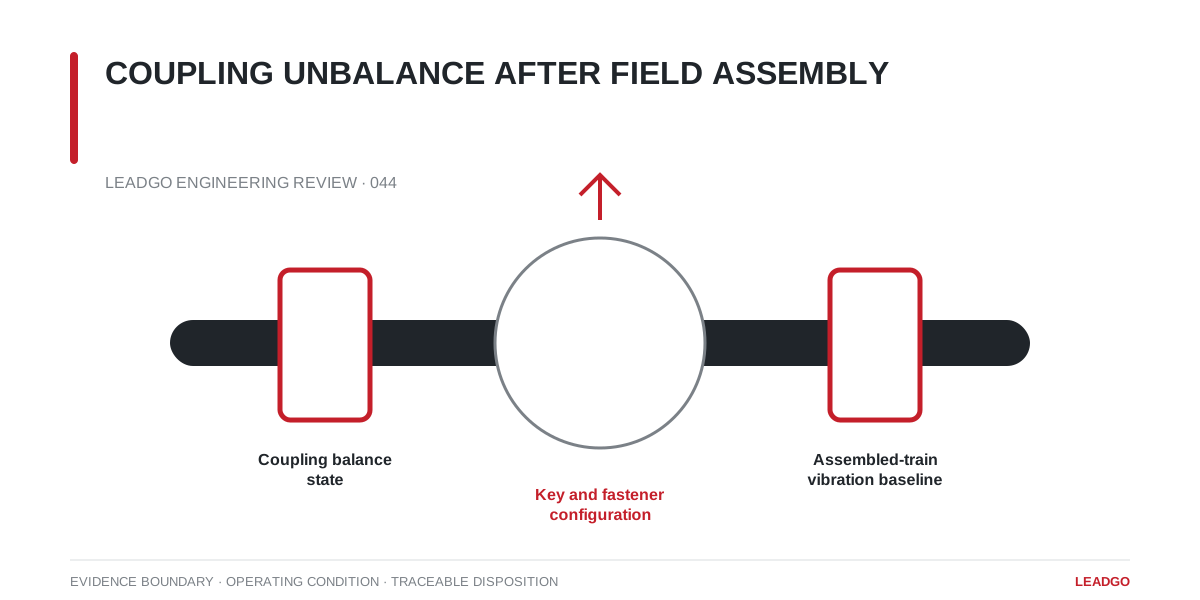
Balance quality belongs to a defined assembly. Replacing bolts, changing a key, rotating an indexed spacer or leaving shipping hardware in place changes that assembly even when every individual component looks serviceable.
| Field item | Verification | Hold point |
|---|---|---|
| Hub and spacer identity | Part number, match marks and orientation | Unidentified or mixed components |
| Key convention | Length, fit and configuration used for balancing | Field key differs from documented state |
| Bolts and fitted parts | Correct type, complete set and specified tightening | Substituted or incomplete hardware |
| Balance weights | Location and secure condition | Missing, loose or damaged weight |
| Final train | Alignment and vibration baseline at stated duty | Abnormal response remains unexplained |
Keep balance and alignment records separate
Complete mechanical fit and alignment before evaluating running vibration. Record speed, load, temperature and measurement locations with the baseline. If coupling work changes the vibration, compare phase and spectrum data before ordering motor rotor balancing.
When the documented balance state cannot be reconstructed, refer the complete coupling assembly to the coupling manufacturer or qualified balancing provider.
Related reading: motor shaft dimensions and coupling fit and motor commissioning baseline data.