
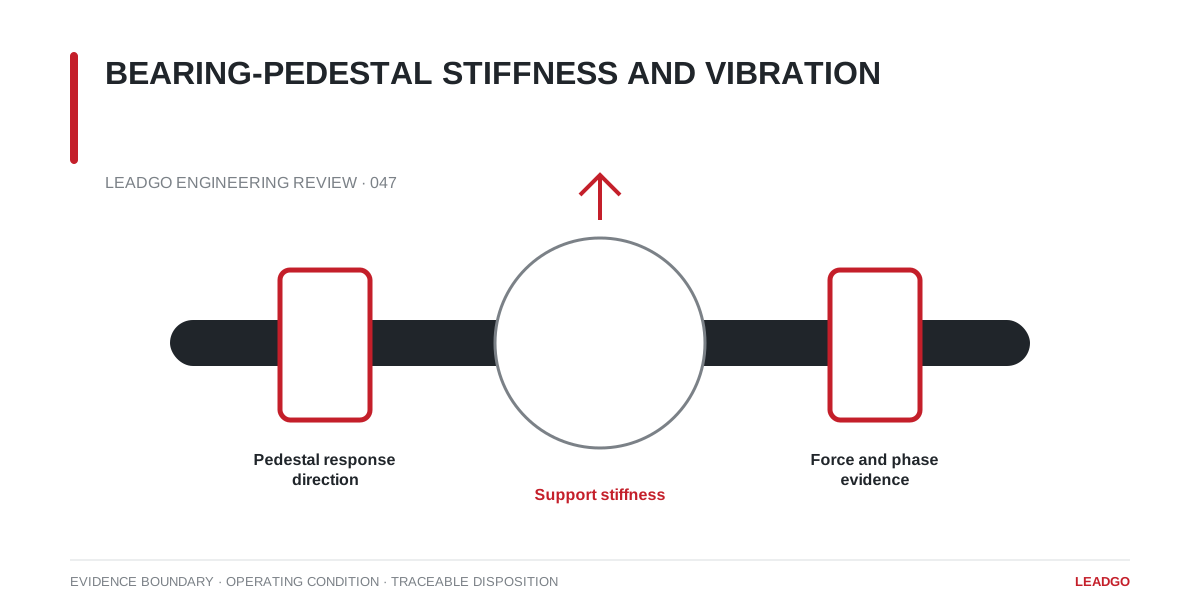
A flexible pedestal can amplify a modest force, while a rigid pedestal can transmit force from another machine. The vibration value alone does not identify the source.
| Pattern | Check next | Premature action to avoid |
|---|---|---|
| One direction dominates at one pedestal | Base, grout, fasteners and local stiffness | Balancing from amplitude alone |
| Similar phase and response across connected structures | Transmitted force or common structural mode | Replacing the motor bearing first |
| Response changes sharply with speed | Resonance or speed-related forcing | Treating one operating point as universal |
| Movement at foot or joint | Soft foot, looseness or cracked support | Masking movement with added mass |
Compare matched operating states
Record sensor orientation and location, speed, load and machine configuration. Inspect baseplate joints, grout, soleplates and hold-downs. Phase and run-up or coast-down information can help separate a structural response from a steady rotating force when the equipment and safety procedure permit those tests.
Any structural modification requires review of the load path and alignment. Re-measure vibration and alignment after the final repair.
Related reading: motor vibration fault detection and shaft alignment before startup.