
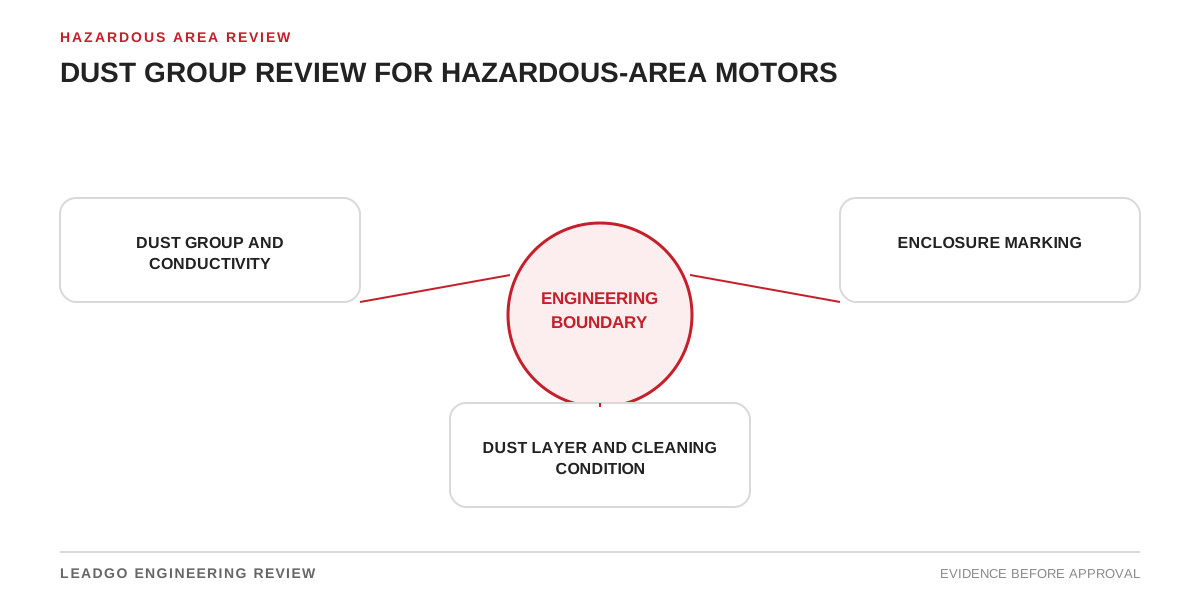
Match motor marking to the dust group and the site’s layer and housekeeping assumptions. A review that records only the final number leaves the source, condition and responsibility unclear; the hazardous-dust selection record must identify this boundary explicitly.
Set the boundary before choosing a value — hazardous-dust selection
Hazardous-area suitability is an equipment-and-installation question. Area classification, gas or dust group, temperature, ambient range, cable entry and accessories must align with the certificate and local installation rules; a familiar enclosure appearance is not evidence of compliance; the hazardous-dust selection record must identify this boundary explicitly.
State the duty, site condition and equipment boundary before comparing options. Keep the model and document revision with manufacturer data; identify the engineering owner and operating case for plant inputs; the hazardous-dust selection record must identify this boundary explicitly.
Three checks that control the answer — hazardous-dust selection
| Step | Review point | What to confirm |
|---|---|---|
| 1 | Dust group and conductivity | Record dust group and conductivity with its source, revision and responsible reviewer. |
| 2 | Enclosure marking | Define enclosure marking and identify the controlled document or measurement that supports it. |
| 3 | Dust layer and cleaning condition | Confirm dust layer and cleaning condition under the stated operating condition rather than a nominal assumption. |
Read the three items together. A change at one boundary can move stress into the supply, controls, bearings, cooling system or driven equipment; record that trade-off with the decision; the hazardous-dust selection record must identify this boundary explicitly.
Where the review often fails — hazardous-dust selection
- Borrowing an unverified input. Using dust group and conductivity from a similar motor or site. A similar frame or power does not prove that the operating boundary is the same; the hazardous-dust selection record must identify this boundary explicitly.
- Treating an interface as a late detail. Closing the review before dust layer and cleaning condition is documented. That moves an unresolved interface into manufacture, installation or commissioning.
If an input is unavailable, request the exact drawing, calculation, test result or site measurement needed to close it; the hazardous-dust selection record must identify this boundary explicitly. A visible open action is safer than a borrowed number.
Keep a usable project record — hazardous-dust selection
Keep these items with the approval or maintenance record:
- source and operating condition for dust group and conductivity
- dated evidence for enclosure marking
- approved limit or disposition for dust layer and cleaning condition
The record should show revision, date, reviewer and open assumptions. Photographs and field notes can support the decision, but controlled drawings, calculations and test reports remain the governing evidence where specified; the hazardous-dust selection record must identify this boundary explicitly.
Decision rule — hazardous-dust selection
Match motor marking to the dust group and the site’s layer and housekeeping assumptions. Apply that rule across the full operating envelope. If evidence is missing, name the document, measurement or responsible party required before manufacture, shipment, installation or energisation; the hazardous-dust selection record must identify this boundary explicitly.
Going deeper — hazardous-dust selection
- Explosion-Proof Motor Selection: How to Read the Marking.
- Explosion-Proof Cable Glands: Part of the Protection System.
Site-to-marking reconciliation matrix — hazardous-dust selection
Complete this matrix with the hazardous-area specialist before a motor is accepted. Do not let the equipment vendor infer missing site data.
| Site input | Evidence source | Motor/certificate item to reconcile | Open-action trigger |
|---|---|---|---|
| Dust group and conductivity | Classification dossier and material data | Complete protection marking and certified dust group | Material identity or conductivity is assumed |
| Zone or protection level requirement | Approved area drawing and basis | Protection level shown in marking/certificate | Location boundary is unresolved |
| Dust cloud/layer temperature basis | Classification study and process data | Surface-temperature marking and certificate conditions | Layer thickness or method differs from site basis |
| Ambient range | Site design data | Certified ambient range, including accessories | Site value lies outside certificate |
| Ingress and cleaning conditions | Environment and housekeeping practice | Enclosure protection and installation requirements | Jet cleaning, abrasion or water exposure is not covered |
| Entries, plugs and sensors | Cable schedule and instrument design | Certified accessories, threads and special conditions | Components are outside approved scope |
The matrix is a reconciliation tool, not a substitute for competent hazardous-area classification. Each row must identify the exact document revision. A marketing description such as “dust-proof” or “explosion-proof” does not close any row.
Work from the dust, not from the catalogue — hazardous-dust selection
First confirm what material can be present during normal operation and foreseeable abnormal releases. The classification team should establish relevant dust properties and the location boundary. If multiple products or contamination states exist, review the credible limiting condition rather than selecting the most convenient sample.
Then define accumulation assumptions. Surface-temperature suitability depends not only on a cloud value but also on layers, their thickness and the cleaning regime used in the classification basis. A housekeeping statement must be operationally credible: who cleans, how often, which surfaces are accessible, and what happens during production peaks or equipment outage?
Finally reconcile the complete motor package. Space heaters, winding sensors, terminal boxes, encoders, brakes and cable glands can have separate requirements. A compliant main enclosure does not automatically make every accessory suitable.
Certificate and marking review — hazardous-dust selection
Ask for the certificate and its schedule or annex, not only a nameplate photograph. Verify model linkage, protection concept, group, temperature marking, ambient range and every special condition. Check that the offered configuration and accessories are included in the certified scope. Record certificate status using the relevant issuing system rather than assuming a PDF remains valid.
Compare production nameplate marking with approved certificate documents at inspection. Differences in model suffix, ambient range, terminal arrangement or accessory can be meaningful. Do not resolve a mismatch by editing the data sheet alone.
Applicability boundary — hazardous-dust selection
This review is for motors installed where combustible dust can create a classified hazardous area. It does not decide whether an area should be classified, calculate ignition temperatures or approve a protection concept. Those tasks require qualified personnel and the applicable framework for the installation country.
Gas/vapour and dust hazards must be reviewed separately even when both may occur. A gas marking does not establish dust suitability. Hybrid mixtures and unusually thick deposits need specific assessment. Mining applications may use different group and regulatory conventions from surface industries.
Common selection failures — hazardous-dust selection
- Selecting from IP rating alone; ingress protection and explosion protection answer different questions.
- Treating all dust as non-conductive without material evidence.
- Using an ambient range that does not cover winter start or local radiant heat.
- Ignoring accumulation on fan covers and cooling surfaces.
- Substituting glands or stopping plugs without checking certification, thread and installation requirements.
- Assuming regular cleaning while the motor location is inaccessible during operation.
Data to request from suppliers — hazardous-dust selection
Ask the motor supplier for exact marking, certificate and schedule, destination-market declaration documents, permitted ambient range, surface-temperature basis, enclosure/cooling details, accessory certification, cable-entry schedule and special installation conditions. Require a drawing identifying certified terminal boxes, sensors and heaters.
Ask the plant team for the approved classification dossier, dust data source, material changes, layer and cleaning assumptions, ambient range, cleaning method and cable schedule. Any gap should remain a technical query; it should not become a vendor assumption.
Acceptance and lifecycle control — hazardous-dust selection
At receipt and installation, check marking legibility, model identity, enclosure damage, fasteners, entries, plugs, earthing and accessory identity. Retain photographs with tag and serial number. Commissioning should verify protection sensors and the cleaning plan.
The review continues after purchase. Process material, housekeeping, accessories or repair scope can change the original basis. Put the reconciliation matrix in the equipment record so future maintenance can see which conditions keep the motor suitable and which changes require a new hazardous-area review.