
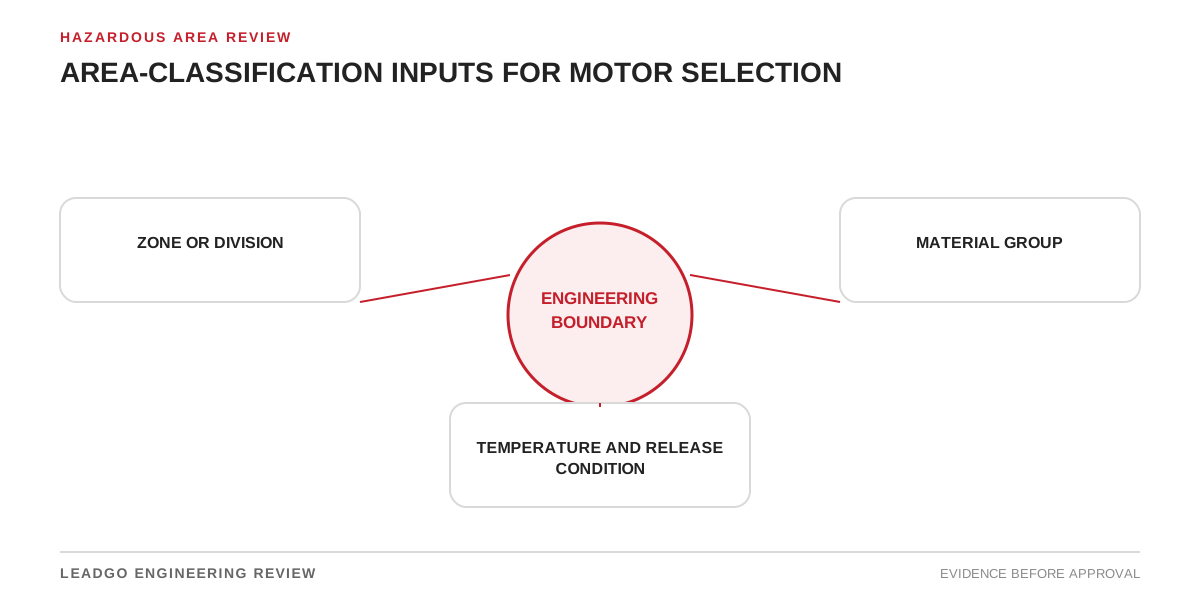
The phrase “explosion-proof motor required” is not a complete specification. It does not identify the classified location, the hazardous material or the temperature limit that the installed equipment must satisfy. Those inputs should come from the site’s approved area-classification dossier, not from a catalogue search.
Translate the classification into purchasing data
| Classification record | What the motor RFQ should state | Why it cannot be guessed |
|---|---|---|
| Equipment location | Tag number and position on the classified-area drawing | Classification can change across a boundary or elevation |
| Gas/vapour or combustible dust | Substance and applicable group | Different substances create different ignition risks |
| Zone or other local classification | Exact designation and governing code | Naming systems are not interchangeable without an engineering basis |
| Temperature requirement | Required temperature class or maximum surface-temperature basis | Suitability depends on the hazardous material and operating case |
| Ambient and site conditions | Minimum/maximum ambient, altitude, outdoor exposure and contamination | The certificate may have conditions or a limited ambient range |
| Installation interfaces | Cable-entry system, earthing, accessories and local inspection requirements | A certified motor can still be installed incorrectly |
Attach the relevant drawing revision or classification schedule to the enquiry. If the motor sits beside a classification boundary, mark its actual location. A plant-wide statement such as “Zone 2 site” is not enough to establish the requirement at one equipment tag.
Keep gas and dust logic separate
Gas/vapour and dust classification use different grouping and protection considerations. Do not convert one into the other by analogy. A location can also contain more than one hazard, so the RFQ must retain every applicable requirement rather than selecting the more familiar one.
The equipment marking, certificate and schedule should then be checked against the documented classification. Review any certificate conditions of use and confirm that terminal boxes, heaters, sensors, cable entries and other supplied accessories remain within the certified arrangement.
Questions that stop a quotation
A responsible supplier should hold the selection open when:
- the RFQ gives a zone but no substance or group;
- the temperature requirement has no process basis;
- the ambient range exceeds, or is absent from, the certification documents;
- gas and dust terminology is mixed without a governing standard;
- a cable gland or accessory is treated as a generic mechanical item; or
- the area-classification drawing revision is unknown.
These are not paperwork defects. Each gap can change the protection concept, marking, accessory selection or installation method.
Close the loop before installation
The purchase record should connect four items: the area-classification source, the motor marking, the certificate schedule and the installed arrangement. Site inspection should confirm that the delivered nameplate matches the approved submittal and that cable entries, earthing and unused openings follow the selected protection method.
For marking interpretation, see how to read an explosion-proof motor marking. For an interface that is often overlooked, review explosion-proof cable glands.