
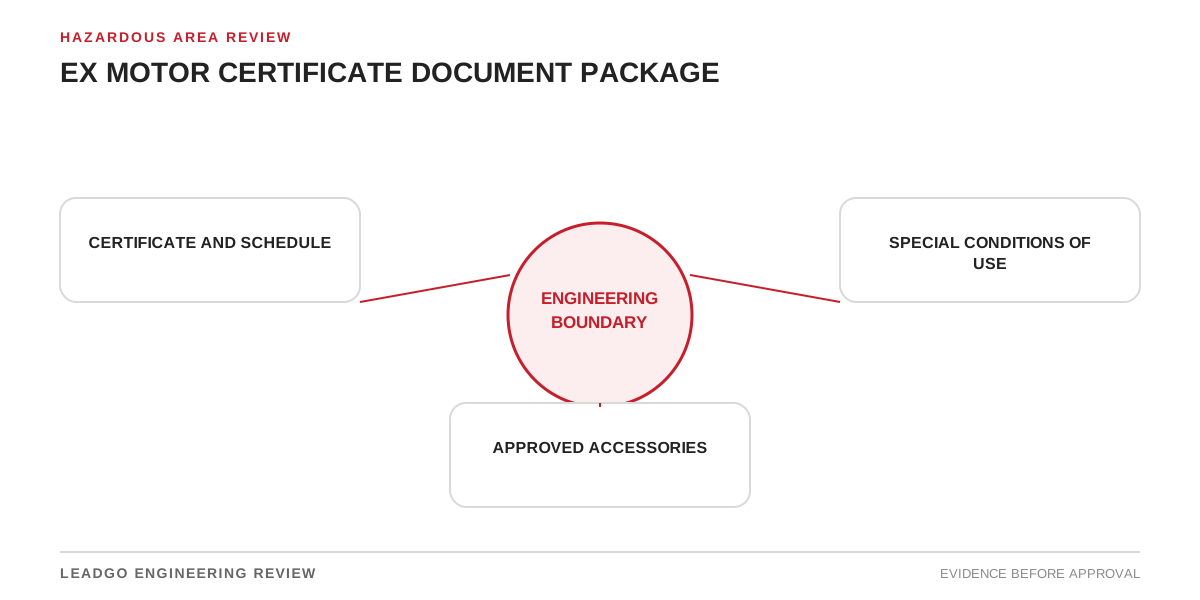
An explosion-protected motor is not approved by a certificate number alone. The defensible purchase record connects the ordered motor to a complete certificate, the hazardous-area requirement, controlled drawings and the accessories that will actually be installed. If any link is missing, a valid certificate for a product family can still be applied to the wrong construction.
This is a document-control problem with engineering consequences. Motor schedules, certificates, cable-gland selections and terminal drawings often move through different workflows. A buyer may receive each item yet never reconcile them against one motor tag. The method below turns that collection into a release package that another engineer can audit later.
Applicability boundary for the certificate package
Use this review for motors intended for gas, vapour or combustible-dust hazardous locations, whether the project calls the equipment explosion-proof, flameproof, increased-safety, non-sparking or by another protection concept. It applies to new purchases, replacement motors, certificate renewals, major repairs and modifications to entries, terminal boxes, sensors or cooling auxiliaries.
The method does not determine whether an area is hazardous. Zone or Division, material group, temperature requirement, equipment protection level, ambient range and installation code must come from controlled project records. Nor does the checklist make different certification schemes interchangeable. The destination jurisdiction and project specification decide which approval is acceptable.
For repaired equipment, use the original design and repair requirements as additional boundaries. A repair report cannot replace missing product certification, and a product certificate cannot prove that a repaired flamepath, winding or entry system has been restored correctly.
Certificate-package reconciliation matrix
Complete every row for the exact purchase item. Record file name, revision and disposition rather than entering a bare “yes.”
| Package item | What it must establish | Reconciliation check | Close when |
|---|---|---|---|
| Area-classification input | Required Zone or Division, group and temperature boundary | Compare with purchase data sheet and marking | Approved plant input is identified |
| Certificate front page | Identity, holder, protection concept and standards | Confirm number and status in the complete set | Legible controlled copy is received |
| Schedule or annex | Covered type designations and construction range | Match ordered type, frame and variant | Ordered motor is explicitly inside scope |
| Special conditions | Restrictions stated by the certificate | Transfer each into design or installation actions | Every condition has evidence and an owner |
| Certified drawings | Controlled construction and interfaces | Check drawing numbers and revisions | Referenced revisions agree |
| Nameplate artwork | Full Ex marking and traceability | Compare with certificate and order identity | Marking is complete and consistent |
| Motor data sheet | Rating, duty, ambient and supply | Compare envelope with certificate limitations | Worst credible duty is covered |
| Terminal-box drawing | Enclosure, terminals and entries | Match box option to certified construction | Ordered arrangement is identified |
| Glands and stopping plugs | Thread, quantity, material and approval basis | Reconcile supplied and site-selected items | Every opening has an approved disposition |
| Sensors and heaters | Accessories and electrical interfaces | Verify coverage and installation instructions | Accessories preserve the certified boundary |
| Converter-duty evidence | Permitted drive, speed-load and protection conditions | Compare with VFD and process duty | Entire operating envelope is supported |
| Instructions | Installation, inspection and maintenance requirements | Confirm ordered variant and applicable language | Site can implement stated controls |
| Production records | Identity and tests for the supplied unit | Link serial or tag to order and certificate family | Traceable release record is available |
| Deviations | Differences from enquiry or certified arrangement | Review technical and jurisdictional impact | Approved disposition is documented |
The matrix is not a request for paperwork by weight. If a row is inapplicable, state why. If one document closes several rows, reference it precisely. The objective is a traceable decision, not a larger transmittal.
Certificate decision steps from enquiry to release
- Freeze the plant hazardous-area input and destination requirement before comparing offers.
- Ask each bidder for the proposed full marking, certificate number and scope, not only a catalogue statement.
- Match the offered type designation to the schedule. Record unresolved suffixes, terminal-box options or frame ranges.
- Extract every special condition and turn it into a design, control, installation or maintenance action.
- Reconcile the data sheet with ambient, duty, starting method, converter operation and auxiliary cooling.
- Review entries, glands, plugs, adapters, sensors and heaters as parts of the protection system.
- Confirm that certified drawing revisions agree across the schedule, supplier drawing list and submitted files.
- Repeat the identity check at final review using the ordered model, nameplate artwork and unit traceability.
- Close deviations before shipment, or retain an approved hold point where physical inspection is required.
This sequence separates selection evidence from manufacturing evidence. A bidder can show that a proposed design is certifiable during enquiry; the final package must still show that the supplied unit is the ordered certified construction.
Common certificate-package errors and their consequences
Approving from a cropped certificate. A front page may omit type ranges and special conditions. The result is an attractive approval record with no proof that the ordered variant is covered.
Searching by certificate number but ignoring revision. An online result can confirm that a number exists, while the supplier’s schedule or drawing references belong to another issue. Keep the reviewed set together.
Treating generic catalogue marking as order evidence. Catalogues screen products. They do not identify the actual terminal box, entry arrangement, accessories or ambient option.
Leaving glands entirely to site without an interface note. Site supply can be acceptable, but the package must state entry threads, unused-opening treatment, environmental needs and approval basis. Otherwise the protection chain stops at the terminal-box wall.
Assuming rated-load temperature classification covers every mode. Starting, converter operation, low-speed cooling, high ambient or frequent starts may create a different thermal case. Review the specified envelope.
Accepting undocumented substitutions. A different box, plug or sensor may look minor. If it affects referenced construction or certified conditions, the supplier must demonstrate its approval basis before release.
Certificate data to request from the supplier
Request a document index that identifies the motor type and order reference. The set should contain the complete certificate and schedule, full marking, certified drawing list, nameplate drawing, dimensional and terminal drawings, data sheet, installation instructions and fitted-accessory list. Ask the supplier to identify special conditions instead of expecting the buyer to discover them across several files.
For VFD operation, request the permitted speed-load envelope, cooling arrangement, required temperature protection, drive restrictions and any cable or filter conditions. For manufacturer-supplied entries, obtain their certificates or declared approval basis and an assembly drawing. For site-supplied entries, obtain the interface requirements needed for selection.
Also request a deviation list. A statement of “no deviation” is useful only when it refers to a defined enquiry revision. If translations are provided, retain the controlled source-language document where required by the scheme or contract.
Certificate acceptance and package-close conditions
Close the review only when the ordered identity falls within the certificate schedule; marking meets the controlled area input; every special condition has a documented implementation; certified drawings agree; and entries, accessories, cooling and converter operation have an approved basis. The final nameplate and document index should link the supplied unit to that decision.
Do not close an open point with “supplier responsibility.” Name the missing evidence, responsible party and due stage. A physical feature can remain a factory or site hold point, but its acceptance method must be stated before shipment.
The retained record should let a future buyer, inspector or maintenance engineer answer four questions without reconstructing email history: What equipment was required? Which certificate covered it? Which conditions controlled installation and operation? What evidence proved that the supplied arrangement complied?