
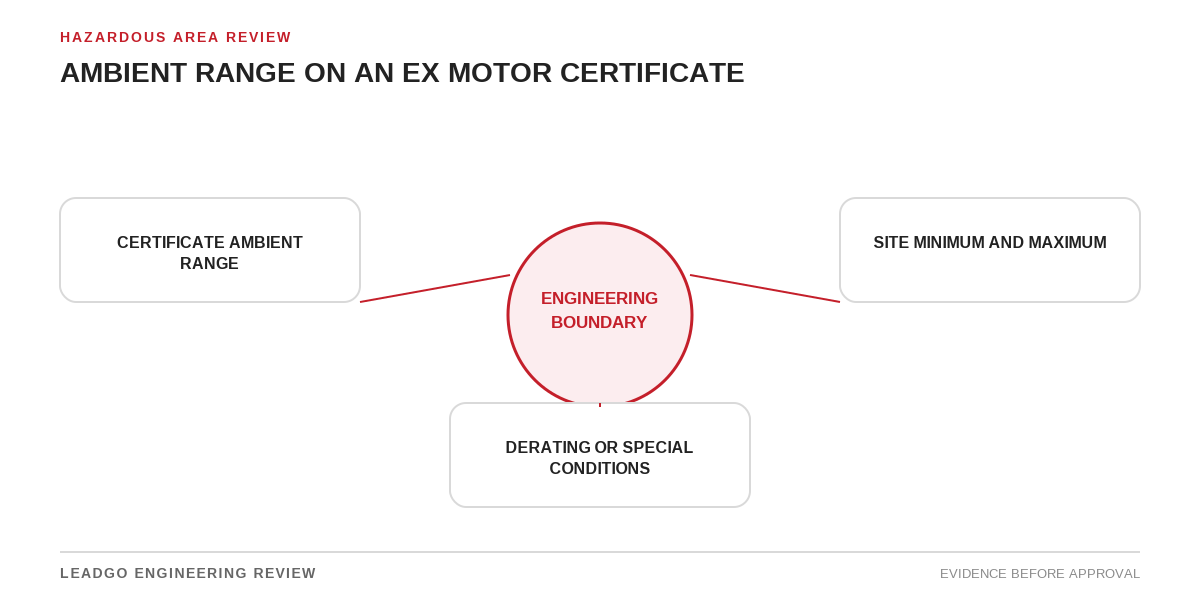
An Ex motor’s ambient-temperature statement is a boundary condition, not a catalogue convenience. A purchasing review should connect the offered motor’s exact certificate and marking to the installation’s expected minimum and maximum conditions, operating duty, and any conditions of use. A value copied from a similar motor, a previous project, or a generic product page does not establish that the offered configuration is suitable.
This guide is a document-review aid. It does not classify an area, approve an installation, interpret a certificate for a regulator, or replace the manufacturer’s instructions and the project’s applicable conformity process. IEC publishes the IEC 60079 series for explosive-atmosphere equipment, while the European ATEX product directive defines its own market scope. The governing scheme and jurisdiction must be determined for the project. Compare the Ex certificate package, review ambient-temperature certificate statements, and check area-classification inputs.
Applicability and review boundary
Start with an equipment identity that can be traced across the offer, nameplate, certificate, drawings and data sheet: manufacturer, model or type, frame or size designation, electrical rating, protection concept, enclosure configuration, accessories and document revisions. The aim is not to infer certification from the product family. It is to verify that the evidence applies to the actual item being purchased and installed.
The certificate and its schedules may state a permitted ambient range, special conditions, or other limitations that matter to selection and installation. The complete marking and certificate must be read together; a partial marking copied into a quotation can omit information that is material to the review. A certificate may also distinguish a certified type from options or components that require separate evidence. Where a motor is supplied with a separately certified accessory, record the accessory identity and its applicable document rather than assuming the motor certificate covers every interface.
The site input must describe the real operating envelope, not only a regional weather statistic. Consider indoor or outdoor location, local radiant heat, nearby process equipment, enclosure or shelter effects, seasonal shutdown, storage before commissioning, washdown, ventilation, altitude if relevant to the manufacturer’s assessment, and the motor’s actual duty. Identify the source and owner for each input. If a process case can produce a different local condition from the normal ambient, keep that case visible for engineering review.
Certificate-to-site review matrix
Use this matrix at technical bid evaluation. It is a procurement control, not a substitute for engineering approval. Write the exact document identifier and revision in the evidence column so that a later reviewer can reproduce the decision.
| Review row | Buyer action | Evidence to request or record | Hold point |
|---|---|---|---|
| 1. Offered identity | Match the offered type, rating and construction to the certificate scope. | Offer line, nameplate data, certificate number and schedule. | Hold if the model string or option set differs. |
| 2. Certificate status | Retrieve the authoritative certificate copy and check issue/revision and status through the applicable scheme. | Controlled certificate URL or issuer copy, issue date, schedule. | Hold if authenticity, scope or current status is unclear. |
| 3. Ambient statement | Transcribe the certificate’s exact ambient wording and units without normalizing or paraphrasing it. | Certificate clause, marking, schedule and manufacturer data sheet. | Hold if sources conflict or the statement is absent. |
| 4. Complete marking | Compare the nameplate/marking string against certificate and order configuration. | Marking drawing, approved nameplate proof, certificate schedule. | Hold if a relevant suffix, symbol or condition is missing. |
| 5. Site minimum | Define the lowest expected condition at the motor location, including unheated shutdown where applicable. | Project design basis, site record or owner-approved environmental input. | Hold if only a regional average is supplied. |
| 6. Site maximum and duty | Define hot ambient/process cases and motor loading, starts, speed control and cooling arrangement. | Process design basis, layout, operating cases, VFD/control data. | Hold if normal and abnormal cases are conflated. |
| 7. Conditions and interfaces | List all specific conditions and verify how the project will meet them. | Certificate conditions, instructions, cable entry/accessory schedule. | Hold each condition with an owner and close-out record. |
| 8. Deviation disposition | Ask the manufacturer/authorized certification route to assess any mismatch for the exact equipment. | Signed technical response, revised evidence or documented rejection. | No acceptance by assumption or verbal assurance. |
| 9. Procurement release | Freeze approved documents and transmit only the accepted configuration to manufacture. | Approved data sheet, certificate reference, deviation log, revision index. | Hold purchase release until critical gaps close. |
Decision steps for an RFQ and technical bid
- State the project boundary in the inquiry. Identify the site, jurisdiction or certification route, hazardous-area equipment specification, design ambient inputs, duty, installation location and any special operating cases. Ask bidders to identify assumptions instead of silently filling gaps.
- Require evidence for the exact offered model. Request the certificate and schedule, complete Ex marking, technical data sheet, outline drawing, terminal-box configuration, accessory certificates where applicable, and all certificate conditions. Ask for document revision and issuer or official verification route.
- Compare the ranges as words and values. Do not assume a range because it is common in a market. Transcribe the certificate statement, then compare it with the project’s minimum and maximum site inputs. If the document uses a stated default, verify that it applies to this certificate and configuration.
- Check operating cases and interfaces. A motor’s local ambient may differ from the site weather figure. Evaluate process heat, enclosure placement, duty and cooling arrangement with the responsible engineers. Confirm whether a VFD, separate blower, space heater, temperature sensor or other accessory changes the configuration or evidence set.
- Classify the result. Mark the line as aligned, clarification required, deviation requiring assessment, or not acceptable. Record the reason and the person accountable for close-out. Do not collapse “supplier says standard” into “meets project requirement.”
- Release only a controlled configuration. Attach accepted drawings, marking and certificate references to the purchase order and inspection plan. Require the supplier to notify the buyer before changing type, materials, accessories, manufacturing location or certification evidence.
Common errors and why they matter
Using a familiar range without reading the certificate. A typical or commonly encountered ambient statement is not a universal permission. The exact certificate, marking and manufacturer instructions govern the offered type. Record the source, not just the number.
Treating a temperature mismatch as a derating calculation. A project engineer should not invent a derating factor or infer that reduced loading resolves a certificate boundary. Request a documented assessment from the responsible manufacturer or certification route for the exact configuration and intended conditions.
Reviewing only the motor body. Terminal boxes, cable entries, heaters, sensors, external fans and other accessories can have separate ratings, conditions or interfaces. The purchase schedule should identify the complete supplied assembly and evidence expected for each element.
Confusing product certification with site approval. Product evidence does not by itself perform area classification, installation design or workplace risk assessment. Those tasks belong to the project’s responsible parties under applicable local rules. Likewise, an IECEx document should not be presented as a universal substitute for every jurisdiction’s conformity process.
Allowing an unresolved deviation to disappear in a drawing revision. Maintain a deviation register with owner, due date, evidence reference and final disposition. If the supplier changes a marking or certificate reference, re-open the affected review rather than assuming the earlier acceptance carries forward.
Supplier data request and close-out record
The RFQ should request: certificate and schedule for the offered type; complete marking string; product data sheet with ambient statement; certificate-specific conditions and instructions; general arrangement and terminal-box drawings; accessory evidence; operating duty and cooling assumptions; list of deviations; and a written declaration identifying documents that will be delivered before manufacture, inspection and shipment. Where the evidence is scheme-specific, require the supplier to identify the official issuer or database route so the buyer can verify the controlled copy.
Keep the project record compact but auditable: one line per motor tag, offered identity, certificate and revision, ambient wording, site input source, interface conditions, deviation reference, disposition, approver role, date and the final approved document index. Preserve superseded versions as superseded; do not leave multiple files named “final.”
Hypothetical example: A project has one motor location near a warm process enclosure and a second motor in an unheated outdoor area. Both purchase lines name the same product family, but the supplier offers different terminal-box accessories and the certificate schedules differ. The buyer should not reuse one ambient review for both tags. Separate the site cases, verify each certificate and configuration, and ask for a documented assessment wherever the actual site envelope does not align. This example is illustrative and does not state a real project result or a permissible numerical range.
When to stop and request engineering disposition
Stop the commercial close-out when the certificate does not clearly match the offered type, the ambient wording is absent or conflicting, a specific condition cannot be met, an accessory lacks traceable evidence, or the site input is not defined. Escalate the exact evidence gap to the project’s hazardous-area responsible engineer and the manufacturer or applicable conformity route. An open item with a named owner is a valid status; an untraceable assumption is not.
For a project-specific review, send the motor tag list, site ambient basis, hazardous-area specification, duty and VFD details, certificate copies, accessory list and requested delivery documents through the LEADGO enquiry form. Ask the supplier to quote against the complete evidence package, not only a motor family name.