
Three machines share a drilling rig, draw from the same power plant, and present three specifications with almost nothing in common. Confusing them is how a rig ends up with a motor that is correct on paper and wrong on the floor.
Direct answer
| Drawworks | Mud pump | Top drive / rotary | |
|---|---|---|---|
| Load character | Four-quadrant — drives up, is driven down | Reciprocating positive displacement, pulsating torque | Rotational, needs torque at low speed and through stalls |
| Energy direction | Consumes hoisting, returns lowering | Consumes | Consumes |
| What decides the machine | Torque at zero speed, and where braking energy goes | Pulsation and the duty behind it | Torque control at low speed, and brush gear in a gas atmosphere |
| The constraint people miss | Start inertia, not running load | Discharge pulsation drives the whole system | The rig floor is a classified location |
Drawworks: the load that gives energy back
Modern land and offshore deep drilling rigs run their hoisting systems on AC variable-frequency motors, and the reason is control rather than efficiency.
An AC-powered, gear-driven drawworks can operate in hoist, lower and stop modes without setting a parking brake or engaging and disengaging a drum clutch at every change of mode. That is possible because the AC machine holds full torque at zero speed. In the lowering mode the motor absorbs energy as back EMF, which is then either dissipated across a resistor bank or regenerated back into the rig power grid. This four-quadrant control is what lets the whole hoisting operation run from a single joystick.
The mechanical arrangement follows from it: the hoist drum couples directly to the drum shaft, the spring-applied, pneumatically released parking brakes couple directly to the same shaft, and the gearboxes carry the AC motors directly coupled.
The sizing constraint is the start, not the run. Deep rigs move massive drill strings and casing strings, and getting that mass into motion produces high-inertia loads that can reach nearly twice the operational static design loads. Those are impact loads on the motor, the rig and the platform structure alike.
This is where a piece of equipment appears that surprises people who assume a VFD already solves everything: soft-start technology for AC motors, used specifically to temporarily reduce those short-time mechanical loads by controlling the current. The problem being solved is structural, not electrical.
Mud pump: pulsation is the specification
The mud pump is a reciprocating positive-displacement machine, and its configuration is chosen around pulsation:
- A triplex pump is three single-acting pistons. An odd number of pistons lets the pump be rotationally balanced, and having at least three reduces the discharge pulsation inherent to single-acting pumps.
- A duplex pump is two double-acting pistons — two power strokes per piston, with the chamber behind the piston filling while the forward chamber discharges.
- Five- and seven-piston single-acting pumps are multiplex.
For the motor, the consequence is torque that pulses at piston frequency rather than sitting flat. That shapes the whole train: flywheel inertia, coupling selection, and whether the drive can tolerate the torsional excitation at the speeds it will actually run. It is the same class of problem as a reciprocating gas compressor, which we cover separately.
Top drive: why the brushes left
The top drive replaces the conventional kelly and rotary table, applying torque and rotation to the top of the drill string while still allowing circulation. Ratings are quoted as a pair — a popular hydraulic system is rated 1,205 horsepower and 500 tons — because the machine is simultaneously a drive and a structural link in the load path from the travelling block. Offshore systems needing structural capacity beyond 1,000 tons typically use two or three electric motors together on a single large dolly.
The motor history is worth knowing, because it explains the specification you will be handed today.
The first electric top drives used DC motors, generally shunt or series wound:
| Speed control | Torque control | |
|---|---|---|
| Shunt DC | Excellent | Poor |
| Series DC | Poor | Excellent — maximum torque at zero or stall speed |
Series DC producing maximum torque at stall is exactly what a drill string wants when it binds. So why did they go?
- Weight and maintenance. DC machines are heavy and usually need high maintenance in land oilfield environments.
- The brushes. DC motors are not well suited to rig locations that may have flammable gas atmospheres, because the brush contact with the commutator can create a spark.
That second reason is a hazardous-area argument, and it is the decisive one. Variable-frequency AC motors were then developed for top drives that can be designed to mimic most of the desirable DC torque and speed characteristics — with the additional benefit of a less complicated prime-mover electric power plant behind them.
Small rigs took a different route entirely: a skid-mounted hydraulic pump feeding closed-loop hydraulic motors on a track-mounted top drive, with one line supplying high-pressure, high-flow fluid and the other returning it to the reservoir.
The thing all three share
The rig floor is a classified location. Every specification above sits on top of an area classification that somebody else produced, and the DC-brush story is the clearest illustration of what happens when the motor technology and the atmosphere are considered separately.
Before any of the three specifications is settled, the classification drawing has to exist — see who classifies a hazardous area and who carries the risk. Where machines sit inside the classified envelope, the marking and certificate checks in how to verify an explosion-proof motor certificate apply unchanged.
Where API Spec 8C fits, and where it does not
API Spec 8C gives requirements for the design, manufacture and testing of drilling and production hoisting equipment: hoisting sheaves, travelling blocks and hook blocks, block-to-hook adapters, connectors and link adapters, drilling hooks, tubing and sucker-rod hooks, elevators of several kinds, and swivel-bail adapters.
It does not cover the drive motors. What it governs is the mechanical load path the drawworks pulls against. That is still worth knowing when you specify a drawworks motor: the hook load your rating works into belongs to a certified system with its own documented design basis, and the two should be discussed together rather than in separate meetings.
What to settle before specifying
- Which of the three machines, and therefore which load shape.
- For a drawworks: the start condition, the braking energy path (resistor bank or regeneration), and whether soft-start is needed for the structure rather than the motor.
- For a mud pump: the pump configuration, and the torsional behaviour of the whole train at running speed.
- For a top drive: torque required at low speed and at stall, and the area classification the machine will live in.
- In all cases: the classification drawing first.
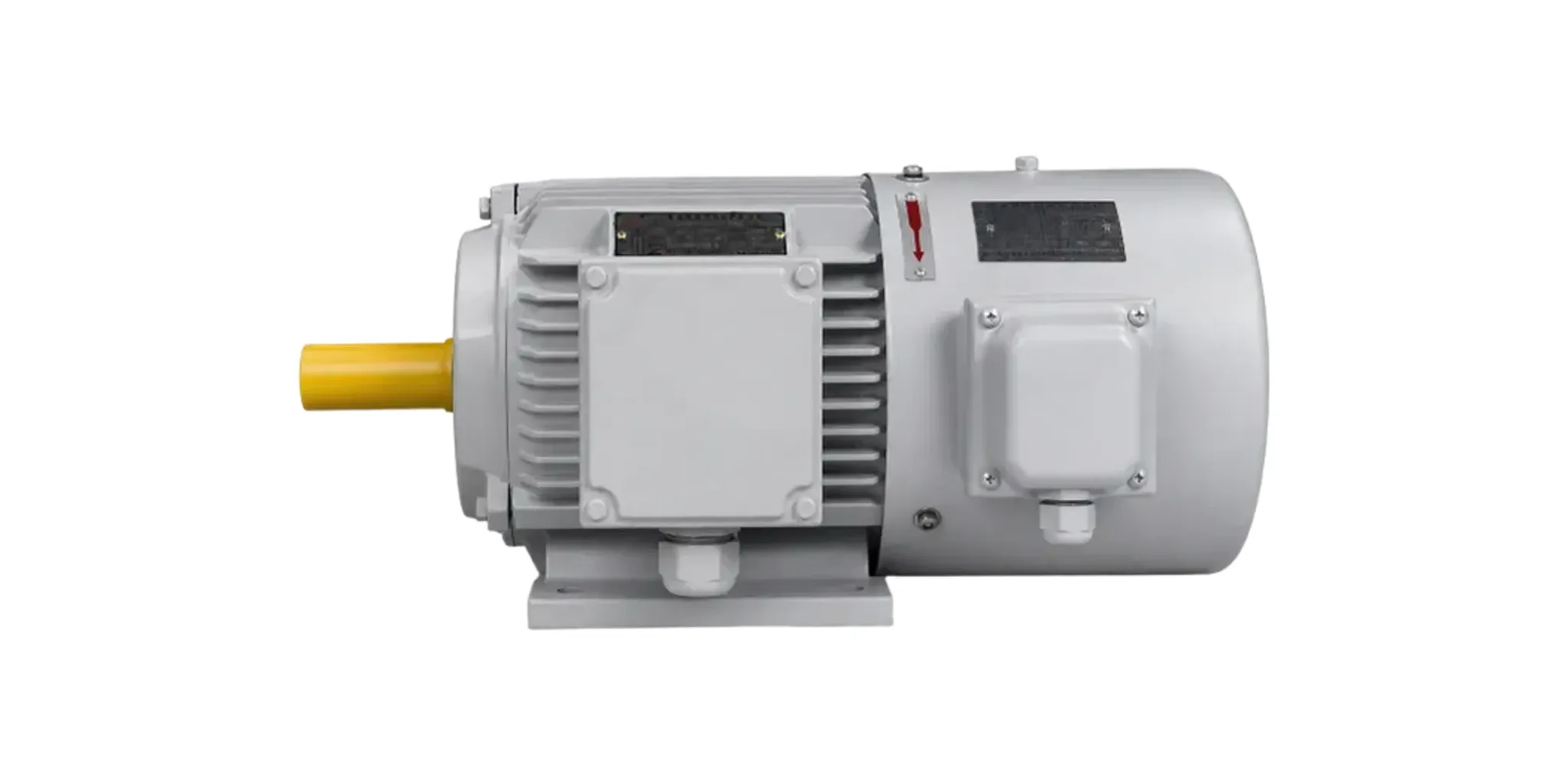
LEADGO supplies the motor, not the rig package — YVP for inverter-duty service where cooling must hold up at low speed, and the flameproof range where the machine sits inside the classified envelope. Send the load shape and the classification; the rest of the specification follows from them.
Going deeper
- Artificial lift motors: beam pump, PCP and ESP compared — the production side of the same field, with three more load shapes
- Motor duty types S1 to S10 — hoisting and braking cycles are S4 and S5 territory, not S1
- NEMA MG 1 explained — where the design letters and supply tolerances behind these ratings are defined