
“Increased safety or flameproof?” sounds like a product-choice question. In a hazardous area, it is first a protection-concept and compliance question.
The site owner or responsible hazardous-area engineer defines the classification. The motor supplier then shows that the proposed equipment marking and certificate cover the application. Price and maintenance are compared only after that fit is established.
The protection concepts are not interchangeable descriptions
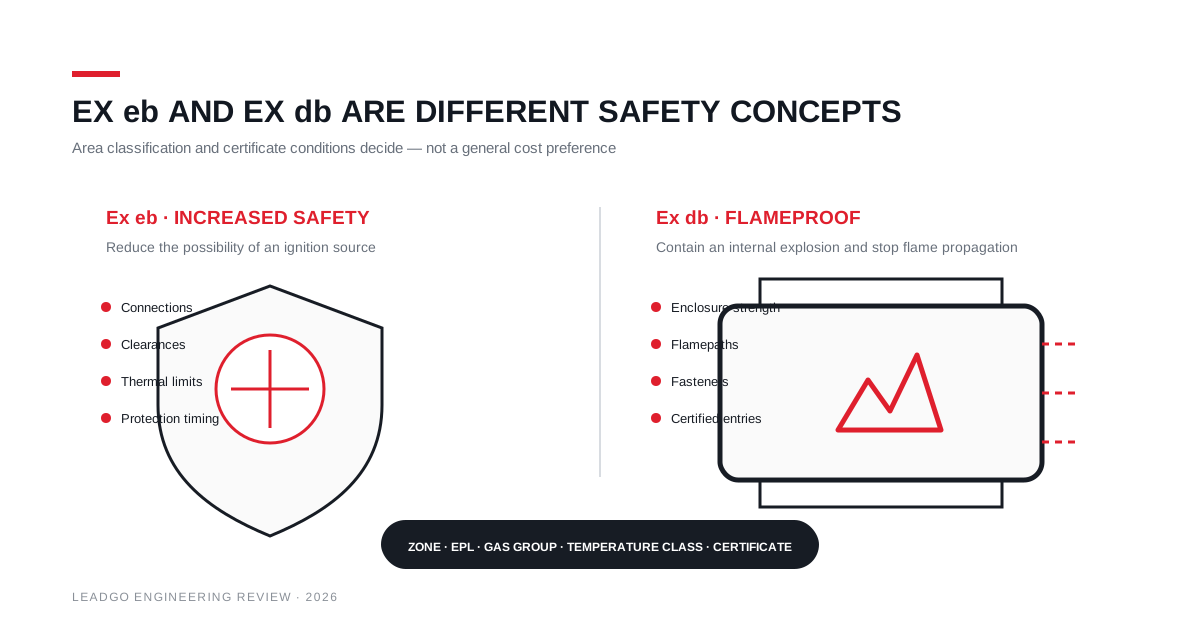
Ex eb increased safety uses additional design measures to avoid arcs, sparks and excessive temperatures in the conditions covered by the standard. The terminals, connections, clearances, windings and thermal behaviour are part of that approach.
Ex db flameproof enclosure assumes that an explosive mixture may enter the enclosure and ignite. The enclosure is designed to withstand the internal pressure and prevent the flame from propagating to the surrounding atmosphere through its joints and openings.
| Question | Ex eb increased safety | Ex db flameproof enclosure |
|---|---|---|
| Core idea | Prevent a capable ignition source | Contain an internal explosion and quench flame propagation |
| Construction focus | Electrical, thermal and connection integrity | Enclosure strength, flamepaths and controlled entries |
| Maintenance sensitivity | Terminations, protection and thermal controls | Flamepath condition, fasteners, entries and enclosure integrity |
| Governing reference | IEC 60079-7 | IEC 60079-1 |
This table explains the concepts; it does not approve either option for a site.
Begin with the required marking
The enquiry should state the hazardous-area basis in full. At minimum, provide:
- zone and required equipment protection level;
- gas or vapour group;
- temperature class or maximum permitted surface temperature;
- ambient-temperature range;
- indoor or outdoor location;
- voltage, frequency, starting method and duty;
- direct-on-line or converter operation;
- local certification and marking requirement.
Do not accept “explosion-proof motor required” as a complete specification. It leaves the supplier to guess the protection concept, gas group, temperature class and jurisdiction.
Starting duty affects the safety case
An induction motor draws high current during acceleration and develops heat in the rotor and stator. The permitted starting time, stalled-rotor time, protection setting and process acceleration time therefore matter.
For an increased-safety motor, thermal protection and the relationship between the motor’s safe time and the protective-device trip time require particular attention. For a flameproof motor, starting remains a thermal and performance issue even though the enclosure protection principle is different.
Provide the load torque-speed curve, reflected inertia, expected starts from cold and hot, and minimum terminal voltage during starting. If the driven machine can jam or restart loaded, say so explicitly.
Converter operation must appear in the certificate review
A VFD changes voltage waveform, cooling, speed and thermal behaviour. Confirm that the motor certificate and manufacturer instructions cover the intended converter duty.
Review the permitted speed range, torque envelope, thermal sensors, drive type, switching or filter conditions, cable length and any restrictions on bypass operation. A motor that is acceptable for line operation is not automatically acceptable across an unrestricted VFD range.
Our VFD-to-motor matching guide explains the electrical side. The hazardous-area review adds the certificate conditions and protection-system responsibilities.
Cost comparisons need the complete installation
An Ex eb proposal may look attractive where its protection concept and certification fit the area. An Ex db proposal may be preferred where the site standard, installed base or protection concept calls for a flameproof enclosure. Neither can be declared universally cheaper.
Compare the total installation:
- motor and certified accessories;
- cable glands, stopping plugs and terminal arrangements;
- protective relays and sensors;
- installation inspection;
- spares and repair capability;
- periodic inspection and maintenance tasks;
- downtime if specialist repair is required.
Repair is especially important. Work on flamepaths, enclosures, windings or certified components must follow the applicable repair standard, certificate information and local rules. An apparently small workshop change can invalidate the protection basis.
What to request with the quotation
Ask for the exact Ex marking, certificate number, certificate schedule, ambient range, temperature class, duty, starting limits and converter conditions. Check that the model and options on the quotation match those documents.
Then verify cable entries, mounting, enclosure, cooling, bearing arrangement, sensors and accessory certificates. The Ex marking guide and hazardous-area responsibility guide help structure that review.
LEADGO’s YBX3 and YBX4 pages describe available flameproof series. Final selection still depends on the project marking and certificate review.
A safe decision sequence
- Obtain the signed area-classification basis.
- Convert it into the required equipment marking.
- Add duty, starting, supply, ambient and VFD conditions.
- Review the proposed certificate and its schedule.
- Compare installation, inspection and repair implications.
- Record approval by the responsible project authority.
That sequence prevents a commercial preference from deciding a safety function.