
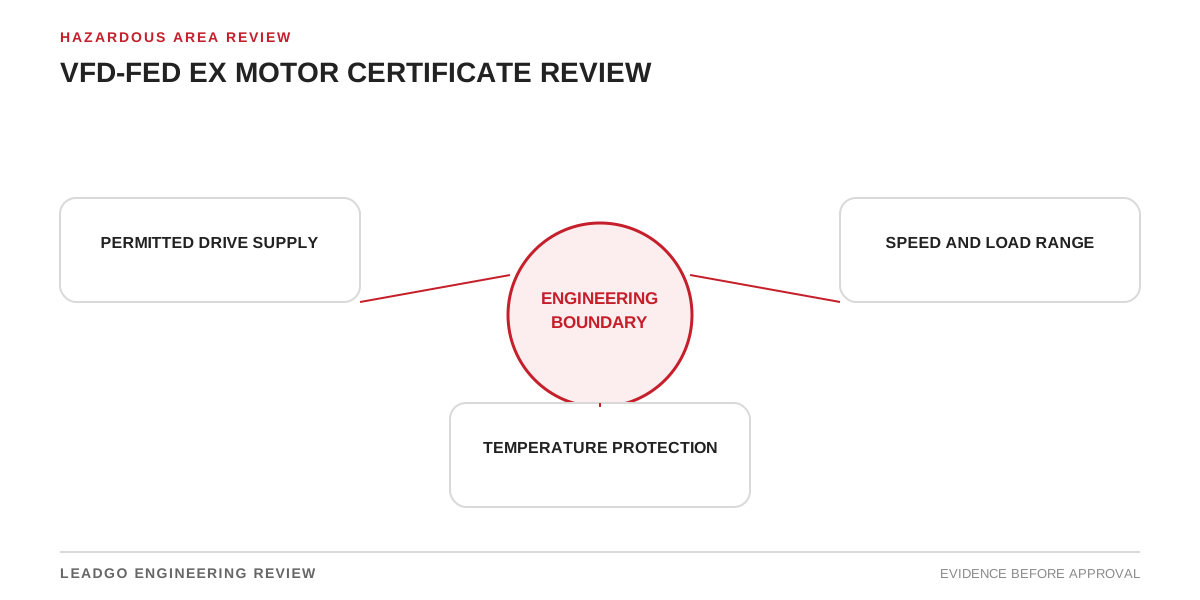
Connecting an explosion-protected motor to a variable-frequency drive changes more than speed. The converter waveform can alter motor losses, surface temperature, bearing-current exposure and the relationship between shaft speed and cooling airflow. A motor may carry valid Ex marking while its certificate limits converter operation to a defined speed range, load curve, protection device or drive configuration.
The procurement risk is easy to miss because the motor, drive and hazardous-area requirements often arrive in separate documents. A motor schedule may say “VFD duty,” the area data sheet may specify a protection concept, and the drive supplier may issue a generic output recommendation. None of those statements proves that the combined installation remains inside the certified boundary.
Applicability boundary: when this review is required
Use this review whenever a motor located in a classified area will operate from a converter, including retrofit projects where an existing fixed-speed motor is being moved to variable speed. It also applies when a bypass arrangement can alternate between converter and line supply, because each operating mode has its own electrical and thermal condition.
The review does not create the hazardous-area classification. Zone or Division, gas or dust group, temperature class, equipment protection level and ambient range must come from the plant’s controlled classification record. If those inputs are missing, the supplier cannot responsibly choose a motor by guessing from the industry name.
The certificate scheme also matters. ATEX, IECEx and North American requirements do not become interchangeable simply because similar IEC protection concepts appear in the design. Confirm the destination, authority having jurisdiction and project specification before treating one certificate as acceptable evidence.
Certificate-to-duty reconciliation matrix
Complete this matrix against the exact ordered motor, not a catalogue family or a certificate belonging to a similar frame.
| Review line | Certificate or manufacturer evidence | Project evidence | Release question |
|---|---|---|---|
| Motor identity | Type designation, frame or variant and certificate coverage | Purchase description and motor tag | Does the ordered construction fall inside the schedule? |
| Protection concept | Full marking and referenced standards | Area-classification requirement | Is the concept suitable for the documented location? |
| Gas or dust group | Certified group and any subgroup limitation | Classified material group | Does the marking cover the actual hazard? |
| Temperature boundary | Temperature class or maximum surface temperature | Process requirement and ambient | Is the worst operating case covered? |
| Ambient range | Certified ambient and stated derating conditions | Minimum and maximum site ambient | Are storage and operating conditions distinguished? |
| Converter arrangement | Named drive, permitted type or waveform conditions | Drive model and output architecture | Is the proposed converter arrangement allowed? |
| Speed-load envelope | Permitted frequency, speed, torque or power curve | Process torque-speed duty | Does every continuous and transient point remain inside? |
| Cooling method | Self-ventilation or independent fan conditions | Site airflow and auxiliary supply | Is cooling maintained at minimum speed? |
| Thermal protection | Sensor type, trip device and required settings | Relay, PLC or drive safety logic | Is the complete trip chain implemented and testable? |
| Cable and output equipment | Cable, filter or switching limitations in instructions | Cable length, filter and output contactor design | Do installation details preserve the approved boundary? |
Attach a source reference and revision to every completed line. “Complies” without a document pointer is not a closed review item.
Common errors that create certification gaps
Using the motor nameplate as the whole certificate. The nameplate gives the marking, but conditions of use usually sit in the schedule and instructions. A buyer who receives only a certificate front page cannot see every limitation.
Treating “inverter duty” as a hazardous-area approval. The phrase may describe insulation or cooling design. It does not establish that the Ex certificate permits the intended converter and duty.
Checking maximum speed but ignoring minimum speed. Overspeed is visible, while low-speed thermal risk is less obvious. With shaft-mounted ventilation, a high-torque low-speed point may be more restrictive than rated speed.
Installing sensors without validating the trip chain. A winding sensor does not protect anything if its channel is incorrectly mapped, its alarm is mistaken for a trip, or the process can automatically restart without the required reset.
Allowing the drive supplier and motor supplier to review different cases. The drive study may use nominal cable length and carrier settings while the motor certificate assumes another configuration. The interface remains open until both sides refer to the same system.
Assuming an independent fan is always available. Loss of auxiliary supply, wrong rotation or a missing interlock can remove the cooling method on which the certified curve depends.
Decision steps from enquiry to commissioning
- Obtain the controlled hazardous-area classification and destination compliance requirement.
- Freeze the motor duty: continuous and transient torque, minimum and maximum speed, starts, reversals and expected ambient range.
- Identify the proposed drive, output filter, cable length, switching arrangement and cooling auxiliaries.
- Request the exact certificate, complete schedule, referenced drawings and installation instructions for the offered motor variant.
- Fill the reconciliation matrix and place every difference on a deviation register.
- Confirm the temperature-protection architecture, including sensors, channel mapping, trip action, reset and failure response.
- Resolve who owns system-level verification where certificate conditions refer to the drive or installation.
- Incorporate approved limits into the motor data sheet, drive settings list, control narrative and commissioning procedure.
- At receipt, confirm the delivered nameplate and certificate number match the approved submittal.
- During commissioning, test independent cooling, thermal trips, permissives and restart behavior without exceeding the approved duty.
A project should not release the motor merely because the supplier answered the certificate question. Release follows when the certificate conditions have been translated into controlled design and test actions.
Data to request from the supplier in the RFQ
Ask each bidder for the following items in a structured schedule so competing offers can be compared on the same basis:
- full Ex marking for the exact offered construction;
- certificate number, complete certificate and schedule;
- list of special conditions of use and referenced instructions;
- permitted converter type or named drive, if the approval is drive-specific;
- continuous and intermittent torque-speed envelope under converter supply;
- minimum continuous speed for each cooling arrangement;
- maximum permitted speed and any mechanical restrictions;
- required winding, bearing or surface-temperature sensors;
- required protective device, trip settings and reset conditions;
- independent-fan electrical data and interlock requirements;
- cable-length, output-filter and carrier-frequency limitations stated by the manufacturer;
- confirmation of permitted bypass or direct-on-line operation, if the project includes it;
- terminal-box, gland and accessory certificate coverage;
- test and inspection records required for the final data book.
If the supplier cannot provide a requested value at bid stage, mark it as an open technical item with a due date. Do not convert a missing response into assumed compliance.
Acceptance process and retained evidence
The factory test may verify winding sensors, auxiliary fans, space heaters and terminal identification, but it cannot recreate every site thermal condition. Separate factory evidence from system validation. The approved package should identify which controls are proven by document review, factory testing, installation inspection and commissioning.
Retain the area-classification input, approved motor and drive data sheets, certificate set, speed-load curve, thermal-protection logic, settings file, cable and filter details, inspection records, deviations and final commissioning results. Link the records to the motor tag, drive tag and document revisions. This traceability matters later when a drive is replaced, carrier settings change or the motor is rewound.
A replacement should be treated as a new interface review when any condition that supported the original acceptance changes. Similar output and frame size do not prove that the replacement certificate, thermal model or converter restrictions are equivalent.