
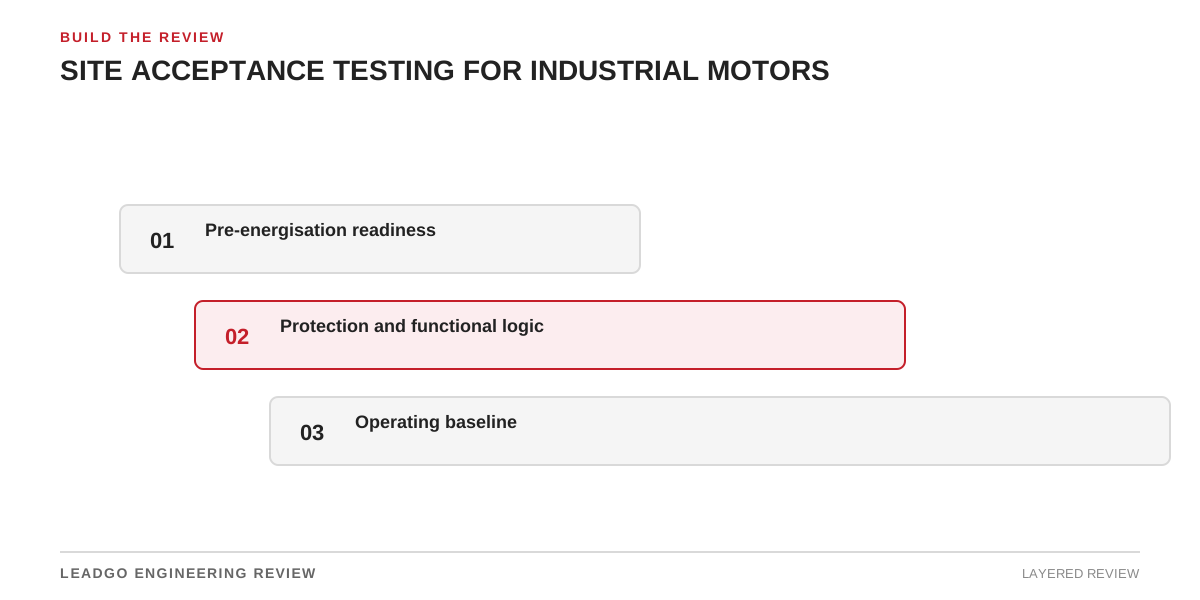
A site acceptance test closes the gap between a motor that passed at the factory and a drive train that is ready to operate. Transport, storage, foundation work, coupling, field cabling and protection settings all enter after the factory report was signed.
Agree the test boundary before energisation
Name the motor, driven equipment, starter or drive, transformer, feeder and auxiliaries included in the test. Mark which party owns each acceptance decision. Define safe stop criteria for abnormal current, vibration, temperature, noise, leakage or process behaviour.
| Phase | Evidence to obtain | Release question |
|---|---|---|
| Receiving | Identity, damage and preservation records | Is this the ordered machine in acceptable condition? |
| Pre-energisation | Alignment, lubrication, insulation, cabling and auxiliaries | Can it be energised without exposing known defects? |
| Functional | Trips, alarms, permissives, direction and emergency stop | Does the control and protection chain act correctly? |
| No-load or uncoupled | Current, sound, vibration and rotation where permitted | Is basic motor behaviour credible? |
| Loaded run | Process point, current, voltage, temperature and vibration | Does the integrated system operate inside agreed limits? |
Preserve as-found evidence
Photograph nameplates and terminal arrangements before changes. Record insulation readings with winding temperature, instrument and test voltage. Confirm foundation condition, soft foot, alignment, coupling setup, oil or grease status, cooler service and cable support.
Do not megger through connected electronics or sensors unless their procedure permits it. Disconnect and protect VFDs, surge devices and instrumentation as required by their manuals.
Test protection as a chain
Checking a relay setting on paper does not prove its CT polarity, wiring, output contact or trip path. Use the approved commissioning method to prove alarms, trips, permissives, heater logic, cooling interlocks and emergency stops. Record the final setting file or setting sheet revision.
Capture a comparable loaded baseline
Measure at a stable, identified process condition. Keep phase currents and voltages, speed, load estimate, bearing and winding temperatures where available, and vibration at named locations. A single “vibration passed” entry has little diagnostic value later.
If the process cannot reach the design point, state the achieved condition and leave full-load acceptance open. Do not scale a partial-load observation into a guarantee without an agreed method.
Acceptance and handover
Release the motor only when exceptions have an owner and disposition. Attach the approved drawing, data sheet, protection settings, test sheets, alignment record and baseline trend to the equipment identity.
For a new project, send LEADGO the SAT requirements with the RFQ so factory test points, sensors and documents support the planned site checks.