
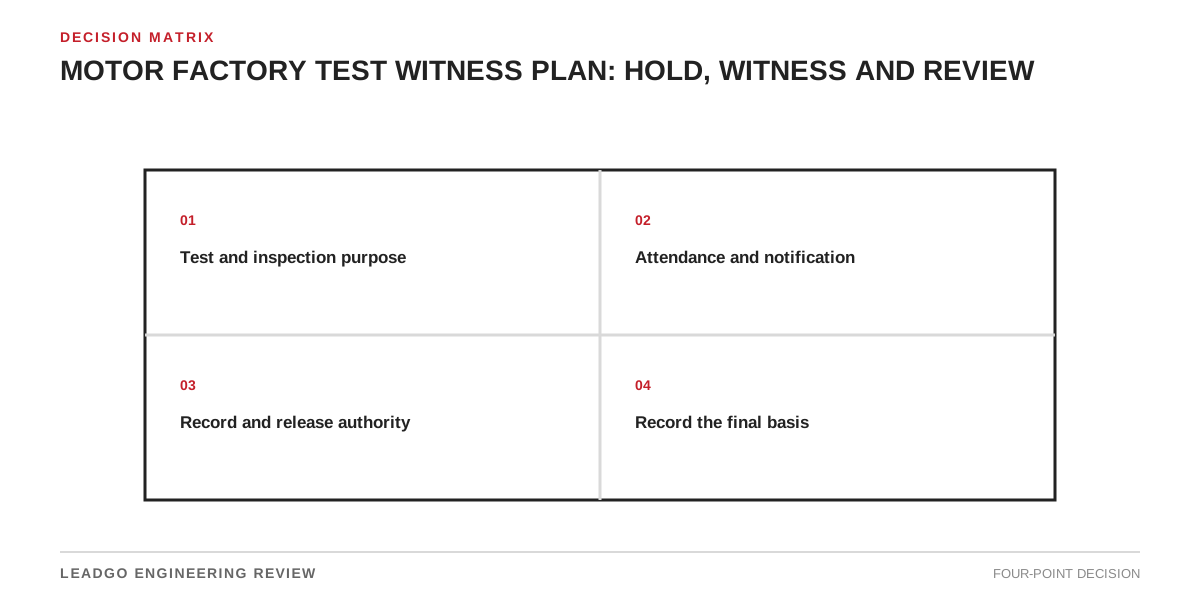
Writing “FAT witnessed by customer” in a purchase order leaves several decisions unresolved. Which tests will be observed? What standard and approved data sheet define acceptance? How much notice is required? Can manufacture continue if the customer is absent? A practical inspection and test plan answers those questions before production reaches a point that cannot be reversed.
Assign a status to each inspection point
| Status | Supplier action | Buyer or inspector action | Release rule |
|---|---|---|---|
| Hold | Stop at the stated stage | Attend or issue written release/waiver | Work does not continue without recorded authority |
| Witness | Give contractual notice and provide access | Attend, waive or use an agreed remote option | Supplier may proceed under the plan’s notice rules |
| Review | Submit a document or result | Check and return status/comments | Next stage follows the document-control procedure |
| Surveillance | Permit observation during normal work | Inspect selected activities | No automatic stop unless a nonconformity is found |
Use the definitions in the contract or approved quality plan. Do not rely on H, W and R letters without a legend; organisations sometimes apply them differently.
Build each row around a risk
An inspection point should say what failure it is intended to detect. For a large motor, this may include material identification, winding checks before impregnation, dimensional interfaces, routine electrical tests, vibration, direction of rotation, accessory function, nameplate verification and final packing. The final list depends on the ordered machine and contract.
For every row, record:
- governing drawing, specification or standard revision;
- measurable acceptance criterion;
- supplier and buyer responsibility;
- notice period and communication address;
- required instrument or calibration evidence;
- record to be included in the data book; and
- action when the result does not conform.
This prevents a witness from discovering at the test stand that the parties are comparing different document revisions.
Plan notice, access and remote evidence
State whether notice is counted in calendar or working days and what information must accompany it. For remote witnessing, confirm camera coverage, live instrument visibility, document sharing and how the inspector can request a repeat observation. A recording can supplement the signed test record but should not become the only evidence unless the contract says so.
Separate test completion from shipment release
Passing the witnessed tests does not automatically close documentation, punch-list or preservation requirements. Identify who may accept concessions and who releases shipment. Open items should state owner, due date and effect on release; they should not disappear into meeting minutes.
Use the motor factory acceptance test checklist to select activities. After testing, apply the test-report-to-order verification method before final release.