
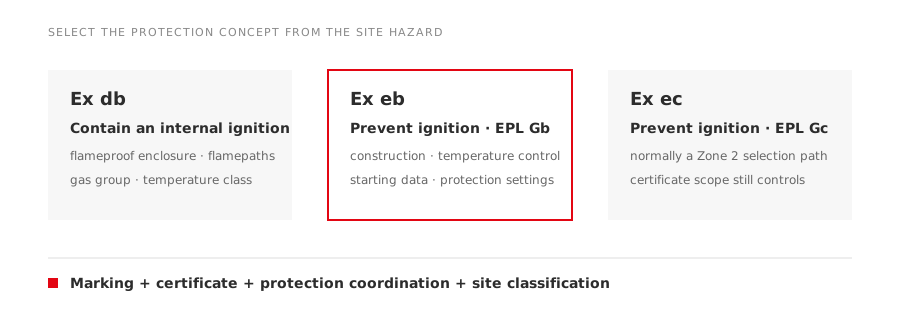
Flameproof protection and increased safety address the same hazard with different engineering logic. Treating them as “higher” and “lower” versions of one product is the wrong starting point.
Direct answer
An Ex db enclosure accepts that an ignition could occur inside and prevents the explosion from propagating into the surrounding atmosphere. Ex eb and Ex ec equipment are designed so that arcs, sparks and excessive surface temperatures do not arise within the conditions covered by their protection level.
Under current IEC terminology, Ex eb is associated with EPL Gb and Ex ec with EPL Gc. That normally places Ex eb in a Zone 1 selection path and Ex ec in a Zone 2 path, subject to the complete marking, certificate and local rules. Area classification remains a site responsibility.
Three concepts, three verification paths
| Protection concept | Basic strategy | Buyer must verify |
|---|---|---|
| Ex db | Contain an internal explosion and cool escaping gases through flamepaths | Gas group, temperature class, flamepath integrity, entries and certificate scope |
| Ex eb | Prevent ignition with enhanced construction and defined thermal/protection requirements | EPL, starting data, protection coordination, terminal and winding requirements |
| Ex ec | Prevent ignition for the lower-risk Gc equipment level | Zone 2 basis, operating conditions, certificate and permitted components |
An Ex eb motor is not an Ex db motor with a lighter enclosure. Its safety depends more directly on temperature control, starting behaviour and correctly coordinated protection. An Ex ec motor should not be moved into a Zone 1 duty because the name “increased safety” sounds reassuring.
Why protection settings matter
Motor heating continues while a rotor is stalled or accelerating slowly. For an applicable Ex eb design, the declared starting and thermal data provide inputs for the protective device. The often-discussed tE time is not a generic value for an entire series; it belongs to the certified design and specified test conditions.
The practical questions are therefore:
- What is the certified starting-current ratio and safe starting-time basis?
- Does the protection trip before the applicable thermal limit is reached?
- Is the actual acceleration time comfortably inside the accepted envelope?
- Are voltage drop, hot restart and process load included in the review?
- If a VFD is used, does the certificate cover converter operation and the proposed protection method?
Changing the relay setting just to complete a difficult start can defeat the protection concept.
Do not translate old markings by guesswork
Older documentation may use non-sparking Ex nA. Current IEC 60079-7 practice includes the corresponding Gc-level concept under Ex ec. That history does not authorize a buyer to rewrite a nameplate or assume an old certificate covers a new standard edition.
Record the complete marking, certificate number, issuing body, standard edition and any suffix or special condition. If the project specification names older terminology, resolve the equivalence with the responsible hazardous-area engineer and certification documentation.
A buyer’s enquiry checklist
Send the supplier:
- area classification drawing and zone;
- gas group and temperature requirement;
- required EPL and certification scheme;
- ambient range, altitude and enclosure exposure;
- load torque, acceleration time and starts per hour;
- line starter, soft starter or VFD details;
- protection relay type and available sensing;
- cable-entry and terminal requirements.
Ask for the exact certificate and schedule, not a certificate from a similar frame or family. Confirm that the ordered model, poles, power, frequency and protection concept appear within its scope.
Questions at quotation review
A quotation that says only “explosion-proof motor” is incomplete. Ask the supplier to reproduce the proposed full marking and explain each element against the area-classification document. If Ex eb is proposed, request the declared starting data and protection assumptions. If Ex ec is proposed, confirm that the installation really has a Gc equipment requirement.
Check the terminal box and cable-entry concept as part of the motor. Incorrect glands, blanking elements or field modifications can invalidate an otherwise suitable protection path. The manual should state permitted connections, tightening requirements and certificate conditions.
For replacement work, compare the old and new certificates rather than power and frame alone. A change from Ex db to Ex eb shifts attention toward starting time and protection coordination. A change from an older Ex nA marking to Ex ec needs documentary review, not a handwritten equivalence note.
Commissioning evidence to retain
Keep the approved certificate, marking photograph, protection settings, measured acceleration time, phase current, supply voltage and final cable-entry record in the asset file. If settings change later, record who approved the change and why. This lets maintenance distinguish an ordinary process trip from a change that may affect the protection concept.