
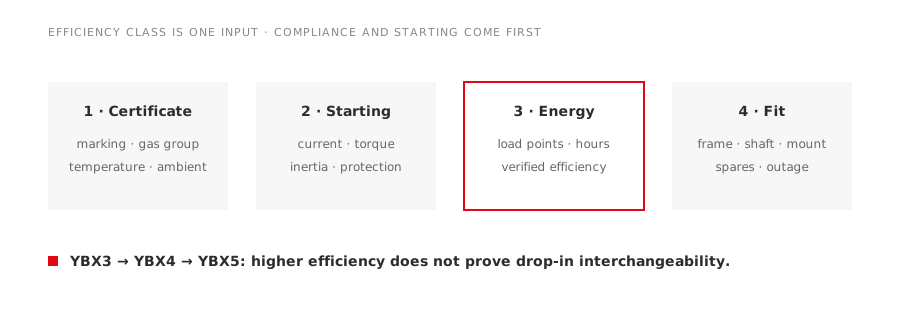
YBX3, YBX4 and YBX5 are often treated as three steps on a simple efficiency ladder. That view is useful for orientation but incomplete for a replacement decision. A flameproof motor must satisfy hazardous-area approval, starting duty, mechanical interchangeability and operating economics at the same time.
The correct question is not “Which series has the highest number?” It is “Which certified motor starts this load, fits this installation and produces a defensible lifecycle result?”
Begin with the hazardous-area requirement
Efficiency cannot compensate for a certificate mismatch. Obtain the area-classification document and specify the protection concept, gas group, temperature class, equipment protection level or zone requirement, ambient range and any special conditions of use.
Then verify the certificate for the exact offered motor. A brochure family name is not enough. Check model designation, frame range, output, pole count, frequency, cooling, terminal arrangement and any converter-fed conditions covered by the approval.
Our guide to verifying an explosion-proof motor certificate explains the document trail. The article on reading Ex markings covers the nameplate fields.
Understand what the series step changes
Within applicable Chinese product standards, YBX3 is associated with an IE3-level route and YBX4 with an IE4-level route. YBX5 is positioned above them for covered ratings. The higher class reduces motor loss at the specified test point, but a series name does not describe every operating point.
Part-load behavior, converter supply, cooling and voltage quality affect real input power. A motor running lightly loaded can spend most of its life away from the rated point used for the headline efficiency class.
That is why the load profile belongs in the enquiry. Record hours at representative load and speed, not only the maximum driven-equipment power.
Do not miss the starting-current difference
A same-power YBX4 replacement should not be approved from efficiency and frame size alone. Comparing the guaranteed envelopes in JB/T 14517—2022 and JB/T 12628—2016 shows that YBX4 locked-rotor current can be 15–25% higher while locked-rotor torque can be about 10% lower than the older YBX3 tables. These are standard guarantee-envelope comparisons, not measurements of every individual motor.
The implication is practical. A protection device sized around the older motor may trip during starting. A high-inertia or high-breakaway-torque load may accelerate differently. Check:
- driven-load torque from zero speed to operating speed;
- combined inertia and permitted acceleration time;
- available voltage at the motor during starting;
- contactor, cable and protective-device ratings;
- maximum starts per hour and hot-restart requirement;
- voltage-drop limits for the facility.
If a VFD is used, confirm that the certificate permits the proposed converter-fed operation and that temperature protection, switching range and cooling conditions are covered.
Build the energy calculation from operating data
At a given shaft output (P_{out}), motor input power is (P_{out}/\eta). For several operating points, calculate the annual input energy at each point and add them:
| Input | Source |
|---|---|
| Shaft load at each operating point | Measurement, process model or driven-equipment curve |
| Annual hours at each point | Control-system history or operating log |
| Motor efficiency at each point | Verified test data or supplier curve |
| Electricity price | Customer tariff, including demand treatment where relevant |
| Installed cost difference | Quotation plus engineering, installation and commissioning |
| Outage cost | Customer production and maintenance estimate |
The annual energy-value difference is then compared with the additional installed cost. Run a sensitivity table rather than one payback number. Load, annual hours and tariff are usually uncertain enough to justify low, expected and high cases.
Do not use a generic statement that purchase price is a fixed percentage of lifetime cost. The result varies sharply between a continuously loaded process motor and a lightly used standby unit.
Mechanical interchangeability remains separate
Confirm mounting, frame, shaft diameter and extension, flange, terminal-box position, overall dimensions and lifting arrangement. A nominal frame can still hide differences in shaft detail or accessories. Check coupling alignment and driven-equipment limits after installation.
Bearing arrangement, lubrication, space heaters, winding temperature detectors and vibration provisions also affect lifecycle cost. Higher efficiency does not remove these maintenance requirements.
When each route can make sense
YBX3 can remain commercially rational when operating hours are low, the existing electrical system is tightly matched to its starting behavior, or the project prioritizes direct interchangeability within an approved scope.
YBX4 becomes attractive for long-running duties where the energy reduction has enough annual hours to accumulate, provided the starter and load accept its guaranteed starting envelope.
YBX5 deserves evaluation when the rating, certificate and application are covered and the project values lower loss over a long service period. Availability, spare strategy and installed cost must be included rather than assumed.
These are decision conditions, not universal rankings.
Keep test evidence comparable
When quotations come from different suppliers, ask for efficiency evidence on the same basis. The declared class, applicable product standard, rated voltage and frequency, test method and tolerance treatment should align. A routine test report confirms production checks on one unit; it does not replace the type-test evidence used to establish a design’s performance. The distinction is explained in type test versus routine test.
For a converter-fed duty, request the permitted speed range and thermal basis rather than applying a line-fed efficiency figure across the full operating map. Auxiliary cooling power, drive loss and time at reduced speed belong in the system calculation. Keep the certified hazardous-area configuration intact when adding sensors, heaters, cable entries or an external fan.
A procurement sequence that avoids rework
- Freeze the hazardous-area classification and applicable jurisdiction.
- Verify certificate scope for the exact offered model.
- Confirm load torque, inertia and starting method.
- Compare rated and locked-rotor electrical data.
- Verify dimensions, mounting and accessories.
- Build a load-weighted energy model.
- Add installation, downtime and spare-parts implications.
- Select from the compliant options using the customer’s decision horizon.
The highest efficiency label is useful information. The best project choice is the compliant motor whose starting behavior, mechanical fit and lifecycle calculation all survive review.