
“Explosion-proof” is too broad to select a motor. A flour dust collector and a solvent-vapour pump can both present explosion hazards, but they do not create the same ignition path.
Direct answer
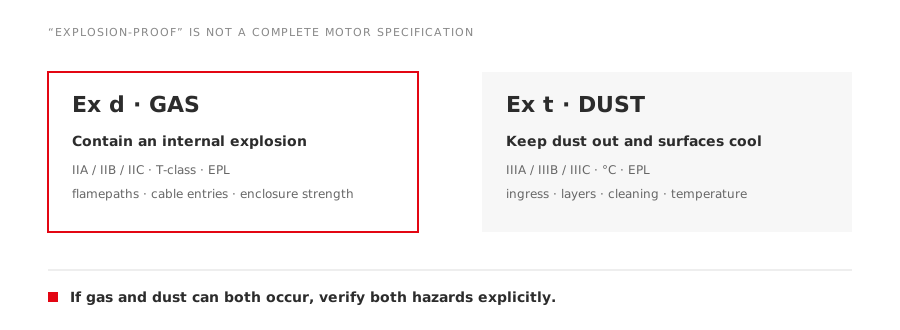
Ex d flameproof equipment is designed for explosive gas atmospheres. It contains an internal explosion and prevents flame propagation through the enclosure joints.
Ex t equipment is designed for explosive dust atmospheres. It relies on enclosure integrity and limitation of surface temperature so combustible dust does not enter in a dangerous quantity or ignite on the equipment surface.
Neither marking automatically substitutes for the other.
Read the full marking
| Question | Gas selection | Dust selection |
|---|---|---|
| Hazard form | Gas, vapour or mist | Combustible dust or fibres |
| Protection example | Ex db | Ex tb |
| Group example | IIA, IIB or IIC | IIIA, IIIB or IIIC |
| Temperature expression | Temperature class such as T4 | Maximum surface temperature such as T135 °C |
| Equipment level example | Gb | Db |
| Main installation concern | Flamepath, entries and gas group | Ingress, dust layers, entries and surface temperature |
The examples are not a complete specification. A buyer must carry across the protection concept, group, temperature, EPL, ambient range and certificate number.
Why IP rating alone is not Ex t
Dust ingress protection is important, but an IP code does not establish dust-explosion protection by itself. Ex t equipment is assessed as an explosion-protected design, including construction, testing, marking and surface-temperature conditions.
Likewise, a heavy cast-iron enclosure is not automatically flameproof. Ex d depends on certified enclosure strength and controlled flamepaths. Machining, fasteners, cable entries and repairs can all affect the protection.
Dust changes the thermal problem
Deposited dust can act as insulation. A motor surface that is acceptable when clean may run hotter under a layer. Dust properties and layer thickness are site variables, which is why the marked maximum surface temperature and certificate conditions must be reviewed against the process material and housekeeping plan.
Conductive dust also influences the subgroup and enclosure requirements. Do not select from “dusty environment” alone; obtain the site’s combustible-dust assessment.
What if gas and dust are both possible?
Some processes can release both. A motor with one marking should not be assumed to cover the second hazard. The equipment may need separate gas and dust protection markings, or the installation may need additional measures determined by the area-classification and ignition-risk assessment.
Ask whether the hazards can occur simultaneously, during different operating modes, or only during abnormal releases. Cleaning and maintenance can also create a temporary dust cloud even when normal operation does not.
Buyer checklist
Provide:
- zone or division from the site classification;
- identified gas and/or dust;
- gas or dust group;
- temperature class or maximum permissible surface temperature;
- required EPL;
- ambient and altitude;
- dust-layer and cleaning assumptions;
- VFD, starting and protection arrangement;
- certification scheme required by the destination.
Then request the exact certificate schedule and confirm that the ordered model and rating fall within it.
LEADGO separates gas flameproof and dust-protected product families. The YBX4 page addresses gas flameproof duty, while YFBX3 and YFBX4 address dust-protected applications. That product separation does not replace the site classification.
Cable entries and maintenance are part of protection
An approved motor can be compromised by an unsuitable gland, unapproved blanking element, damaged flamepath or dust path created during maintenance. Specify entries for the protection concept, cable construction and exposure. Keep the instructions and certificate conditions with the motor record.
For Ex d equipment, do not machine, paint or repair flamepaths without an accepted repair basis. For Ex t equipment, preserve seals and fasteners, and control dust accumulation according to the site assessment. A replacement bolt or gasket that appears equivalent can still change the certified construction.
Temperature evidence differs
Gas applications commonly use a class such as T4. Dust equipment commonly marks a maximum surface temperature in degrees Celsius. Do not convert between them with a simple look-up: dust assessment considers cloud and layer behaviour, while gas assessment follows the identified gas and temperature class.
For converter-fed motors, ask how maximum surface temperature was established across the permitted speed, load and control range. At receiving inspection, photograph the complete marking and compare it with the approved datasheet and certificate before installation.