
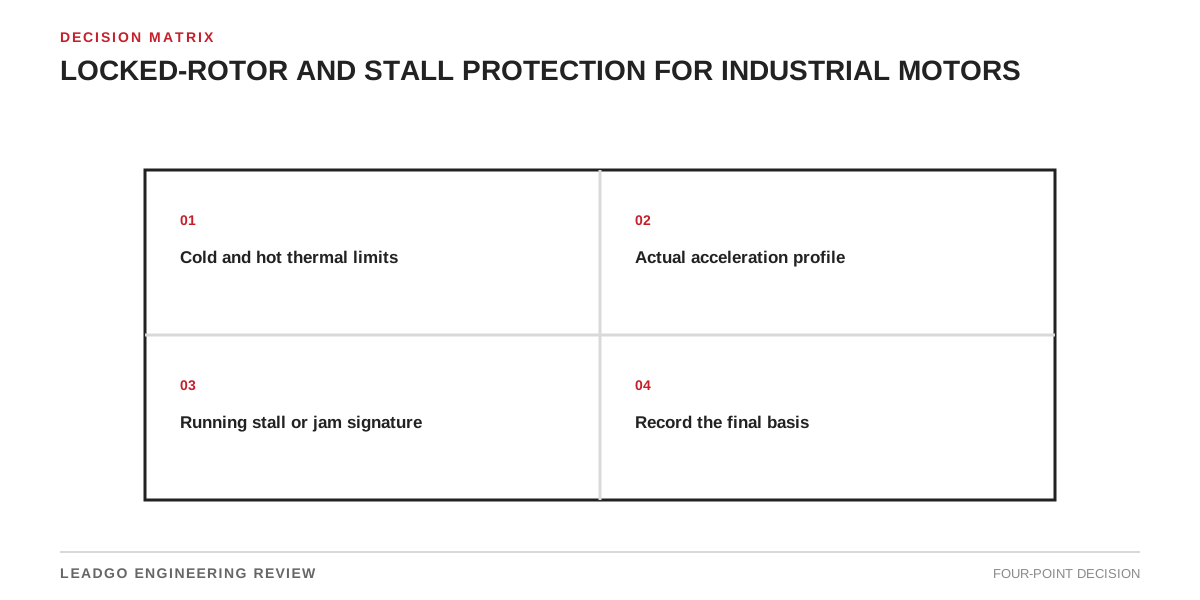
High current during acceleration is expected. The same magnitude after the machine is running can indicate a jam. Protection has to recognise the operating state before it interprets the current.
Separate the three operating states
ABB’s application manuals distinguish failure to accelerate, prolonged starting and a running stall. That separation should appear in the cause-and-effect chart rather than being compressed into one overcurrent timer.
| Observed state | Current evidence | Speed or process evidence | Protection question |
|---|---|---|---|
| Normal acceleration | Current rises above start detection and then decays | Speed increases toward the operating band | Does measured acceleration remain below the approved worst-case time? |
| Rotor does not begin to turn | Starting current persists | Speed switch remains inactive or shaft speed stays near zero | Can the trip act before the applicable locked-rotor thermal limit? |
| Acceleration begins but does not complete | Current remains elevated longer than expected | Speed plateaus below the operating band | Is load torque, supply voltage or mechanical resistance preventing completion? |
| Running machine jams | Current rises after the running state was established | Speed collapses or process indication confirms blockage | Is the jam element fast enough for the hot motor and driven equipment? |
Breaker status alone does not prove that a motor is starting. A restart after a short interruption, process reacceleration or flying start can create a different sequence. Define the state logic from the actual control philosophy.
Overlay start time on the motor capability
The review needs two curves: the expected current-versus-time trace and the motor’s applicable thermal withstand boundary. Use hot and cold data supplied for the actual motor. A normal start must clear the protection curve without nuisance operation, while a failed start must be interrupted before the relevant thermal boundary.
ABB notes that start durations vary widely by application. A timer copied from a similar-rated pump may be unsuitable for a fan, conveyor or crusher because inertia, load torque and depressed terminal voltage change acceleration.
Decide whether current alone is enough
Current-only supervision works when a clear time margin exists between the slowest legitimate start and the safe stall time. If those intervals overlap, adding delay merely trades nuisance trips for motor damage. Speed feedback, a zero-speed switch or dependable process evidence may be needed.
Running-stall logic deserves a separate pickup and delay review. The motor is already hot, cooling may fall with speed, and the process can impose mechanical limits shorter than the motor thermal limit.
Commission the logic with recorded starts
The commissioning record should retain:
- motor hot and cold withstand information;
- calculated acceleration at minimum starting voltage and maximum load;
- current and speed traces from representative starts;
- start-detection, transition and running-state logic;
- locked-rotor and running-jam pickup and delay values;
- permitted consecutive starts and thermal reset behaviour.
The setting is ready for service when the slowest valid start, fastest required fault clearance and restart rules all fit within one documented protection envelope.