
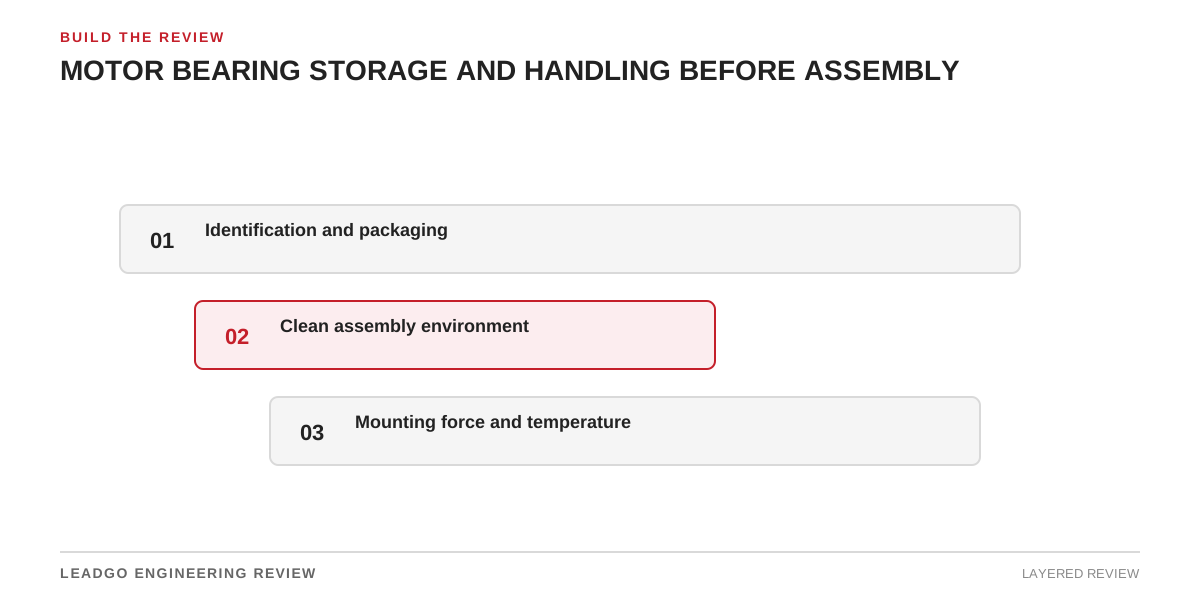
A bearing can be damaged before it reaches the shaft. Moisture, dust, mixed identities, impact and incorrect mounting force may leave no obvious external mark yet shorten service life.
| Stage | Control | Record |
|---|---|---|
| Receiving | Verify designation, clearance and packaging | Purchase/inspection traceability |
| Storage | Dry, vibration-free, original sealed pack | Location and issue date |
| Preparation | Clean tools, shaft and housing | Assembly checklist |
| Mounting | Controlled force or temperature | Method and measured temperature |
Preserve identity and cleanliness
Separate bearings by full designation, including suffixes and internal clearance. Reject damaged or wet packaging through the quality process rather than wiping and returning it to stock. Avoid locations exposed to vibration from operating machinery.
Mount without hidden damage
Measure shaft and housing fits before opening the package. For a press fit, load the fitted ring directly. For thermal mounting, use controlled induction or approved heating equipment, monitor temperature and avoid local hot spots. After mounting, confirm seating, axial location, free rotation where appropriate and lubrication condition.
Retain the bearing identity, inspection result, fits, mounting method, temperature or force record and assembler. This record supports later root-cause analysis and prevents a storage problem being misdiagnosed as a motor-design problem.
Related reading: bearing failure analysis and bearing fits and clearance.