
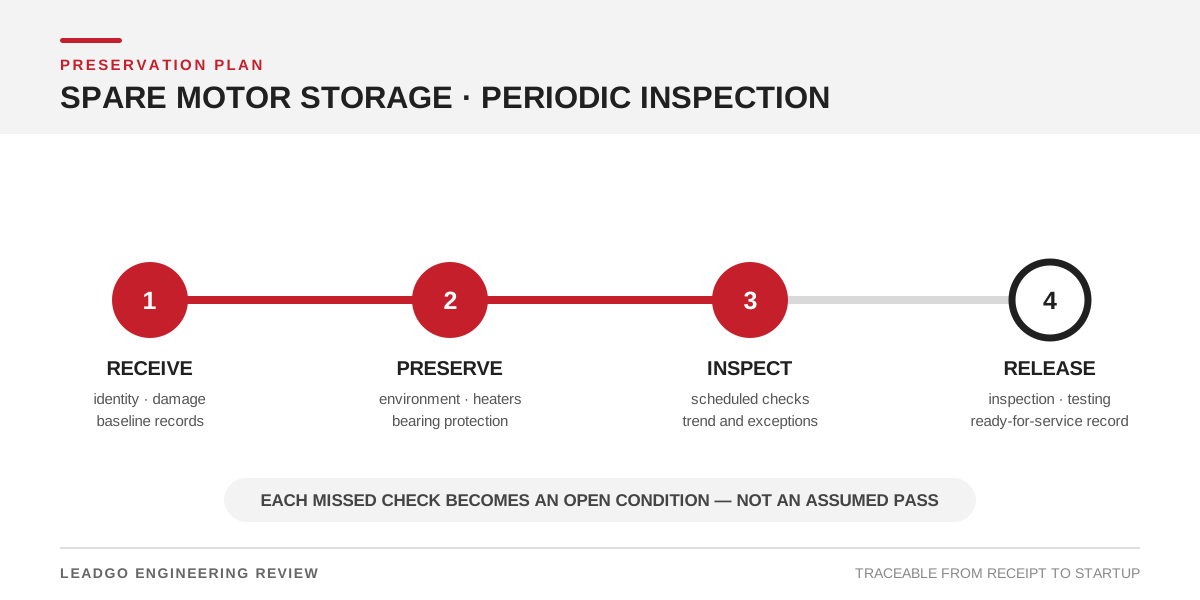
A spare motor is insurance only if it can start when the operating motor fails. A dry warehouse receipt from two years ago does not prove today’s winding, bearing or accessory condition.
Classify the storage environment
Record whether the motor is indoors, temperature controlled, heated, exposed to dust, salt air, vibration or condensation. Keep it off the floor, protected from water and impact, with covers that prevent contamination without trapping moisture.
| Observation | Risk | Preservation response |
|---|---|---|
| Temperature cycling near dew point | Internal condensation | Verify heater or controlled dry storage and trend insulation condition |
| Nearby machinery vibration | False brinelling risk | Relocate or isolate the stored motor |
| Damaged wrapping or open entry | Dust and moisture ingress | Inspect, dry if required and restore sealed protection |
| Long idle bearing period | Lubricant separation or contact damage | Follow bearing and motor maker’s shaft-care instruction |
| Missing accessory box | Commissioning delay | Inventory heaters, sensors, glands and loose parts by motor tag |
Build a motor-specific preservation file
Keep the nameplate, purchase specification, approved drawing, test report, bearing details, lubrication instruction and manufacturer storage procedure together. Log storage location and every inspection. Generic warehouse checklists cannot replace model-specific limits.
Trend insulation measurements under comparable temperature and test conditions. The trend and sudden change are usually more informative than an isolated number detached from temperature and history.
Protect bearings and machined surfaces
Do not rotate a shaft merely to tick a box. Confirm whether the bearing arrangement and preservation instruction call for rotation, and record the new resting position. Maintain corrosion protection on exposed shaft surfaces without contaminating coupling fits or seals.
If transport locks or rotor restraints are fitted, keep their purpose visible. Removing them too early or leaving them installed for a start can both cause damage.
Release the spare through a defined gate
Before installation, inspect for corrosion, water marks, damaged leads, blocked drains, loose hardware and foreign material. Confirm free shaft movement where permitted, bearing and grease condition, accessory function, winding condition and document completeness.
For an explosion-protected spare, include marking, certificate scope and flamepath condition in the release review. Storage preservation never overrides certified construction requirements.
What to include when ordering a critical spare
Specify interchangeability boundaries: frame and mounting, shaft, terminal-box orientation, supply, duty, protection, accessories and certification. Ask for the storage instruction and preservation state at shipment. LEADGO can identify which interfaces must remain identical and which options can be adjusted.