
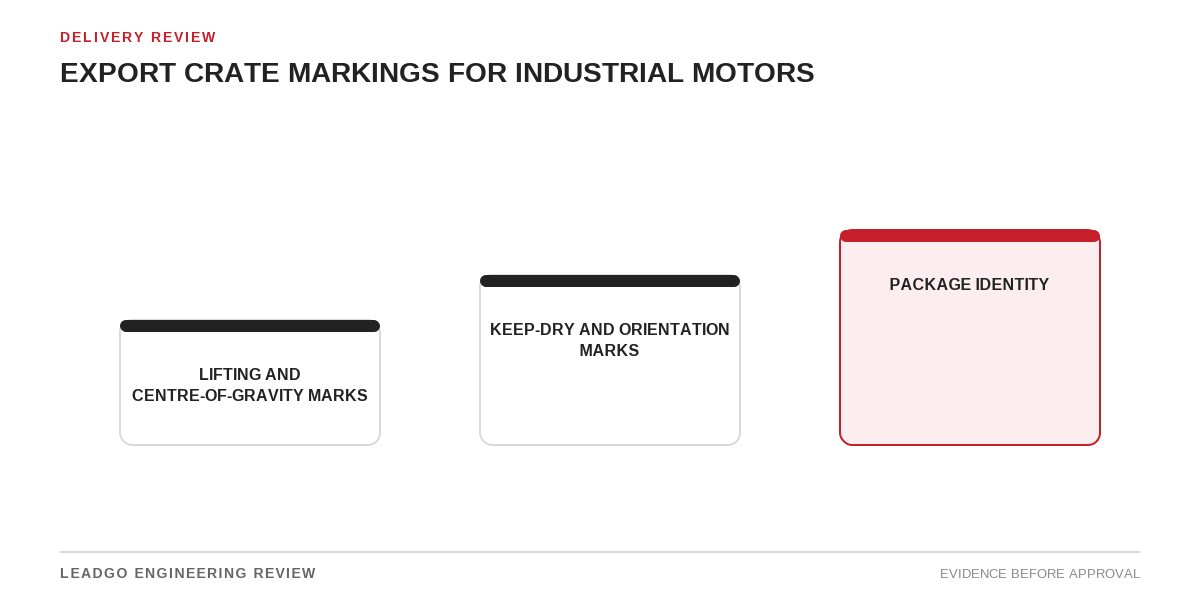
Approve motor export-crate markings against the final packing list and the actual packed arrangement. Give every case an identifiable place in the shipment, verify its weight and handling information, and resolve inconsistencies before dispatch. Keep the motor’s identity separate from the package identity so receiving staff can reconcile loose accessories without opening every case.
For a shipment enquiry, send the proposed crate labels, package list and destination instructions. Include any split delivery, loose-item cases and purchaser marking format. These inputs let the supplier confirm a workable identification scheme before labels and shipping documents are finalized.
Applicability and marking authority
This review applies to crated motors and associated cases where the buyer needs reliable shipment identification and handling information. It is especially useful when a project includes several similar motors, consolidated accessories or deliveries to different site stores. The method addresses marking consistency; it does not design the crate or approve a lifting operation.
Different markings have different sources of authority. The purchaser can specify order and tag references, logistics can confirm shipping identifiers, and the packaging or handling design determines applicable handling information. Regulated marks require the relevant authorized process. A single label designer should not invent all of these fields from a quotation.
The route, package material and applicable rules determine whether additional markings are required. Confirm these with the responsible logistics provider and relevant authority. Do not copy a dangerous-goods, certification or treatment symbol simply because it appears on another motor shipment.
Build the identity map before preparing labels
Start with the purchase order, motor serial numbers, project equipment tags and package numbers. Record which motor and loose items belong to each case. A motor identifier remains associated with the equipment; a case identifier describes one physical package in the current shipment. They should be linked rather than treated as interchangeable.
For shared accessory cases, itemize the allocations in the packing record. The outside label can identify the common case while the detailed list explains which items serve each motor. Avoid creating a label so crowded that the essential shipment reference is difficult to read.
Prepare labels only after the case allocation is sufficiently stable. If a package is divided or combined, revise the identity map and affected records together. The motor document transmittal register provides a useful way to distribute the corrected packing documents and preserve their revision history.
Crate-marking reconciliation matrix
Use this proposed worksheet before accepting the final marking photographs. It is a coordination aid for the purchaser and supplier, not a substitute for the applicable marking standard or transport instructions.
| Marking item | Governing input | Physical or documentary check | Discrepancy to resolve |
|---|---|---|---|
| Package identifier | Final package allocation | Label matches the packing-list case number | Duplicate number on separate cases |
| Shipment reference | Agreed logistics instructions | Correct order or booking reference is legible | Superseded shipment reference remains visible |
| Consignee or delivery reference | Authorized delivery instructions | Intended destination can be identified | Similar project names lead to ambiguity |
| Equipment allocation | Motor-to-case identity map | Contents are traceable to the relevant tags | Accessory case assigned to the wrong motor |
| Gross weight | Final packed-package data | Units and value agree with transport records | Motor-only weight used as packed weight |
| Net weight where required | Agreed packing information | Definition and units are consistent | Net and gross values reversed |
| External dimensions where required | Final case measurements | Record describes the package actually shipped | Dimensions copied from an earlier crate design |
| Handling information | Approved packing and handling basis | Mark position and meaning match that basis | Generic arrows conflict with required orientation |
| Special storage instruction | Supplier preservation requirements | Relevant instruction is clear to the receiver | Label conflicts with the supplied storage document |
| Regulated marking | Applicable authorized process | Responsible provider confirms valid application | Supplier-created artwork imitates a controlled mark |
Photograph the package identifier together with each relevant marking area. A close-up proves readability, while a wider view establishes location and which case was checked. Retain the photographs with the final packing-list revision so a receiver can reconstruct the dispatch condition.
Marking approval should identify the unresolved field when a label is incomplete. Do not approve the whole layout subject to an unspecified later correction. The final dispatch check needs a clear basis for distinguishing a completed correction from a promise.
Decision sequence when a marking disagrees with the records
- Identify the physical case and stop using the disputed label information for the affected planning decision.
- Establish which source owns the field: equipment identity, package measurement, delivery instruction or handling design.
- Confirm the final packed condition with that source owner and determine whether other packages are affected.
- Correct the marking and all dependent shipment documents through the agreed revision process.
- Remove or clearly supersede conflicting shipment information using the packer’s approved method.
- Obtain replacement photographs and record the person who verified the correction.
- Notify the forwarder and receiving contact if they already received the earlier information.
Keep corrections within the responsible party’s authority. A purchaser noticing an incorrect handling symbol should ask the packing designer to resolve it, rather than moving the symbol to a guessed location. A marking that appears plausible is still unreliable when its underlying design information is unknown.
The Canadian Trade Commissioner Service’s export documentation checklist emphasizes agreement in package counts, weights, dimensions and units across shipping records. Use this consistency principle to reconcile the motor shipment, while checking the specific documents required for its route.
Worked case: one accessory crate becomes two
Imagine a hypothetical shipment originally planned with one motor crate and one accessory crate. During packing, the supplier divides the accessory contents into two cases. The case count on the older packing list and labels is now incorrect, even though the total equipment scope has not changed.
The supplier updates the package allocation, assigns distinct identifiers to the two accessory cases and records the final package data. The buyer checks that every accessory remains assigned to its motor and that no item is counted twice. Logistics receives the corrected case count and dimensions before confirming the collection arrangement.
Replacement photographs show the new identifiers and the removal of contradictory shipment information. The receiving contact receives the corrected packing list with a clear revision reference. The earlier record remains in the document history, but it is no longer presented as the current unpacking guide.
This example demonstrates why a crate label review must follow the physical packing arrangement. It makes no assumption about freight charges, customs treatment or acceptance rights. Those consequences require the parties responsible for the actual transport contract.
Common errors in industrial shipment markings
A frequent mistake is using a motor’s catalogue mass as the gross package weight. Request the final packed-package value and the supplier’s basis for it. The crate, supports and included contents need to be represented in the shipment data used by logistics.
Another problem is leaving old consignee or package references visible on reused packaging. Ask the packer to eliminate ambiguity while preserving any markings that must remain under the applicable rules. Reuse decisions and controlled treatment marks require competent review, rather than a simple instruction to paint everything over.
For wood packaging, the IPPC frequently asked questions explain that authorization to apply the ISPM 15 mark belongs within the national plant protection system. A buyer’s artwork approval cannot grant that authority. Confirm applicability and the authorized provider rather than treating the mark as a decorative export logo.
Do not rely on a photograph of one face to establish that all required markings are present. Define the photographs needed for the actual package arrangement, including areas obscured by wrapping or braces. Check legibility after the final protective wrapping has been applied.
Supplier data request and receiving handover
Request the final label layout, package allocation, packed dimensions and weights, marking photographs and the relevant handling or preservation instructions. Ask the supplier to identify the source for each technical marking. Where a regulated mark is applicable, request confirmation through the responsible authorized provider rather than requesting unofficial artwork.
The US International Trade Administration’s common export documents guidance distinguishes packing records from other transaction documents. Keep those purposes clear: a detailed packing list supports identification, but it does not replace every document required for shipment or clearance.
Connect the approved marking package to the motor export packaging and storage plan and the receiving inspection before unpacking. Tell the receiving team which identifiers should appear and how to report a mismatch before case contents lose their original association.
The release record should leave no unexplained disagreement between the physical cases and the documents sent ahead. When a late packing change occurs, repeat the affected reconciliation and transmit the correction. That is the point at which label preparation becomes reliable shipment control.