
Someone sends the nameplate photo and asks for “the same motor”. The kilowatts match, the frame matches, the pole count matches — and the replacement trips on overload, or the fan moves noticeably more air than it should, or the noise complaint arrives a week later.
Direct answer
A fan is not a constant-power load. Its shaft power rises with the cube of speed, and two motors that agree on every nameplate figure you normally compare can still run at different speeds.
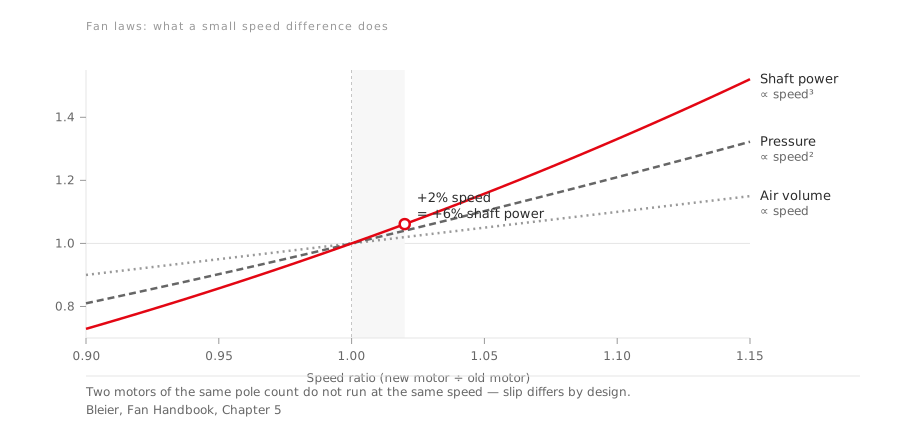
So the first number to match is not the kilowatts. It is the full-load speed.
Then four more things, in order of how often they are missed:
| What changes | Why it matters | |
|---|---|---|
| 1 | Full-load speed | Cube law — a small difference is not a small difference |
| 2 | Cooling basis | An in-airstream motor is cooled by the fan’s own air |
| 3 | Shaft and mounting | Diameter, extension, mounting type, overhung load |
| 4 | Rotation and supply | Direction is not free; drive-fed changes the specification |
The cube law, and why it is a cube
The fan laws set out how performance converts when speed changes:
- Air volume varies as the first power of speed.
- All pressures — static, velocity and total — vary as the square of speed.
- All powers — air power and brake power — vary as the cube of speed.
The handbook makes a point of noting that the exponents adding up is not a coincidence: air power is air volume multiplied by total pressure, so if volume follows the first power and total pressure follows the second, their product must follow the third.
That is the whole mechanism, and it turns modest differences into awkward ones:
| Replacement runs | Shaft power becomes | Sound level changes by |
|---|---|---|
| 2% faster | +6% | +0.4 dB |
| 5% faster | +16% | +1.1 dB |
| 10% faster | +33% | +2.1 dB |
The sound figures come from the same chapter: the level changes by 50 × log₁₀ of the speed ratio. Notice which column moves fastest — power. A noise complaint is often the first symptom people notice, but it is the smaller of the two effects.
Why two “identical” motors run at different speeds
Pole count sets the synchronous speed, which is fixed by the supply frequency. But an induction motor runs slower than synchronous by its slip, and slip is a design outcome rather than a standard value. Two four-pole machines of the same rating from different designs will have different full-load speeds, and the difference lands directly in the cube.
This has a consequence worth stating plainly, because it runs against a common assumption:
Moving up an efficiency class does not automatically reduce the power a fan absorbs.
Lower losses generally mean lower slip, and lower slip means a slightly faster machine. On a cube-law load that shows up as more air moved and more shaft power demanded — the fan is simply doing more work. The efficiency gain is real and is still there per unit of air moved, but it does not appear as a lower motor current unless the speed is brought back down: through a drive, a pulley ratio, or a re-pitched impeller.
If the retrofit was justified on energy savings, that correction is not optional — it is where the savings actually come from.
The cooling basis is easy to lose
On a direct-drive arrangement the motor commonly sits in the airstream, and the handbook notes the plain consequence: the motor is cooled by the air passing over it. The fan’s own flow is part of the cooling.
Replace that machine with a standard self-cooled one and the arrangement still looks right, because the fan is still blowing. But the two machines were rated on different cooling bases, and the standard machine’s rating assumed its own shaft fan doing the work.
The reverse mistake is equally common on belt-driven units, where the motor sits outside the airstream and gets no help from the fan at all.
The cooling arrangement is a coded specification rather than a description — see what TEFC actually means for the IC codes, and in particular for why a shaft-driven fan and a separately driven fan are not interchangeable once a drive is involved.
Shaft, mounting and the load the belt puts on the bearings
A belt drive imposes an overhung load on the motor shaft extension that a direct coupling does not. Two motors can share a frame size and still differ in shaft extension, bearing arrangement and permissible radial load — and the bearing is where that difference gets paid.
Check, before ordering:
- Shaft diameter and extension length, not just frame size
- Mounting — foot, flange, or the specific flange designation with its bolt-circle
- Bearing arrangement, if the drive is belted
- Direction of rotation as installed — a fan impeller run backwards still moves air, poorly and noisily, which is why it can go unnoticed
If the old machine was on a drive
Two separate specifications change, and neither is visible on a nameplate photograph:
- Insulation. A drive-fed machine faces voltage stress an across-the-line machine does not, and the replacement has to be rated for it.
- Cooling at low speed. A shaft-mounted fan turns slowly exactly when the machine still needs to be cooled. That is the IC411 versus IC416 question, and on a fan retrofit it is usually the deciding one.
There is one piece of good news here: a fan is the load where a drive pays back most directly, because reducing speed reduces power by the cube. The same law that makes a 2% speed error expensive makes a 10% speed reduction worth roughly a third of the power.
What to measure before ordering
- Full-load speed from the existing nameplate — the actual rpm figure, not the pole count.
- Rated output and the measured running current, so you know how much margin the original actually had.
- Cooling arrangement, including whether the machine sits in the airstream.
- Shaft diameter and extension, mounting type, and whether the drive is belted or direct.
- Supply — across-the-line or drive-fed, and if drive-fed, the drive make and the cable length.
- Direction of rotation as installed.
With those six, a supplier can tell you whether a machine is a replacement or merely a similar motor.
LEADGO builds fan and blower motors across the induction and permanent-magnet ranges, including the DZTYP low-speed direct-drive permanent magnet system that replaces a cooling-tower motor, drive shaft and gearbox with a single machine in the gearbox position. On a retrofit the useful first message is the six items above — a nameplate photograph alone cannot answer the speed question, which is the one that decides the outcome.
Going deeper
- What TEFC actually means — the enclosure and cooling codes, and why IC411 and IC416 are not interchangeable on a drive
- Motor duty types S1 to S10 — what the duty rating assumed, and what happens when the real duty differs
- How to check a nameplate power rating — because the nameplate is where this comparison starts
- How a motor is built, stage by stage — where the cooling arrangement is decided