
A motor built for one grid arrives on another, and the question is always the same: will it run. It usually will. Whether it should is a different question, and the answer depends less on the motor than on what is bolted to its shaft.
Frequency changes two things
Speed. Synchronous speed is 120f/p, so going from 50 Hz to 60 Hz raises it by 20% for any pole count. A four-pole machine moves from 1500 to 1800 rpm synchronous, and the actual speed follows with its slip.
Flux, through the voltage-to-frequency ratio. Flux in the core is set by volts per hertz. Change the frequency and leave the voltage alone and the flux changes inversely. That single ratio decides whether the machine keeps its torque, loses it, or saturates.
Everything below is a consequence of those two.
The three cases
| Supply | V/Hz | Flux | Speed | What it means |
|---|---|---|---|---|
| 380 V 50 Hz (design) | 7.60 | reference | reference | The rating on the plate |
| 460 V 60 Hz | 7.67 | similar ratio | +20% | Electrically favourable, but requires a confirmed 60 Hz rating |
| 380 V 60 Hz | 6.33 | lower | +20% | Under-fluxed; output and torque require manufacturer re-rating |
| 460 V 50 Hz | 9.20 | about 20% high | reference | Over-fluxed, heading for saturation |
The close ratio is why 380 V / 50 Hz and 460 V / 60 Hz often appear together on dual-rated nameplates. If only one rating appears, the arithmetic is a screening check rather than permission to create the second rating.
The last row is the one to be careful with. Over-fluxing pushes the core into saturation, where magnetising current rises steeply for very little extra flux, and the losses that go with it turn up as heat. Under-fluxing loses torque, which is visible and annoying. Over-fluxing damages things.
The load decides, not the motor
Here is the part that catches people, and it has nothing to do with the motor being Chinese, European or American.
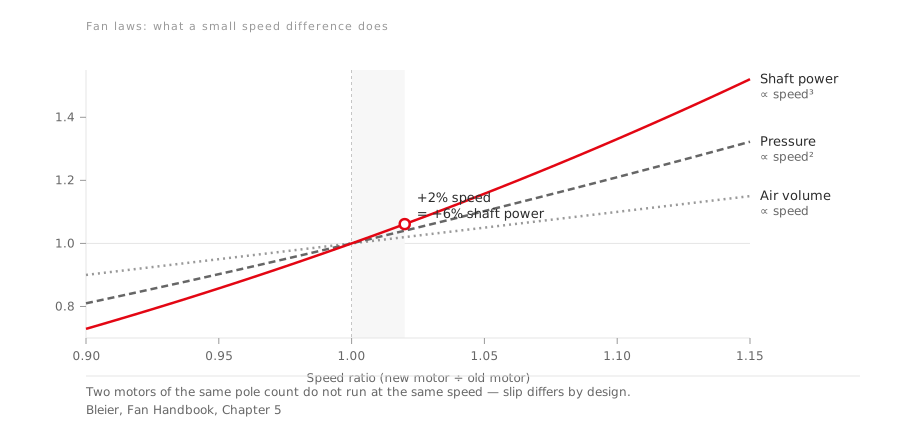
For the same centrifugal fan or pump, with unchanged geometry and broadly similar efficiency and system conditions, the affinity laws estimate the following at 20% more speed:
| Quantity | Scales as | At 60 Hz instead of 50 Hz |
|---|---|---|
| Flow | speed | ×1.20 |
| Pressure or head | speed² | ×1.44 |
| Shaft power | speed³ | ×1.728 |
If the manufacturer confirms a 60 Hz rating with about 20% more output, the estimated fan demand still rises by 73%. A drive train correctly matched at 50 Hz can therefore be overloaded at 60 Hz even though the V/Hz ratio looks acceptable.
Constant-torque loads behave differently. A conveyor, a positive-displacement pump or a crusher needs roughly the same torque at either speed, so the power demand rises in proportion to speed, about 20%, and that lines up with what the motor can give. The same frequency change is routine on one load and a failure on the other.
This is the first question to settle, before any discussion of the motor: is the load constant torque or does it follow a cube law.
What else moves with the speed
- Cooling may improve. A shaft-mounted fan turns faster, but the resulting temperature rise depends on fan design, internal losses and the manufacturer’s 60 Hz validation.
- Noise rises. Windage and magnetic noise both increase, and on a machine near a noise limit this matters.
- Bearing and mechanical limits. Twenty per cent more speed is real for bearing life and for any balance or critical-speed margin, particularly on two-pole machines.
- Starting performance. Locked-rotor current and torque change with voltage, frequency and the motor design. Use the manufacturer’s figures at the intended supply rather than inferring protection settings from V/Hz alone.
- Driven equipment ratings. Gearboxes, couplings and the fan or impeller itself have speed limits of their own that nobody looks up until something fails.
Not the same thing as a drive
A variable frequency drive changes frequency and voltage together, holding the ratio constant, which is precisely why it can vary speed without disturbing flux. That is a designed operating region with a break point, and the constant-torque and constant-power regions are stated in the product standard.
Connecting a motor to a different grid changes the frequency while the voltage is whatever that grid supplies. There is no controller holding the ratio for you. The two situations look similar written down and behave nothing alike.
What the standard actually covers
MG 1 requires a motor to operate successfully at rated load with a variation of ±5% of rated frequency at rated voltage, and notes that performance within those variations will not necessarily meet the standards established for operation at rated voltage and frequency. The full tolerance picture is set out in what MG 1 covers.
A move from 50 Hz to 60 Hz is a 20% change. It sits four times outside the band the standard addresses. That does not make it wrong, and manufacturers rate machines for both grids every day. It does mean you are in re-rating territory rather than tolerance territory, and the answer has to come from the motor’s rating at the new frequency rather than from an assumption that it will cope.
What to ask for
- The nameplate rating at the frequency you will actually use, including output, full-load current and speed. A dual-rated plate states both; a single-rated plate needs a re-rating from the manufacturer.
- The voltage at that frequency, and confirmation that the ratio is preserved.
- The driven equipment’s power demand at the new speed, which is where the cube law does its damage.
- The speed limits of everything else on the shaft.
LEADGO builds for both grids: the NEMA Premium series is designed around 60 Hz and North American frames, while the IE3 induction series covers IEC frames on 50 Hz. Tell us the supply frequency and voltage with the enquiry and the rating you get back will be the one for your grid.
Related: What a 1.15 service factor actually permits · Fan and blower motors: why a like-for-like replacement often is not · Motor duty types S1 to S10