
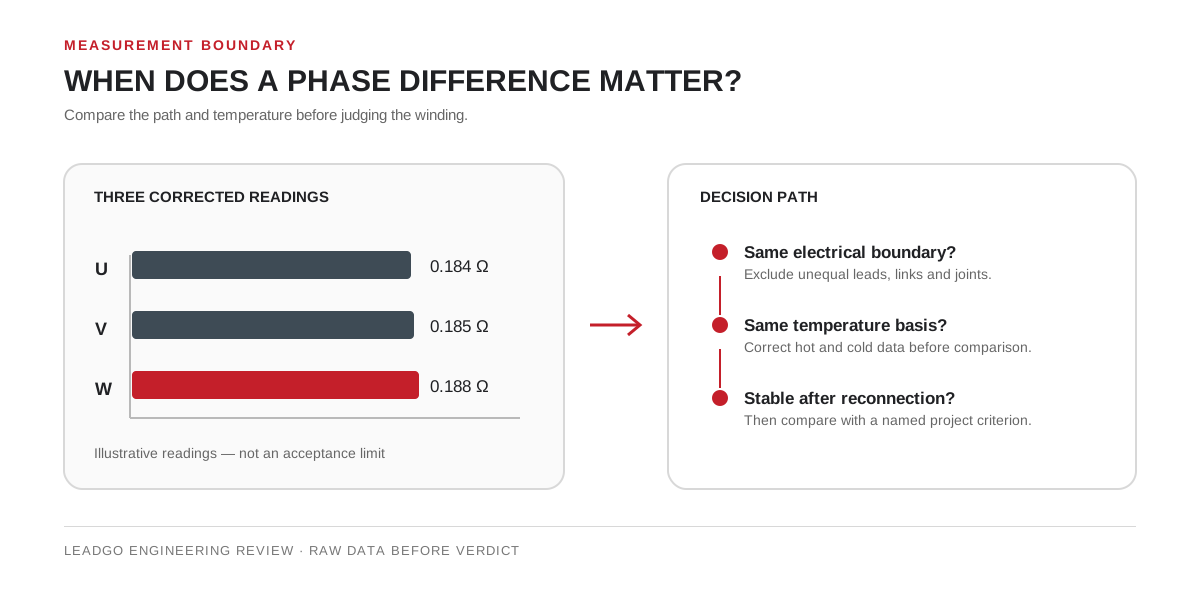
A resistance reading is easy to obtain and easy to over-interpret. If one phase is higher than the others, the winding may be damaged—but the same pattern can also come from a loose test clip, a different external lead path or a warmer coil.
The useful question is therefore not “Are the three numbers identical?” It is “Did we create three genuinely comparable measurements, and does the remaining difference point inside or outside the motor?”
Freeze the measurement boundary before comparing phases
Draw the connection that was actually tested. A measurement taken at the motor terminals does not have the same boundary as one taken from the starter or at the end of a long cable. Star and delta connections also change what the instrument sees between terminals.
For every reading, keep these items together:
- terminal pair and motor connection state;
- whether cables, links, contactors or joints are included;
- winding temperature or a documented temperature estimate;
- instrument, lead arrangement and test current;
- time allowed for the value to settle.
Low resistance measurements benefit from a four-wire Kelvin method because the voltage-sensing leads do not include the main test-lead voltage drop. The instrument still cannot correct a dirty terminal or an inconsistent connection by itself.
Work the comparison without inventing an acceptance limit
For a quick phase spread, calculate:
Spread (%) = (highest reading − lowest reading) ÷ average reading × 100
Suppose the corrected readings are 0.184 Ω, 0.185 Ω and 0.188 Ω. Their average is 0.1857 Ω and the spread is about 2.15%. That number is a description of the dataset, not an automatic verdict. Acceptance must come from the governing specification, approved procedure or manufacturer for that motor.
Temperature correction should be applied before comparing a hot result with a cold baseline. The conductor material and the agreed reference temperature must be known; copying a correction factor from another report is not enough.
Use the pattern to choose the next check
| Observed pattern | Plausible explanation | Next check before opening the motor |
|---|---|---|
| One value moves when the clips are remade | Contact or surface condition | Clean the terminal, remake all four connections and repeat |
| One terminal pair is consistently high | Link, joint, lead or winding path | Change the measurement boundary and inspect every included joint |
| All readings shift after a recent run | Winding temperature | Let temperature stabilise or correct every phase to one basis |
| Values drift instead of settling | Thermal effect, unstable contact or test setup | Reduce uncertainty in test current, connection and stabilisation time |
| Difference remains after cables and links are excluded | Internal connection or winding condition | Compare with factory/baseline data and escalate to additional electrical tests |
This sequence prevents a common mistake: declaring a rewind from a terminal-box problem. It also prevents the opposite mistake, where repeated cleaning is used to explain a difference that remains inside the motor boundary.
Treat the result as a trend, not an isolated photograph
Megger’s motor condition-monitoring guidance notes that resistance measurements should be temperature-corrected and that trending can reveal a connection deteriorating over time. The practical value is strongest when the same terminal boundary and method are repeated.
A commissioning record should therefore become the baseline for later maintenance. Do not save only a rounded “pass” result. Save the raw readings, temperature, setup and correction basis so the next engineer can reproduce the comparison.
Release decision for a commissioning record
Approve the resistance check only when all four statements are true:
- the three measurements cover equivalent electrical paths;
- the temperature basis is recorded and comparable;
- repeated readings are stable after remaking the connections;
- the result meets the project-specific acceptance source named in the report.
If the report cannot identify its acceptance source, leave the result open. A precise percentage without a traceable basis is still an unsupported decision.
Evidence used for this review
- Megger: The missing link in motor condition monitoring
- Megger: Q and A on winding resistance testing