
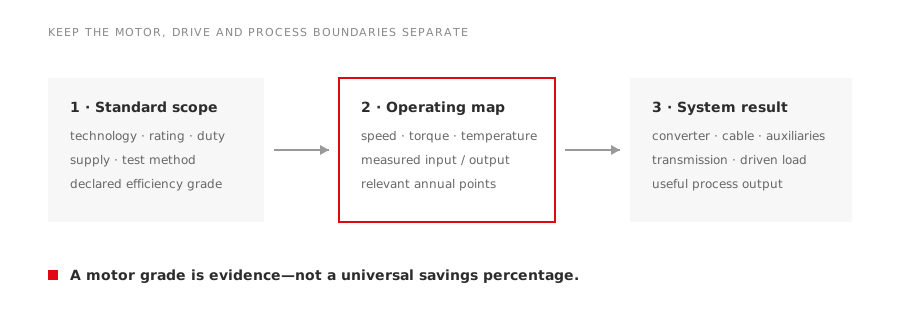
Permanent magnets remove rotor copper loss from one familiar induction-motor loss path, but that does not turn “PMSM” into an efficiency certificate. Buyers still need a defined rating, test boundary and applicable standard.
Direct answer
When a supplier states a Chinese PMSM efficiency grade under GB 30253, verify:
- that the exact motor falls within the cited standard’s scope;
- the model, output, speed, supply and duty used for the declaration;
- the test method and rated-point result;
- whether converter losses are inside or outside the number;
- whether the application needs part-load and variable-speed data.
Do not transfer a grade from one series, rating or supply arrangement to another.
Keep three boundaries separate
| Boundary | What it answers | What it does not answer |
|---|---|---|
| Motor efficiency grade | Losses within the defined motor test and rating | Converter and process performance |
| Motor-plus-converter data | Electrical drive losses at stated points | Pump, fan, compressor or transmission losses |
| Complete system assessment | Energy used to deliver the process requirement | Universal savings independent of the duty |
This separation prevents a common mistake: comparing the rated efficiency of a direct-on-line induction motor with an unclear “system efficiency” value for a PMSM package.
Rated point versus operating map
A rated-point value is useful for classification and comparable procurement. A variable-speed application may spend most of its time elsewhere. Request data at the speed and torque points that dominate annual operation.
For each point, identify:
- mechanical output definition;
- electrical input measurement location;
- motor temperature and cooling condition;
- converter model and switching settings if included;
- cable and auxiliary losses if material;
- test uncertainty and tolerance treatment.
A high rated efficiency cannot compensate for poor pump selection, throttling, an oversized motor or a process operated away from its useful point.
Technology does not replace evidence
PMSM designs may offer high efficiency and power factor, especially across selected operating ranges. They also introduce application questions:
- Is a converter required?
- What position or sensorless-control method is used?
- What happens during starting, field weakening or regeneration?
- How is rotor temperature and demagnetisation risk managed?
- Can the drive safely control a spinning motor after a trip?
- What commissioning and replacement support is required?
These do not make PMSM unattractive. They show why the efficiency decision belongs to the complete drive and process.
A procurement evidence pack
Request:
- exact model and rating covered by the declaration;
- applicable standard and edition;
- rated efficiency and test method;
- part-load or speed-torque efficiency data relevant to the duty;
- converter-loss data and system boundary;
- motor and drive thermal limits;
- control, feedback and restart requirements;
- test report or third-party evidence where contractually required.
The contract should state which values are guaranteed and which are typical. A brochure curve without test conditions is useful for discussion but weak as an acceptance criterion.
LEADGO’s TYC and TYP pages describe different PMSM product routes. Efficiency and drive selection must still be confirmed at the quoted rating and application point.
Compare like with like
Create one comparison sheet for all candidates. Use the same mechanical output, speed, torque, duty and ambient basis. State whether each result is motor-only or includes a converter. If one supplier provides a full map and another only a rated point, mark the information gap rather than interpolating unsupported values.
Power factor, current and efficiency answer different questions. Reduced current through improved power factor does not automatically produce the same percentage reduction in real energy. Retain the measured or guaranteed real input and output values used in the calculation.
Acceptance testing and commissioning
The purchase document should identify test method, instruments, operating temperature, witness requirement and treatment of uncertainty or permitted tolerance. Decide whether acceptance uses a type test for the design or a routine measurement on the supplied unit. These routes provide different evidence.
For a packaged drive, define auxiliary loads and whether cooling fans, pumps or control power sit inside the boundary. After installation, confirm rotation, current, voltage, speed, process output and final drive parameters. Collect enough history to compare the real speed-torque distribution with the tender assumptions. If the plant operates elsewhere, update the model; the lesson may be a process adjustment rather than a different motor.