
TYP Series
TYP Series High-Efficiency Variable-Frequency Permanent Magnet Synchronous Motor
Designed to run on a drive across a wide frequency range, with high overload torque at low current — LEADGO's highest-volume permanent magnet line.
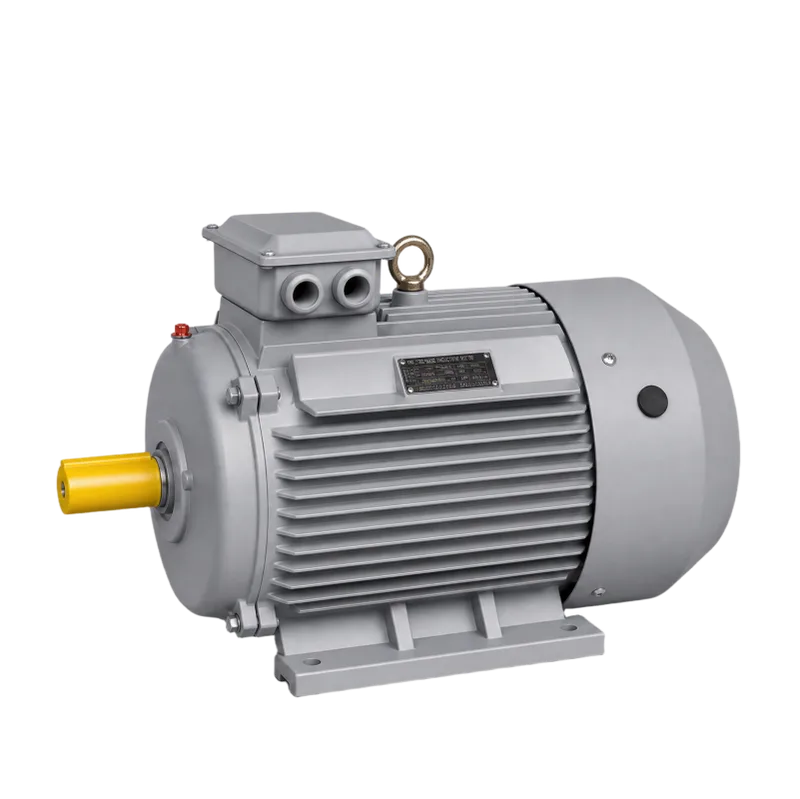
TYP is a permanent magnet synchronous motor built specifically to be paired with a synchronous drive for stepless speed control. High-strength magnets are set into the rotor, giving large starting and running overload torque, low current, and a wide usable frequency band. Encoder and non-encoder variants are built.
Against an induction motor of the same rating the brochure figure is 5–10% higher efficiency with a power factor close to unity, giving an overall energy saving of 12–15%.
It replaces YVP and YCT series machines on stepless speed duty, runs well at low speed, and holds tighter control accuracy. LEADGO builds a matched control cabinet for the series, so motor and control ship as one variable-frequency soft-start system.
Core specifications
| Parameter | Value |
|---|---|
| Frame size | H80 – H355 mm |
| Power range | 0.37 – 400 kW |
| Base frequency | 37.5 / 50 / 75 / 100 / 150 / 200 / 240 Hz (custom on request) |
| Efficiency | GB 30253 grade 1 or grade 2 |
| Voltage | 380 V |
| Protection degree | IP54 / IP55 |
| Insulation class | Class F |
| Cooling | IC411 |
| Feedback | With or without encoder |
Standards and certification
- Q/1083 SLJ 018-2018 (high-efficiency variable-frequency PM synchronous motor)
- GB 30253
Typical applications
- Axial and centrifugal fans, pumps, separators, compressors, belt conveyors
- Slurry, tailings, overflow and vertical multistage pump duty across mining, smelting and oil & gas
- Extruders, blow moulding machines and pulverisers in rubber and plastics
- Replacement of YVP and YCT machines on stepless speed duty
Selection guide
FAQ
Downloads
Certificates and test reports are issued against the specific model and rating rather than the series, so we send the ones that apply to your order. Tell us the rating and the market and we will send them.
Related products
Technical articles on this series
Cement Decarbonisation: Where Motor Upgrades Actually Pay
ReadCooling Tower Fan Drives: Direct Drive or Gearbox, and What Decides It
ReadDrive System Efficiency: IE for the Motor, IES for the System
ReadInterior Permanent Magnet Motors vs Surface Magnet Rotors
ReadLine-Start PM Motors: Permanent Magnet Efficiency Without a Drive
ReadMotor Failure Modes in Mining, Ranked by How Often They Come Up
ReadPermanent Magnet vs Induction Motors in Oilfield Duty
ReadVFD Retrofit: Keep the Induction Motor or Move to PM?
ReadWhere Synchronous Machines Are Used, and Why
ReadRequest a quote — TYP Series
Tell us the rating, quantity and application and an engineer will come back with a specification, the documents for that model, and a price.
Contact Sales