
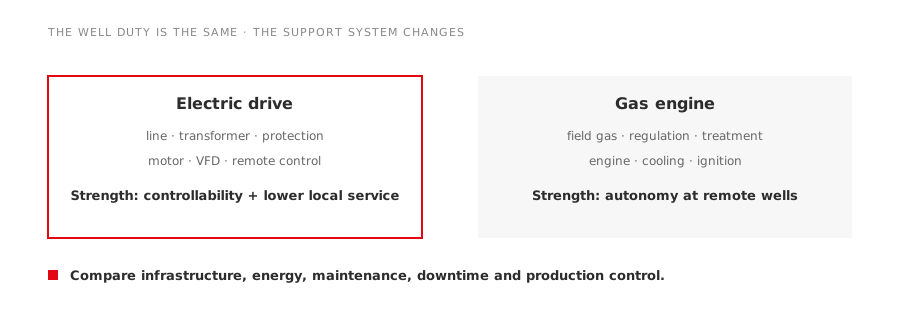
Oilfield electrification is easy to oversimplify. An electric motor is efficient and controllable; a gas engine can use fuel already available at a remote well. Either statement can be true without deciding the project.
The useful comparison is site-specific. It includes the cost of reaching the well, conditioning fuel or power, maintaining the prime mover, controlling production and recovering from an outage.
Where a gas engine remains practical
A remote well may have associated gas but no economical grid connection. A properly selected engine can convert that local fuel into shaft power without a distribution line, transformer and utility service. This autonomy is valuable where wells are widely dispersed or temporary.
The fuel is not automatically free. Field gas can vary in pressure, heating value, moisture and contaminant content. Liquids, hydrogen sulfide, carbon dioxide or other components may require separation, regulation or treatment. The engine supplier must state an acceptable fuel specification, and the operator must measure the actual gas against it.
Maintenance includes ignition, lubrication, cooling, filters, valves and the mechanical wear expected from a combustion engine. Service frequency and parts logistics can dominate economics when sites are difficult to reach.
What electric drive changes
An electric motor removes on-site combustion from the driven unit and generally has fewer routine engine-service items. A VFD or dedicated controller can shape starting, regulate speed, limit torque and provide data for remote monitoring.
On a pumpjack, however, the load is cyclic. Motor current and torque change through the stroke. The system must handle peak torque, inertia, regeneration or overhauling portions of the cycle, starts and hot ambient conditions. Our guide to pumpjack motor sizing describes that duty, and pumpjack troubleshooting covers field symptoms.
Electric drive also moves dependency upstream. Distribution reliability, voltage drop, lightning protection, transformer capacity and spare electrical components become part of production availability.
Infrastructure is the first commercial gate
For electric drive, identify the nearest suitable supply and calculate line, transformer, switchgear, protection, metering and civil work. Include voltage drop during starting and the cumulative effect of several wells starting or operating together. If local generation supplies the field, include generator efficiency, fuel and maintenance rather than treating the electricity as grid power.
For a gas engine, include fuel gathering, separation, pressure regulation, treatment, storage where applicable and safe venting or shutdown. If usable gas would otherwise be sold or used elsewhere, give it an opportunity cost rather than assigning zero value.
The system boundaries must match. Comparing a motor at its terminals with an engine plus untreated “free gas” produces an answer before the analysis begins.
Control can affect production as well as energy
Electrification can make variable-speed and automated operation easier. A controller may slow or stop a pumping unit when fluid inflow does not support continuous operation, then restart under defined conditions. The value can come from avoiding unnecessary strokes, reducing mechanical stress or improving operating discipline.
That benefit should be measured separately from motor efficiency. It depends on well behavior, instrumentation and control logic. A poorly tuned controller can reduce production or increase cycling. Establish the operating objective and responsibility for tuning before assigning savings.
Gas-engine systems can also be automated, but speed regulation, remote starting and data integration may require different hardware and maintenance skills.
Build the lifecycle comparison
Use an annual model with the same production and availability assumptions for both options.
| Cost or value | Electric drive inputs | Gas-engine inputs |
|---|---|---|
| Infrastructure | Line, transformer, switchgear, VFD/controller | Fuel handling, regulation, treatment, engine package |
| Energy | Metered kWh and tariff structure | Measured gas consumption and gas value |
| Routine maintenance | Motor, drive, electrical inspections | Oil, filters, ignition, cooling and engine service |
| Downtime | Grid and electrical restoration | Engine repair and fuel-system interruption |
| Control impact | Speed and pump-off strategy | Governor and automation capability |
| Compliance | Electrical and hazardous-area requirements | Fuel gas, exhaust, emissions and hazardous-area requirements |
Run several scenarios for grid-extension cost, tariff, gas value and annual runtime. State who supplied each input. Do not publish one payback period as though it applies to every field.
Environmental and safety boundaries
Local emissions generally fall when a well moves from an on-site engine to grid electricity, but the broader emissions result depends on electricity generation and methane management. Keep local air-quality, greenhouse-gas and economic claims separate.
Both systems require hazardous-area review. Electric equipment needs the correct certification and installation for the classified location. Gas handling adds ignition, leak and exhaust considerations. Site classification and jurisdiction determine the compliance route.
Reliability must include restoration
Compare not only failure frequency but time to restore. An electric motor may need less routine attention, yet a damaged long distribution line can affect many wells. A gas engine may require frequent service, while a field mechanic can sometimes restore one unit without waiting for utility work.
List critical spares, technician availability, diagnostic tools and travel time. Remote monitoring is valuable only if alarms lead to an actionable response.
A sensible pilot structure
Choose a representative well rather than the easiest well. Record a baseline for production, runtime, fuel or electricity, maintenance hours, trips and downtime. Define the measurement boundary and weather or seasonal effects. Run long enough to capture normal load variation and maintenance events.
After commissioning, compare:
- production per operating day;
- energy or fuel per comparable production unit;
- planned and unplanned maintenance;
- trip causes and recovery time;
- peak electrical demand;
- control interventions;
- safety and environmental observations.
Decision conditions
Electric drive tends to become stronger when suitable power is nearby, many wells can share infrastructure, remote control has operational value and combustion-engine maintenance is burdensome. A gas engine tends to remain strong where the site is isolated, acceptable field gas is reliably available and electrical infrastructure would be disproportionate.
Those conditions can change over a field’s life. A pilot and transparent lifecycle model let the operator choose with evidence instead of assuming that one prime mover is universally modern or universally economical.