
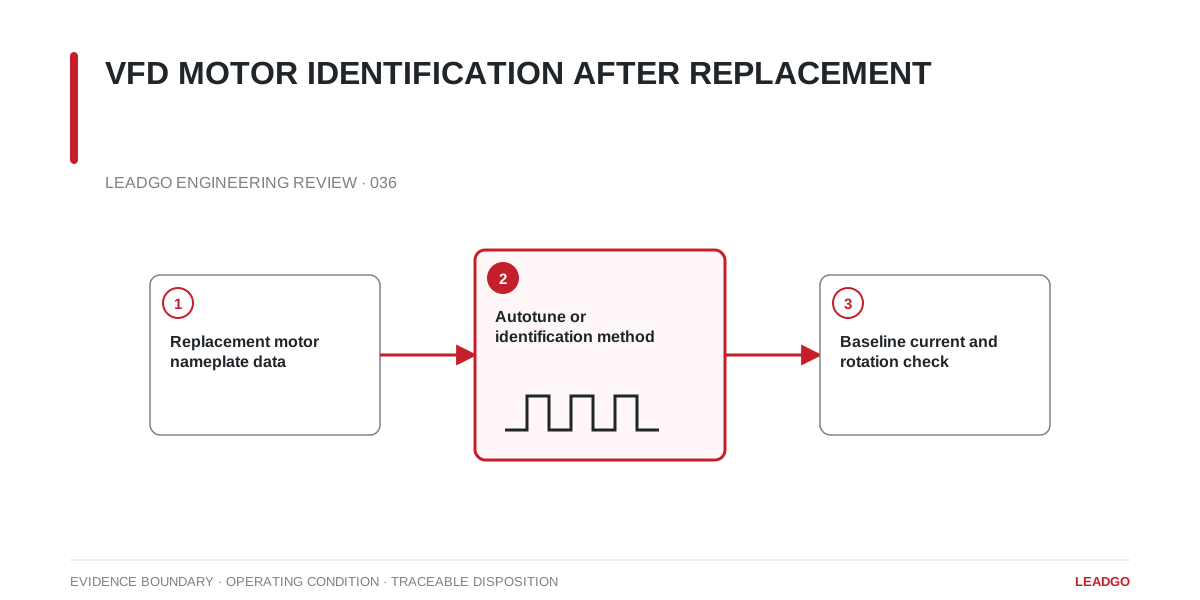
Replacing a motor without updating the drive can leave the system running on resistance, current and speed data from the removed machine. The motor may turn, yet torque control, thermal protection and low-speed stability can be wrong.
Freeze the old baseline
Before removal, save the drive parameter set and event history. Record the old motor nameplate, rotation, normal current and speed feedback. This is a troubleshooting reference, not a parameter source for the replacement.
Enter the new motor’s rated voltage, current, frequency, speed, power and connection exactly as approved. Check encoder type, pulse count, polarity and mechanical mounting where feedback is used.
Choose the identification method deliberately
Drive manufacturers distinguish between static, standstill and rotating identification routines. A rotating routine may require the motor to be uncoupled or the process to be secured against movement. Follow the drive procedure and site safety controls rather than selecting the most complete tune by default.
After identification, review parameters that depend on the motor model: current limits, thermal model, slip compensation, flux control, speed limits and protection thresholds. Do not overwrite application settings blindly with factory defaults.
Return-to-service decision
Before applying process load:
- confirm direction with a controlled bump test;
- compare minimum-load current and phase balance with the approved basis;
- verify speed feedback, permissives and protection status;
- increase load in planned steps while monitoring current, torque estimate, temperature and alarms.
Retain the new nameplate data, parameter backup, tune method, uncoupled or coupled condition, rotation result and loaded baseline. That record makes the next intervention faster and prevents the old motor model from returning through an archived parameter file.