
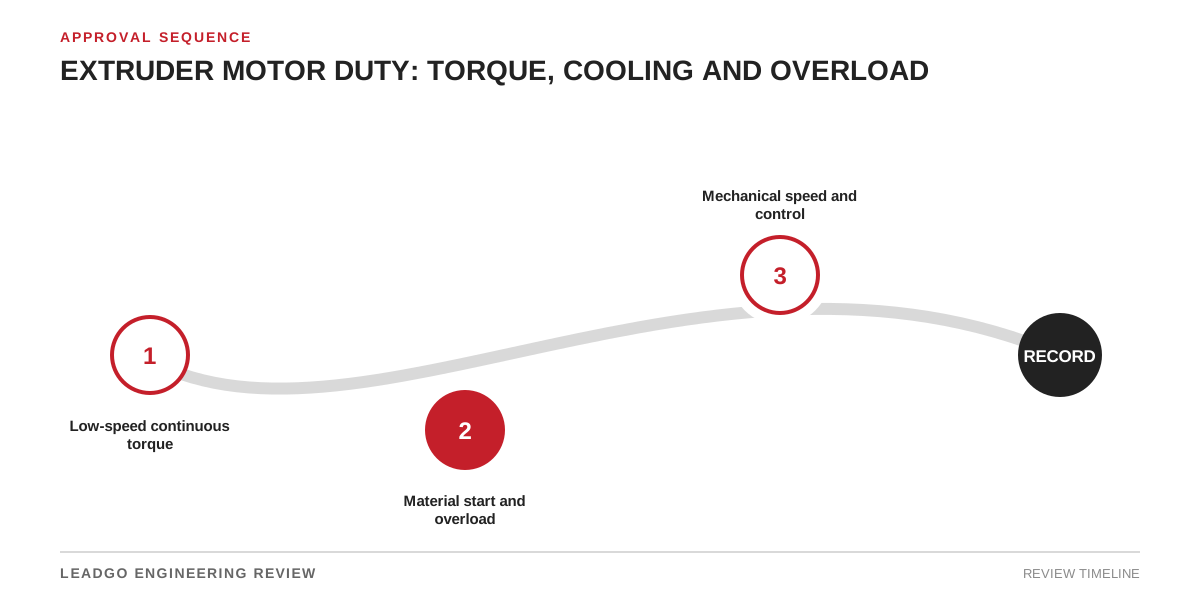
Extrusion load changes with polymer, temperature, screw geometry and feed condition. A motor that handles steady production can still current-limit during a cold or material-filled start.
Build the operating envelope
| Case | Required input | Approval check |
|---|---|---|
| Normal recipe | Torque versus speed and duration | Continuous thermal capability |
| Cold/material start | Breakaway torque and acceleration | Timed motor and VFD overload |
| Minimum speed | Continuous shaft torque | Cooling and current margin |
| Blocked screw | Maximum credible torque | Gearbox limit and trip setting |
Translate screw torque through gearbox ratio and efficiency. Do not hide gearbox or coupling margin inside an unexplained motor service factor.
Check cooling and controls
Compare every continuous point with the manufacturer’s VFD torque envelope. If forced ventilation is required, interlock fan proof with operation and define its separate supply. Above base speed, confirm voltage limitation, field weakening, rotor speed, bearing and driven-equipment limits.
The RFQ should include recipes, speed range, start state, duty cycle, ambient, elevation, cooling arrangement and gearbox limits. During commissioning, trend speed, current and material temperature through the limiting recipe and verify that protection trips before mechanical damage.
Related reading: matching a VFD to a motor and variable-torque versus constant-torque loads.