
How to choose a motor stopping method by reviewing process time, regenerated energy, heating, safety and mechanical stress.
Engineering boundary — Motor Braking Methods
Motor Braking Methods must be reviewed against the real driven load, supply arrangement and site environment. For Motor Braking Methods, classify each input as measured, calculated, specified or still open.
Review matrix — Motor Braking Methods
| Step | Review point | Why it matters |
|---|---|---|
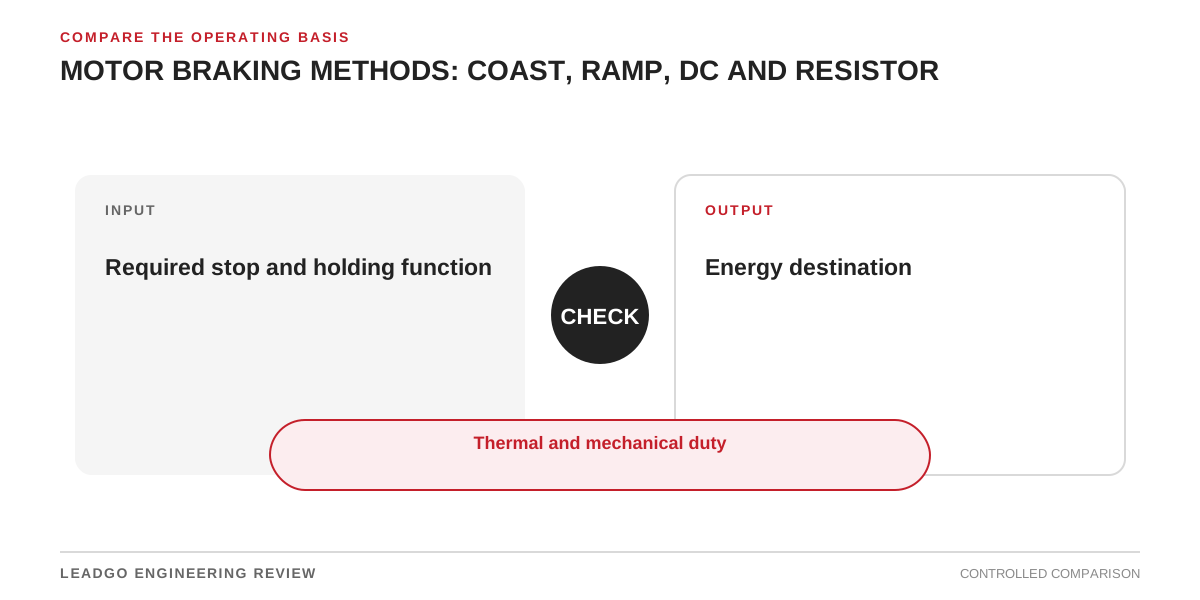
| 1 | Required stop and holding function | Separate controlled deceleration from the need to hold the machine stationary afterward. |
| 2 | Energy destination | Determine whether energy is dissipated in the motor, drive, resistor, mechanical brake or returned to the supply. |
| 3 | Thermal and mechanical duty | Review stopping frequency, resistor duty, motor heating, coupling torque and process shock. |
Failure controls — Motor Braking Methods
-
Confirm the operating case and document revision used for Motor Braking Methods.
-
Record every unresolved Motor Braking Methods interface before manufacture or energisation.
-
Retain the final Motor Braking Methods evidence with the motor data book.
Evidence package — Motor Braking Methods
Keep the governing data sheet, calculations, supplier confirmation and inspection or test results for Motor Braking Methods. Measurements for Motor Braking Methods must state the instrument, operating condition and acceptance basis.
Acceptance decision — Motor Braking Methods
Stopping method should be selected from required stop time and energy flow, then checked for motor heating, drive capability and mechanical stress.
Accept Motor Braking Methods only when the review matrix is complete and every deviation has an identified owner. For Motor Braking Methods, never infer approval from a catalogue value disconnected from the ordered motor.